Vol-au-vent
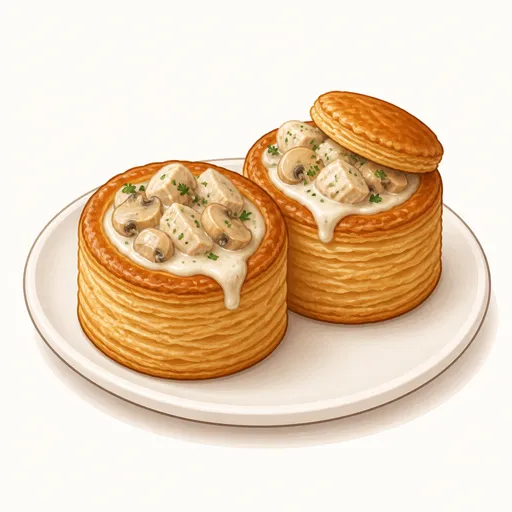
Vol-au-vents are hollow cylinders of puff pastry so light that their French name means "flying in the wind." The crisp, towering pastry cases are spooned full of chicken and mushrooms in a rich, silky cream sauce. It is an elegant French appetizer, perfect for parties and holidays.
- Difficulty
- Hard
- Prep
- 1 hr 10 min
- Cook
- 45 min
- Rising or chilling
- 2 hr 30 min
- Total time
- 4 hr 25 min
- Method
- Oven-baked
Ingredients
Puff pastry
Egg wash
Creamy chicken and mushroom filling
Flour for rolling
Instructions
Step 1
Dice 200 g cold unsalted butter, toss it with 250 g all-purpose flour and 4 g salt, then add 125 g ice water and gather everything into a rough dough still speckled with butter. Keeping the pieces of butter intact is the secret to pastry that puffs into many layers. Wrap the dough and refrigerate for thirty minutes; it is ready when it feels firm and cold.
Step 2
Dust the surface with flour, roll the dough into a long strip and fold it in thirds, turn it ninety degrees and repeat for six turns in total, chilling the dough for about thirty minutes after every two turns. The repeated folding creates hundreds of thin layers of butter that make the pastry rise tall. The dough is finished when it is smooth, shows only fine streaks of butter and does not stick to the counter.
Step 3
Roll the dough about five millimeters thick and use an 8 cm round cutter to cut sixteen circles, pressing the cutter straight down once without twisting. Twisting the cutter seals the edges and makes the pastry rise lopsided. You are done when you have sixteen circles with clean, sharp edges and the layers clearly visible on the sides.
Step 4
Use a small 5 cm cutter to stamp out the centers of eight circles to make rings, brush a thin layer of 50 g egg beaten with 10 g whole milk over the eight solid bases and set a ring on each, then chill the whole tray for twenty minutes. Do not let the egg drip down the sides, because dried egg glues the layers together. They are ready when the rings are firmly stuck to the bases and the dough is cold and firm again.
Step 5
Heat the oven to 200°C for at least twenty minutes and line a baking tray with parchment paper. High heat right from the start makes the water in the butter turn to steam quickly and push the layers apart. The oven is ready when an oven thermometer shows the right temperature and holds steady.
Step 6
Brush more egg wash over the tops of the rings, place the small cut-out centers on the tray as lids and bake at 200°C for about 20 to 25 minutes; the lids will be done a few minutes sooner. Baking long enough dries out the inside so the filling does not make it soggy. The cases are ready when they have risen to three times their original height, are glossy golden brown and feel feather-light.
Step 7
As soon as the cases are cool enough to handle, use the tip of a small knife to gently press the soft dough left in the center down to the bottom to make a deep well. A wider well holds more filling without cracking the walls. You are done when each case has a neat cavity with a flat bottom and intact walls.
Step 8
Cut 300 g boneless chicken thighs into small cubes, slice 150 g white button mushrooms and finely chop 30 g shallots. Melt 30 g unsalted butter in a pot over medium heat, sauté the shallots until fragrant, then add the chicken and mushrooms and cook for about six minutes. Medium heat lets the mushrooms release their liquid and then cook it off, concentrating the flavor. The filling is ready when the chicken has turned opaque, the mushrooms are soft and the bottom of the pot is nearly dry.
Step 9
Sprinkle 25 g all-purpose flour over the chicken and mushrooms, stir for a minute, then slowly pour in 250 g whole milk while whisking constantly. Cooking the flour in butter first keeps the sauce from turning lumpy or tasting of raw flour. The sauce is ready when it simmers gently, thickens and coats the back of a spoon in a thin layer.
Step 10
Turn the heat down to low, add 60 g heavy cream, a pinch ground nutmeg and 5 g lemon juice, season with salt and pepper to taste and finally sprinkle in 5 g chopped mixed fresh herbs. A touch of lemon keeps the cream sauce from feeling too heavy and brightens its flavor. The filling is finished when the sauce is glossy and smooth, moderately thick and tastes well balanced.
Step 11
Warm the pastry cases in a 180°C oven for about five minutes, spoon the hot filling into the wells until full and set the small lids on top. Fill them only just before serving so the pastry stays crisp. They are ready when the filling comes up level with the rim, the sauce spills over just a little and the pastry still crackles when you cut into it.
Equipment
- Oven
- Rolling pin
- Bench scraper
- Cookie cutter
- Pastry brush
- Small saucepan
- Whisk
- Baking sheet
- Parchment paper
- Kitchen scale
- Plastic wrap
- Refrigerator
Tips
- To save time, you can use store-bought puff pastry; just roll it out again to a thickness of five millimeters before cutting.
- You can replace the chicken thighs with shrimp or other seafood; in that case, sauté for only a few minutes so the shrimp do not turn rubbery.
- The pastry cases can be baked a day ahead and stored in an airtight container, and the filling can be made ahead and reheated when needed.
Storage
Baked pastry cases stay crisp in an airtight container at room temperature for about two days. Store the filling separately in the fridge for up to three days; filled vol-au-vents should be eaten right away because the pastry softens very quickly.
Common problems and how to fix them
- The pastry cases rise at a slant or topple over.
- The cutter was twisted or the dough was rolled unevenly. Press the cutter straight down in one firm motion and roll the dough evenly, perhaps with two wooden sticks of the same thickness on either side as guides.
- The filling sauce is lumpy.
- The milk was added too quickly. Take the pot off the heat and whisk vigorously; if lumps remain, strain the sauce through a sieve and then return the chicken and mushrooms to it.
- The bottoms of the cases turn wet and soggy after filling.
- The cases were not baked dry enough or the filling is too thin. Bake the cases a few minutes longer until completely dry and cook the sauce a little thicker before spooning it in.
This recipe is based on the common ratios for this bake and is written entirely in our own words.