Shoofly pie
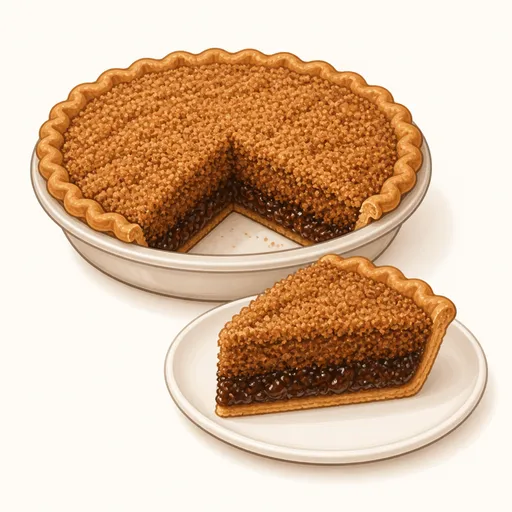
Shoofly pie is the beloved molasses pie of the Amish community in Pennsylvania. Beneath a crisp crust lies a moist, pudding-soft molasses filling, topped with a cinnamon-scented brown sugar butter crumb. The deep sweetness and gentle bitterness of molasses go wonderfully with a cup of hot coffee.
- Difficulty
- Easy
- Prep
- 35 min
- Cook
- 45 min
- Rising or chilling
- 3 hr
- Total time
- 4 hr 20 min
- Method
- Oven-baked
Ingredients
Crust
Brown sugar butter crumb
Molasses filling
Instructions
Step 1
Mix 160 g all-purpose flour with 5 g granulated sugar and a pinch salt, add 115 g cold unsalted butter cut into cubes, then use your fingertips to pinch the butter into pea-sized pieces. Drizzle in 50 g ice water a little at a time and bring the dough together with a fork. Those intact bits of butter create a flaky crust as it bakes, so the dough is ready when a squeezed handful holds together and is still streaked with butter.
Step 2
Press the dough into a flat disk about 3 cm thick, wrap it tightly in plastic wrap and refrigerate for at least 60 minutes. Resting relaxes the gluten and firms the butter, so the crust shrinks less in the oven. The dough is ready when it feels firm and evenly cold.
Step 3
On a lightly floured counter, roll the dough into a circle about 5 cm wider than your pie dish, roll it loosely around the rolling pin and drape it into a 23 cm dish, pressing gently into the bottom and sides. Fold the overhang under and crimp a wavy edge so the crust stands firm when the filling bubbles. The crust is ready when it covers the bottom without tears and the rim sits slightly above the edge of the dish.
Step 4
Set a rack in the lower part of the oven and preheat to 200°C for about fifteen minutes, with a baking sheet underneath to catch any filling that bubbles over. Heat from below bakes the crust crisp instead of letting the wet filling turn it soggy. The oven is ready when the heat indicator light goes off.
Step 5
Put 130 g all-purpose flour, 110 g brown sugar, a pinch ground cinnamon and a pinch salt in a bowl, add 60 g softened unsalted butter and rub it between your fingers. This crumb gives the pie a crisp top and also soaks up some of the molasses to form a soft, cakey middle layer. It's ready when it looks like damp sand with a few small clumps the size of corn kernels.
Step 6
Bring 180 g water to a boil, dissolve 4 g baking soda in it, then stir in 230 g molasses. Let it cool for about five minutes before beating in 50 g eggs. Letting the mixture cool a little keeps the eggs from scrambling. The filling is ready when it's lightly foamy, evenly dark brown and free of egg streaks.
Step 7
Sprinkle about one third of the crumb over the bottom of the crust, gently pour the molasses filling over it, then scatter the remaining crumb evenly over the top. Pour slowly and close to the crust so the filling doesn't punch a hole in the bottom. The pie is ready when the filling comes about three quarters of the way up the crust and the crumb covers the surface.
Step 8
Set the pie on the baking sheet and bake at 200°C for the first 10 to 12 minutes. The high heat at the start sets the bottom crust before the filling can soak in. This stage is done when the edge of the crust starts turning pale golden.
Step 9
Lower the oven to 180°C and bake for another 30 to 35 minutes, until the filling puffs up and then sets. Moderate heat cooks the molasses evenly without scorching it bitter at the edges. The pie is done when the center only jiggles slightly as you nudge the dish and a skewer inserted 3 cm from the edge comes out almost clean.
Step 10
Set the pie on a rack and let it cool at room temperature for at least two hours before cutting. As it cools, the filling keeps firming up and separates into a gooey bottom layer and a light, spongy top layer. It's ready when the bottom of the dish no longer feels warm and the knife leaves a clean cut.
Equipment
- Oven
- Pie dish
- Rolling pin
- Mixing bowl
- Whisk
- Kitchen scale
- Plastic wrap
- Baking sheet
- Wire cooling rack
- Refrigerator
Tips
- Use light or regular molasses; dense blackstrap molasses makes the pie harshly bitter and almost black.
- If you prefer a drier pie, mix all of the crumb into the filling instead of layering it, and the pie will turn out uniform like gingerbread.
- Serve with a spoonful of unsweetened whipped cream to balance the deep sweetness of the molasses.
Storage
Covered tightly with plastic wrap, the pie keeps at room temperature for two days. You can refrigerate it for up to five days; the filling firms up, so let the pie sit out for about thirty minutes before serving.
Common problems and how to fix them
- The filling bubbled over and burned on the baking sheet.
- Baking soda makes the filling rise vigorously as it heats. Fill the crust only three quarters of the way and always set a baking sheet underneath.
- The bottom crust is soggy and wet.
- The crust wasn't cold enough or the oven wasn't hot enough at the start. Next time, put the lined dish in the freezer for ten minutes before filling it and bake on the lowest rack.
- The top cracked and all the crumb sank to the bottom.
- The filling was too thin or the crumb was too fine. Leave some larger clumps in the crumb and make sure the baking soda water has cooled a bit before mixing.
This recipe is based on the common ratios for this bake and is written entirely in our own words.