Apple pie
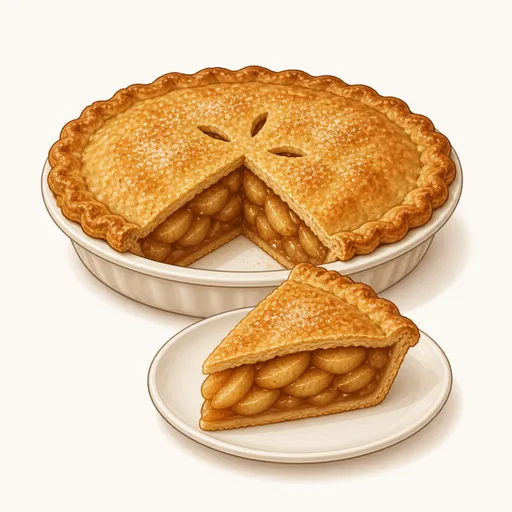
Classic American apple pie wraps tender sliced apples, mingled with brown sugar and warm cinnamon, in two layers of crisp, flaky butter crust. When you cut into it, the apple slices hold their shape in a thick, glossy sauce, and a scoop of vanilla ice cream on the side makes it just right.
- Difficulty
- Medium
- Prep
- 50 min
- Cook
- 1 hr 10 min
- Rising or chilling
- 4 hr
- Total time
- 6 hr
- Method
- Oven-baked
Ingredients
Crust
Apple filling
Egg wash
Instructions
Step 1
Mix 325 g all-purpose flour, 12 g granulated sugar and 5 g salt in a large bowl, add 225 g cold diced unsalted butter and use your fingertips to press each piece of butter flat into the flour. The intact pieces of cold butter melt in the oven and create flaky layers. The mixture is ready when it looks like coarse breadcrumbs with pea-sized pieces of butter still visible.
Step 2
Drizzle 100 g ice water over the mixture a little at a time, tossing gently with a fork until the dough starts to come together. Use only as much water as you need, because too much makes the crust tough and prone to shrinking. The dough is ready when a handful squeezed in your palm holds together without feeling wet or sticky.
Step 3
Divide the dough in two, one portion slightly larger, press each into a flat disk, wrap well and refrigerate for at least an hour. Resting lets the dough hydrate evenly and the butter firm up. The dough is ready when the disks are as firm as cold butter and flecked with streaks of butter.
Step 4
Peel and core 1,200 g apples, slice them about half a centimeter thick, put them in a large bowl and toss right away with 15 g lemon juice. Moderately thick slices turn tender without collapsing into jam, and the lemon juice keeps them from browning. The apples are ready when the slices are even and still bright white.
Step 5
Sprinkle 120 g granulated sugar, 50 g brown sugar, 25 g cornstarch, 4 g ground cinnamon and a pinch ground nutmeg over the apples, toss well and let them sit for about fifteen minutes. The cornstarch thickens the juices the apples release so the filling does not run. The filling is ready when the slices are evenly glossy with sugar and a little liquid has gathered at the bottom of the bowl.
Step 6
Heat the oven to 220°C with a rack in the lowest position and a baking tray on the rack to heat along with the oven. The hot tray drives strong heat into the bottom of the pie plate so the bottom crust bakes crisp. The oven is ready after about twenty minutes of preheating.
Step 7
Roll the larger disk into a circle about 30 cm across and roughly three millimeters thick, then roll it around the rolling pin and unroll it into a 23 cm pie plate, pressing lightly so it hugs the bottom and sides. Rolling the dough wider than the plate keeps it from being stretched, so it will not shrink back in the oven. The crust is ready when it covers the plate with about two centimeters of overhang.
Step 8
Pile the apple filling into the crust, mounding it high in the center and leaving behind the juices pooled in the bottom of the bowl. Apples shrink a lot as they bake, so mounding them high keeps the pie from sinking. The filling is right when it is generous, a few centimeters higher than the rim, with the slices packed closely together.
Step 9
Roll the remaining dough into a circle about 28 cm across, lay it over the filling, trim the excess, then tuck the edge of the top crust under the bottom crust and crimp it with your fingers. Tucking and crimping the edge keeps the filling from bubbling out. The edge is right when it is evenly sealed all around with a clear wavy pattern.
Step 10
Beat 25 g eggs, brush a thin layer over the crust, sprinkle with 10 g granulated sugar and cut four or five small slits in the center of the top. The slits let steam escape so the crust does not puff up and crack. The top is ready when it is evenly glossy and the slits are clearly open.
Step 11
Set the pie plate on the hot tray in the oven and bake at 220°C for about 20 to 25 minutes. The high initial heat makes the butter in the crust steam quickly so the layers puff and the bottom does not turn soggy. Move on when the top crust starts to turn pale golden and firm up.
Step 12
Lower the oven to 190°C and bake for about 35 to 45 minutes more, covering the edge with foil if it darkens too soon. This stage cooks the apples until tender and gives the cornstarch time to thicken the filling. The pie is done when the crust is deep golden brown and thick juices bubble slowly through the slits.
Step 13
Set the pie on a rack and let it cool for at least three hours before slicing. The filling must cool completely for the sauce to set; cut too soon and it will run out. The pie is ready when the bottom of the plate is completely cool and a slice stands firm and holds its shape.
Equipment
- Oven
- Pie dish
- Rolling pin
- Mixing bowl
- Kitchen scale
- Pastry brush
- Plastic wrap
- Refrigerator
- Baking sheet
- Wire cooling rack
Tips
- Mix two kinds of apples, one tart and crisp and one sweet and soft, so the filling has deep flavor and still keeps its texture.
- If your kitchen is warm, put the bowl of flour and the diced butter in the freezer for ten minutes before making the crust.
- A glass pie plate lets you see the bottom crust so you can tell whether it has browned.
Storage
Loosely covered with a clean towel, apple pie keeps at room temperature for one day; after that, wrap it well and refrigerate it for up to three more days. To serve, warm individual slices in a 170°C oven for about ten minutes to crisp the crust again.
Common problems and how to fix them
- The bottom crust is wet and soggy.
- The bottom of the plate did not get enough heat or the filling was too juicy. Set the plate on a preheated tray on the lowest rack and leave behind the juices pooled at the bottom of the apple bowl.
- There is a large gap between the top crust and the filling.
- The apples shrank a lot after the crust had already set. Slice the apples thinner, pack them more tightly, or let them rest with the sugar longer before filling the crust.
This recipe is based on the common ratios for this bake and is written entirely in our own words.