Pumpkin pie
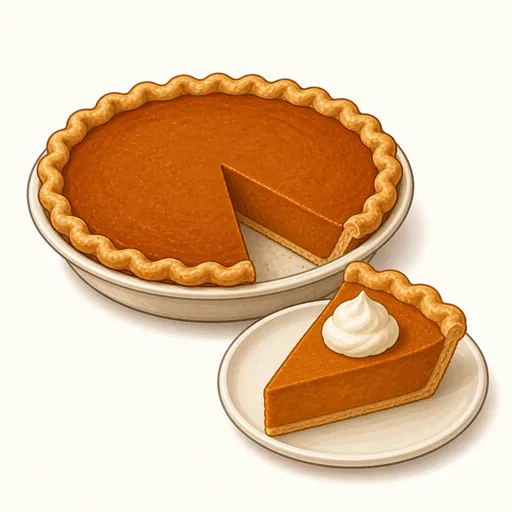
Pumpkin pie is the must-have dessert of an American Thanksgiving: a crisp, flaky butter crust holding a pumpkin filling as smooth as egg custard. A spice blend of cinnamon, ginger and nutmeg gives it a warm aroma, and it's perfect with a spoonful of whipped cream.
- Difficulty
- Medium
- Prep
- 40 min
- Cook
- 1 hr 15 min
- Rising or chilling
- 3 hr
- Total time
- 4 hr 55 min
- Method
- Oven-baked
Ingredients
Pie crust
Pumpkin filling
Instructions
Step 1
Put 160 g all-purpose flour, 6 g granulated sugar and 3 g salt in a food processor, add 115 g cold unsalted butter cut into cubes and pulse in short bursts, then gradually drizzle in 50 g ice water and keep pulsing. The butter has to stay cold to form little pieces that melt in the oven into a crisp, flaky crust. The dough is ready when it looks like coarse breadcrumbs and a handful holds together when squeezed without being wet.
Step 2
Turn the dough out onto the counter, quickly gather it into a ball, press it into a disk about three centimeters thick, wrap it in plastic wrap and refrigerate for at least an hour. The butter firms up again and the gluten relaxes, so the crust won't shrink in the oven. The dough is ready when it's firm, cold and only dents slightly when pressed.
Step 3
Dust the counter with a little flour, roll the dough into a circle about 30 cm across, roll it around the rolling pin and unroll it into a 23 cm pie dish, press it gently against the bottom, then tuck the overhang under and crimp a wavy edge. Letting the dough fall into the dish instead of stretching it keeps the crust from shrinking. The crust is ready when it covers the dish completely with an evenly tall rim; put the dish in the freezer for about fifteen minutes before baking.
Step 4
Line the crust with parchment paper, fill it with dried beans or rice as pie weights and bake at 200°C for about 15 minutes, then remove the paper and weights and bake for another five to ten minutes. Blind baking the crust first keeps the bottom from going soggy under the liquid filling. The crust is ready when the bottom is dry and pale golden and the rim is starting to turn a rich golden color.
Step 5
In a large bowl, whisk 150 g eggs with 150 g brown sugar, 6 g pumpkin pie spice and 3 g salt, add 425 g pumpkin puree and 4 g vanilla extract, then slowly pour in 360 g evaporated milk and stir well. Stir gently so you don't create too many bubbles that leave the top pitted. The filling is ready when it's smooth, an even orange-brown and free of white streaks of milk.
Step 6
Set the pie dish on a baking sheet, pour the filling into the still-warm crust and bake at 220°C for the first 10 to 15 minutes. The high heat quickly sets the edges of the filling while the crust keeps crisping. Move on when the filling next to the crust starts to set and looks slightly glossy.
Step 7
Lower the oven to 175°C and bake for about 35 to 45 minutes more, covering the rim of the crust with foil if it darkens too quickly. The lower heat cooks the custard gently, so the filling stays smooth and doesn't crack. The pie is done when the edges are firmly set while a circle about five centimeters wide in the center still jiggles gently like jelly when you shake the dish.
Step 8
Set the pie on a wire rack and let it cool completely at room temperature for about three hours before slicing. The filling keeps setting from the leftover heat, and cutting it while warm will leave it runny. The pie is ready when the bottom of the dish no longer feels warm and the filling is flat, firm and no longer jiggles.
Equipment
- Oven
- Pie dish
- Rolling pin
- Food processor
- Whisk
- Mixing bowl
- Kitchen scale
- Parchment paper
- Wire cooling rack
- Refrigerator
Tips
- Homemade steamed pumpkin puree is usually wetter than canned, so simmer it gently until thick and let it cool before mixing.
- If you don't have pumpkin pie spice, you can blend ground cinnamon, ground ginger, ground nutmeg and a pinch of ground cloves.
- Small cracks on top can be cleverly hidden under a layer of whipped cream when serving.
Storage
Once cool, cover the pie with plastic wrap and keep it in the fridge for three to four days. You can serve it cold or let it sit at room temperature for about twenty minutes so the crust softens slightly and becomes more fragrant.
Common problems and how to fix them
- A large crack runs across the middle of the filling.
- The pie baked too long or the oven was too hot. Take the pie out while the center still jiggles slightly, and remember to lower the heat after the first stage of baking.
- The bottom of the crust is wet and soggy.
- The crust wasn't blind-baked dry enough before the filling went in. Bake the crust for a few more minutes after removing the weights, until the bottom is pale golden.
This recipe is based on the common ratios for this bake and is written entirely in our own words.