Portuguese egg tarts
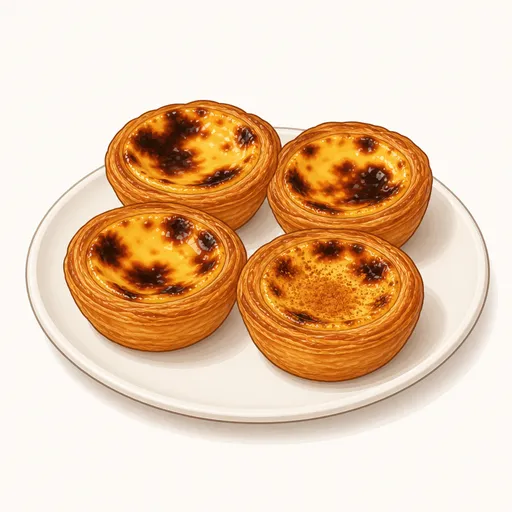
Portuguese egg tarts, also known as pastéis de nata, have a shatteringly crisp puff pastry shell and a rich, creamy egg custard filling with signature caramelized scorch marks on top. They bake at a very high temperature for a short time, so the pastry flakes into crisp layers while the custard stays soft and silky.
- Difficulty
- Medium
- Prep
- 35 min
- Cook
- 20 min
- Rising or chilling
- 20 min
- Total time
- 1 hr 15 min
- Method
- Oven-baked
Ingredients
Puff pastry shells
Egg custard filling
Topping
Instructions
Step 1
Dust the counter with a little to taste all-purpose flour, lay 300 g store-bought puff pastry on top and roll it up very tightly from the long side into an even log. Rolling tightly creates spiral rings of layers that help the shells flake beautifully in the oven. The log is ready when it's evenly round, about four centimeters across, with no gaps in the middle.
Step 2
Wrap the log in plastic wrap and refrigerate it for about twenty minutes. The butter in the pastry layers needs to firm up again so it doesn't melt when you press the dough into the pan. It's ready when the log is firm and doesn't squash when you slice it.
Step 3
Preheat the oven to 230°C, or as hot as your oven will go, with a rack in the upper position. Very high heat is the secret to the caramelized spots on the custard and a crisp crust. The oven is ready when it has preheated for at least twenty minutes and the oven thermometer reads steady.
Step 4
Cut the log into twelve even slices, lay each slice flat in a cup of a muffin pan, dip your thumb in cold water and press from the center outward, working the dough up the sides of the cup. A wet thumb keeps the dough from sticking and helps it spread more evenly. The shells are ready when the bottoms are thin, the sides rise just above the rim of the pan and the spirals are clearly visible.
Step 5
Put 200 g whipping cream, 100 g whole milk and 60 g granulated sugar in a saucepan and heat over medium, stirring until the sugar dissolves, then turn off the heat as soon as small bubbles appear around the edge. Heating dissolves the sugar completely and shortens the baking time for the custard. It's ready when it's steaming gently with tiny bubbles around the edge but hasn't come to a boil.
Step 6
Whisk 72 g egg yolks with 8 g cornstarch and 3 g vanilla extract until smooth, then slowly pour in the hot cream mixture while whisking constantly. Pouring slowly warms the yolks gradually so they don't curdle. The custard is ready when it's uniform, slightly thick and a creamy yellow color.
Step 7
Strain the custard through a fine-mesh sieve into a pitcher with a spout, then pour it into the shells until they're about three-quarters full. Straining makes the custard perfectly smooth, and leaving some room lets it puff up without overflowing. You've poured enough when the custard sits about half a centimeter below the edge of the shells.
Step 8
Bake the tarts at 230°C for about 15 to 20 minutes, without opening the oven door for the first ten minutes. The intense heat scorches the sugar in the custard into caramelized spots while the pastry puffs into crisp layers. They're done when the shells are a deep golden brown, the custard has puffed slightly and dark brown spots appear on top.
Step 9
Leave the tarts in the pan for about five minutes, then lift them out onto a rack and sprinkle the tops with a little a pinch ground cinnamon and to taste powdered sugar if you like before serving. Waiting a few minutes lets the custard settle and keeps the shells from breaking as you remove them. They're finished when the custard has sunk back slightly and flattened and the shells sound crisp when tapped.
Equipment
- Oven
- Muffin tin
- Rolling pin
- Small saucepan
- Whisk
- Sieve
- Kitchen scale
- Plastic wrap
- Refrigerator
Tips
- A thin, dark metal muffin pan gives crisper shells that brown faster than a silicone pan.
- If your oven doesn't produce scorch marks on the tops, switch on the broiler for the last two minutes and watch very closely.
- You can make the custard a day ahead and keep it in the fridge; just stir it again before pouring.
Storage
The tarts are best within a few hours of baking. You can keep them in an airtight container in the fridge for up to two days and reheat them at 180°C for about five minutes to crisp the shells again before eating.
Common problems and how to fix them
- The shells are soft and soggy on the bottom.
- The puff pastry was too warm when pressed into the pan or the oven wasn't hot enough. Chill the log more thoroughly and preheat the oven longer before baking.
- The custard overflows the shells as it bakes.
- You filled the shells too full. Fill them only about three-quarters full and press the sides of the shells up slightly above the rim of the pan.
This recipe is based on the common ratios for this bake and is written entirely in our own words.