Saint-Honoré cake
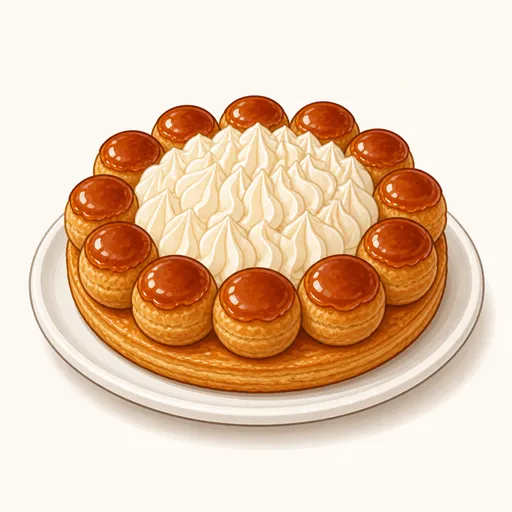
The Saint-Honoré is named after the patron saint of French bakers. It has a puff pastry base ringed with choux pastry, topped with a crown of small cream-filled puffs dipped in crisp caramel, with waves of piped whipped cream in the center. It's a cake for special occasions, elaborate but truly spectacular.
- Difficulty
- Very hard
- Prep
- 1 hr 30 min
- Cook
- 45 min
- Rising or chilling
- 2 hr 30 min
- Total time
- 4 hr 45 min
- Method
- Oven-baked
Ingredients
Puff pastry base
Choux pastry
Vanilla pastry cream
Dipping caramel
Chantilly cream
Instructions
Step 1
Heat 300 g whole milk until it just comes to a boil; meanwhile, whisk 72 g egg yolks with 70 g granulated sugar and 25 g cornstarch, pour in the hot milk while whisking, then return it all to the pan and cook over medium heat, stirring constantly, and finally add 20 g unsalted butter and 4 g vanilla extract. The cream needs to boil for about a minute so the cornstarch cooks fully and loses its starchy taste. It's ready when it is thick, smooth and glossy and the whisk leaves a clear trail.
Step 2
Spread the cream on a tray, press plastic wrap directly onto the surface and chill it in the fridge for about two hours. Wrap that touches the cream keeps a dry skin from forming. It's ready when it is cold throughout and has set into a soft mass.
Step 3
Preheat the oven to 190°C and line a baking sheet with parchment paper. This temperature is just right for both the puff pastry base and the choux to puff and bake at the same time. The oven is ready when the heating light switches off.
Step 4
Roll 250 g store-bought puff pastry about 3 mm thick, lay a 22 cm plate on top and cut around it, move the round to the baking sheet and prick it thoroughly all over with a fork. Pricking it well keeps the base from rising too much or puffing unevenly. It's ready when the round is even and the holes are about a centimeter apart.
Step 5
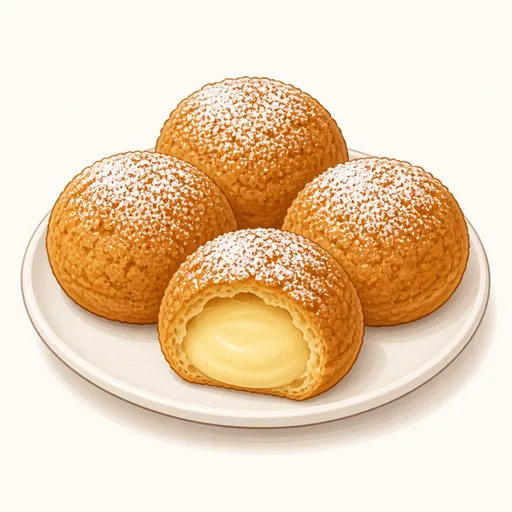
Bring 60 g water, 60 g whole milk, 50 g unsalted butter, 3 g granulated sugar and a pinch salt to a rolling boil, dump in all of 75 g all-purpose flour at once and stir vigorously over medium heat for two more minutes. Drying the dough on the stove drives off some moisture so it can absorb more egg. It's ready when it gathers into a ball, pulls away from the sides of the pan and leaves a thin film on the bottom.
Step 6
Transfer the dough to a bowl, beat it on low speed to cool it a little, then gradually add 125 g beaten eggs, waiting until each addition is fully absorbed before adding more. Adding them slowly lets you stop right when the dough reaches the right consistency. It's ready when it is glossy and falls from the lifted paddle in a V shape.
Step 7
Pipe a ring of choux right along the edge of the base and a thin spiral in the middle, then on another baking sheet pipe about sixteen small puffs the size of a large coin. The choux ring around the edge forms the wall that supports the puffs on top. It's ready when the rings are unbroken and the puffs are round and all the same size.
Step 8
Bake both sheets at 190°C for 25 to 30 minutes without opening the oven door for the first twenty minutes. The steam inside puffs the choux up hollow, and opening the oven early makes them collapse right away. They're done when the puffs are evenly golden brown and light and the base is crisp and dry; the small puffs can come out a few minutes earlier.
Step 9
Once the puffs have cooled, whisk the pastry cream until soft and smooth again, poke a small piping tip into the bottom of each puff and fill it with cream, then spread the remaining cream thinly over the center of the base. Re-whisked cream pipes easily without lumps. The puffs are ready when they feel heavy in your hand and a little cream peeks out of the hole.
Step 10
Cook 150 g granulated sugar with 50 g water over medium heat, without stirring, until it turns a light amber, dip the bottom of the pan in cold water for a few seconds, then dip the top of each puff into the caramel. Cooling the pan quickly stops the caramel from darkening further and turning bitter. The puffs are ready when the tops are coated in glossy, crisp caramel with no long drips.
Step 11
Dip the bottom of each puff into a little of the remaining caramel and stick them one by one onto the choux ring around the edge of the base. The caramel sets quickly like glue and holds the puffs firmly in place. The crown is ready when the puffs sit snugly side by side in a closed ring and don't wobble.
Step 12
Whip 300 g well-chilled whipping cream with 30 g powdered sugar and 3 g vanilla extract for about four minutes. Only cream that's stiff enough holds crisp piped lines. It's ready when it is firm and leaves clear ridges on the surface.
Step 13
Spoon the cream into a piping bag fitted with a Saint-Honoré tip or a leaf tip and pipe close, diagonal wavy lines to cover the center of the base inside the ring of puffs. This distinctive wavy piping is the hallmark of the cake. It's ready when the center is filled with rippling cream piped almost as high as the tops of the puffs.
Step 14
Chill the cake for about thirty minutes to let the cream set, then serve it, cutting with a serrated knife. A short chill keeps the cream standing tall before the caramel has a chance to absorb moisture. It's ready when the cream is cold and the caramel is still crisp.
Equipment
- Oven
- Small saucepan
- Piping bag
- Baking sheet
- Parchment paper
- Hand mixer
- Whisk
- Spatula
- Mixing bowl
- Kitchen scale
- Plastic wrap
- Refrigerator
Tips
- You can bake the puffs and base in the morning, but only dip them in caramel and assemble the cake within a few hours of serving.
- Keep a bowl of cold water beside you when making caramel; if you burn yourself, plunge your hand into it immediately.
- If the caramel thickens while you're dipping, just warm it over low heat for a few seconds to loosen it again.
Storage
Saint-Honoré is best enjoyed the same day, because the caramel absorbs moisture and softens in the fridge. Cover any leftovers loosely and refrigerate for up to a day, accepting that the caramel won't be crisp anymore.
Common problems and how to fix them
- The puffs collapse after coming out of the oven.
- They weren't dried out inside. Next time, bake them five minutes longer, or turn off the oven and leave the door ajar so they can dry for another ten minutes.
- The caramel crystallized into a sandy texture.
- Sugar stuck to the sides of the pan or you stirred it while cooking. Brush around the sides of the pan with a wet pastry brush and only swirl the pan gently.
- The whipped cream sags and the piped lines lose their shape.
- The cream wasn't cold enough or wasn't whipped long enough. Chill the bowl and whisk beforehand and whip until the peaks stand straight up.
This recipe is based on the common ratios for this bake and is written entirely in our own words.