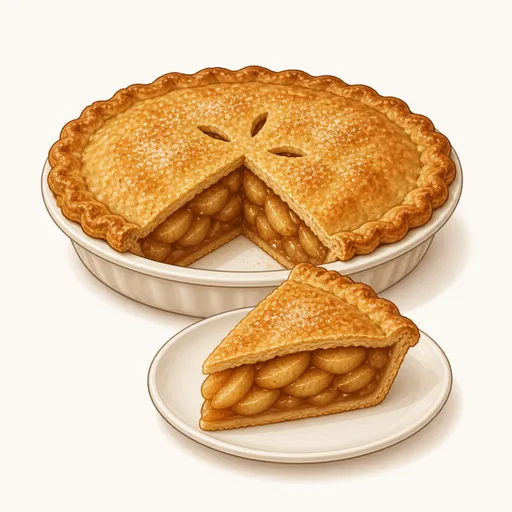
Rustic apple galette
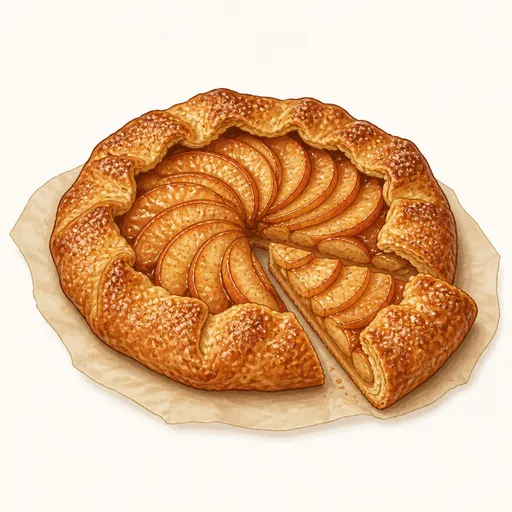
A galette is a rustic, free-form French tart that needs no pan: you simply roll buttery pastry into a circle, pile apples in the middle and fold the edges up into natural pleats. The flaky, many-layered crust, the tender cinnamon-scented apples and the slightly charred caramel edges make every bite both simple and irresistible.
- Difficulty
- Easy
- Prep
- 35 min
- Cook
- 45 min
- Rising or chilling
- 1 hr 20 min
- Total time
- 2 hr 40 min
- Method
- Oven-baked
Ingredients
Pastry
Apple filling
Egg wash and glaze
Instructions
Step 1
Mix 190 g all-purpose flour, 12 g granulated sugar and 3 g salt, add 130 g very cold cubed unsalted butter and flatten each piece between your fingers, then drizzle in 60 g ice water and gently gather it into a ball. Those leaf-thin flakes of butter become crisp, flaky layers in the oven. The dough is ready when it just holds together and the surface is still streaked with yellow butter.
Step 2
Press the dough into a disk about two centimeters thick, wrap it well and chill it for an hour. Cold dough keeps the butter solid, so the pastry doesn't stick as you roll and the layers stay distinct. It's ready when it feels firm but still gives a little when pressed with a finger.
Step 3
Peel and core 650 g apples, slice them about three millimeters thick and immediately toss them with 10 g lemon juice, 50 g brown sugar, 12 g cornstarch and 2 g ground cinnamon. The lemon keeps the apples from browning, and the cornstarch thickens the juices the apples release in the oven. They're ready when every slice is evenly coated with cinnamon sugar and looks slightly glossy and moist.
Step 4
Preheat the oven to 200°C with a rack in the middle and have a baking sheet lined with parchment paper ready. With no pan to support it, a galette needs strong heat so the crust firms up quickly. The oven is ready when the heating light has switched off.
Step 5
Roll the dough out on parchment paper into a circle about 32 cm across and roughly three millimeters thick; the edges don't need to be perfectly round. Then slide the whole sheet of paper onto the baking sheet. Rolling right on the paper lets you move the crust without tearing it. It's ready when it is evenly thick with no thin spots where you can see the paper underneath.
Step 6
Arrange the apple slices in an overlapping spiral in the center of the crust, leaving a border about five centimeters wide, dot 15 g unsalted butter in small pieces over the top, then fold the edge of the crust up over part of the apples, overlapping it into pleats all the way around. The pleats form a wall that keeps the apple juices from running onto the sheet. The galette is ready when the folded border hugs the apples snugly and only the center is left uncovered.
Step 7
Brush 25 g beaten eggs over the folded crust, then sprinkle 10 g granulated sugar evenly over the border. The egg helps the sugar stick and bakes into a crisp, sparkling edge. The border is ready when it looks glossy and is covered with a thin layer of sugar crystals.
Step 8
Bake at 200°C for 40 to 45 minutes, rotating the sheet once halfway through so the crust browns evenly. The high heat crisps the bottom and lightly caramelizes the edges of the apples. It's done when the crust is a deep golden brown, the juices are bubbling and thick in the center and the bottom looks dry and crisp when you lift the edge of the paper.
Step 9
Warm 30 g fruit jam, ideally apricot, until runny and brush it over the apples while the galette is still hot, then let it cool on the sheet for about twenty minutes. The jam keeps the apples beautifully glossy, and the juices thicken as it cools. It's ready when the filling has set and you can slide the whole galette onto a cutting board without it breaking.
Equipment
- Oven
- Baking sheet
- Parchment paper
- Rolling pin
- Mixing bowl
- Kitchen scale
- Pastry brush
- Plastic wrap
- Refrigerator
Tips
- Choose tart, crisp apples such as Granny Smith, or mix two varieties for a filling with balanced sweetness and tang.
- Sprinkling a thin layer of almond flour or cookie crumbs over the crust before adding the apples helps keep the bottom from getting soggy.
- If your kitchen is warm and the dough turns soft and sticky while you fold, put the whole sheet in the fridge for fifteen minutes before baking.
Storage
A galette is best on the day it's baked, left uncovered at room temperature. Wrap any leftovers loosely and keep them in the fridge for up to three days, then reheat in a 180°C oven for about ten minutes to crisp the crust again.
Common problems and how to fix them
- Apple juice runs onto the baking sheet and the bottom is soggy.
- The pleats weren't sealed well enough or the apples didn't have enough cornstarch. Overlap the folds more tightly and toss the apples just before arranging them so they don't have time to release their juices.
- The crust is hard and not flaky.
- The butter melted during mixing or the dough was overworked. Keep all your ingredients very cold and gather the dough only until it holds together.
This recipe is based on the common ratios for this bake and is written entirely in our own words.