Rough puff pastry
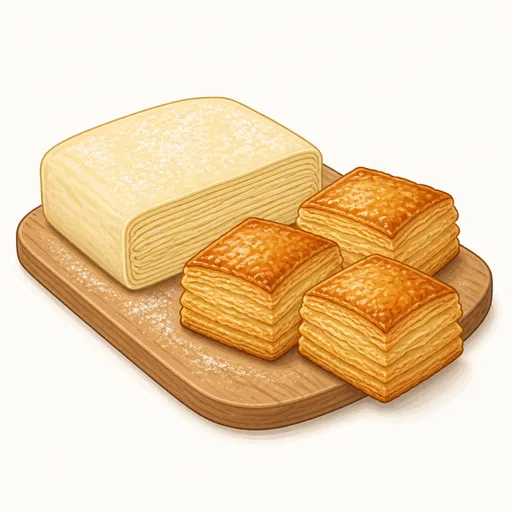
Rough puff pastry is a way to make layered pastry without rolling a big block of butter into the dough the way classic puff pastry does. Cold butter is cut into cubes and mixed straight into the flour, and after a few folds it bakes into tall, crisp, flaky layers. You can use it for vol-au-vents, galettes, sausage rolls or pie crusts.
- Difficulty
- Medium
- Prep
- 40 min
- Cook
- 22 min
- Rising or chilling
- 2 hr
- Total time
- 3 hr 2 min
- Method
- Oven-baked
Ingredients
Dough
Flour for rolling
Instructions
Step 1
Cut 200 g unsalted butter into cubes about one and a half centimeters across, then chill them in the fridge for another fifteen minutes. The colder the butter, the better it holds its shape during mixing, and those pieces are what create the puffed layers later. It's ready when the cubes are hard and don't feel sticky or greasy when you pick them up.
Step 2
Mix 250 g all-purpose flour with 4 g salt in a large bowl, add the cold butter and toss it gently with your hands so each cube gets a thin coating of flour. Don't squeeze the butter, because the whole cubes are what turn into thin sheets as you roll. The mixture is ready when the butter cubes are separate and evenly coated in white flour.
Step 3
Stir 5 g lemon juice into 120 g ice-cold water, drizzle it gradually into the bowl and use a blunt knife or your hands to toss the mixture until it comes together into a shaggy mass. Mix only until the dough holds together, since overmixing makes it tough and shrink in the oven. The dough is ready when it keeps its shape when squeezed and still shows big patches of butter.
Step 4
Press the dough into a flat rectangle, wrap it tightly in plastic wrap and chill it in the fridge for about thirty minutes. The rest lets the flour hydrate evenly and the butter firm up before rolling. It's ready when it feels cold and firm to the touch.
Step 5
Dust the counter lightly with flour, roll the dough into a strip three times as long as it is wide, then fold it in thirds like a letter, turn it a quarter turn, and roll and fold it once more. Each fold triples the layers of butter, so the layers get thinner and more even every time. After two folds the dough is noticeably smoother with just long streaks of butter; wrap it and chill it for thirty minutes.
Step 6
Place the dough with the open edge facing you and roll and fold it in thirds two more times just as before, brushing off the excess flour before each fold. Brushing off the extra flour helps the layers stick together so the pastry doesn't turn dry and papery. The dough is ready when it is smooth with butter streaks as fine as thread; wrap it and chill it for another thirty minutes.
Step 7
Roll and fold the dough in thirds one last time, press the corners gently to square them off, then wrap it well and chill it for at least thirty minutes. This final turn builds enough layers for the pastry to rise high without crumbling. The dough is finished when it is an even pale yellow and a cut edge shows many thin stacked layers.
Step 8
Roll the dough about three to four millimeters thick, cut it into the shapes you need with a very sharp knife in one clean stroke, place them on a baking sheet lined with parchment paper and bake at 200°C for about 18 to 25 minutes. A sharp knife doesn't press the edges together, so the layers are free to separate as they puff. The pastry is done when it has risen high, is evenly golden brown, feels light when lifted and has a dry, crisp bottom.
Equipment
- Oven
- Rolling pin
- Bench scraper
- Mixing bowl
- Kitchen scale
- Baking sheet
- Parchment paper
- Plastic wrap
- Refrigerator
Tips
- If your kitchen is warm, put the bowl and rolling pin in the fridge for about ten minutes before you start so the butter doesn't melt.
- Rough puff pastry can be divided, wrapped well and frozen; to use it, move it to the fridge overnight to thaw slowly.
- When the butter starts sticking to the rolling pin or breaking through the surface, stop and put the dough in the fridge right away instead of pushing on with rolling.
Storage
Unbaked dough keeps for two days in the fridge if well wrapped, or for about a month in the freezer. Baked pastry is best eaten the same day; if it softens, reheat it at 180°C for about five minutes to crisp it up again.
Common problems and how to fix them
- The baked pastry didn't puff and is dense and hard.
- The butter melted into the dough during mixing or rolling. Next time, use very cold butter, work quickly and give the dough longer rests in the fridge between folds.
- Butter leaks out onto the baking sheet during baking.
- The oven wasn't hot enough or the dough sat out too long before baking. Preheat the oven thoroughly and chill the cut pastry for ten minutes before it goes in.
- The pastry shrinks and warps after baking.
- The gluten was tight from too much handling or too short a rest. Let the dough rest fully in the fridge after rolling and cutting, and avoid stretching it as you place it on the sheet.
This recipe is based on the common ratios for this bake and is written entirely in our own words.