Quiche Lorraine
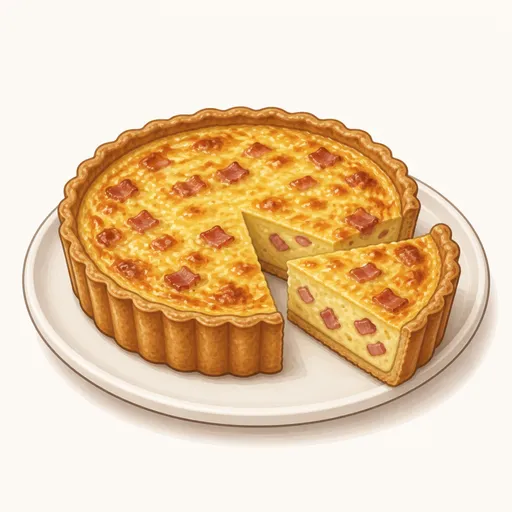
Quiche Lorraine is a classic savory tart from the Lorraine region of France, with a crisp butter crust (pâte brisée) and a rich, creamy egg custard filling studded with bacon. It's delicious warm or at room temperature, making it perfect for brunch or packing for a picnic.
- Difficulty
- Medium
- Prep
- 40 min
- Cook
- 1 hr
- Rising or chilling
- 1 hr 35 min
- Total time
- 3 hr 15 min
- Method
- Oven-baked
Ingredients
Pâte brisée crust
Bacon and egg custard filling
Instructions
Step 1
Mix 200 g all-purpose flour with 3 g salt, add 100 g cold unsalted butter cut into small cubes and rub it in until only rice-sized bits of butter remain, then add 18 g egg yolks and 45 g ice water. Those little bits of butter create a crisp, flaky, multilayered crust in the oven. The dough is ready when it just comes together into a ball and is still marbled with streaks of butter.
Step 2
Pat the dough into a flat disk, wrap it tightly and refrigerate for about an hour. Resting in the cold lets the dough hydrate evenly and firms up the butter, so the crust shrinks less. The dough is ready when it feels as firm as cold butter.
Step 3
Roll the dough into a circle about five centimeters wider than a 23 cm tart pan, lift it into the pan and press it snugly into the corners, then roll the rolling pin over the rim to trim off the excess. Pressing the dough well into the bottom corners helps the crust stand firm when the heavy filling goes in. The shell is ready when the sides are even and there are no cracks.
Step 4
Prick the bottom of the shell all over with a fork, then put the pan in the fridge for about twenty minutes. Once the butter in the crust is firm, it turns to steam in the oven and creates flaky layers instead of melting out. The shell is ready when it's cold and firm and the folds up the sides hold their shape.
Step 5
Preheat the oven to 200°C with a rack in the middle and a baking sheet on the rack below. The hot sheet underneath gives the bottom of the crust a strong blast of heat so it bakes up crisp. The oven is ready when the temperature has held steady after about fifteen minutes.
Step 6
Line the shell with parchment paper, fill it with dried beans or pie weights and bake at 200°C for 15 to 18 minutes. Blind baking with weights sets the shell's shape before it meets the liquid filling. The shell is ready when the edges are lightly golden and the bottom no longer looks wet.
Step 7
Remove the paper and beans, lower the oven to 180°C and bake the shell for another 5 to 8 minutes. Drying out the bottom keeps it from soaking up the filling, so it stays crisp. The shell is ready when the bottom is an even pale golden color; then lower the oven to 170°C, ready to bake the filling.
Step 8
Cut 200 g bacon into short strips about one centimeter wide and cook them in a skillet over medium heat until the fat renders and the bacon is lightly crisp, then drain on paper towels. Cooking the bacon first makes it more flavorful and keeps the filling from swimming in fat. The bacon is ready when it's a rosy brown with crisp edges.
Step 9
Lightly whisk 150 g eggs and 36 g egg yolks, then add 300 g heavy cream, 150 g whole milk, a pinch salt, a pinch ground black pepper and a pinch ground nutmeg. Stir just until combined so the filling doesn't get too foamy. The mixture is ready when it's uniform, creamy yellow and pours smoothly.
Step 10
Scatter the bacon and 80 g grated Gruyère, if using, evenly over the shell, pour in the egg custard almost to the rim and bake at 170°C for 30 to 35 minutes. A moderate heat sets the eggs smoothly and browns the top gradually. The quiche is done when the top has puffed slightly, is mottled golden and the center barely wobbles.
Step 11
Let the quiche rest in the pan for about fifteen minutes before removing it and cutting it into slices. The filling needs time to set so the slices don't run. It's ready when the top springs back when pressed lightly and the knife cuts neat, clean slices.
Equipment
- Oven
- Tart pan
- Rolling pin
- Nonstick skillet
- Whisk
- Mixing bowl
- Kitchen scale
- Parchment paper
- Plastic wrap
- Refrigerator
Tips
- The original quiche Lorraine has no cheese, but a little Gruyère makes the top more golden and the flavor richer.
- Bacon is already quite salty, so taste a piece before deciding how much salt to add to the filling.
- Set the tart pan on a baking sheet when you pour in the filling so you can move it without sloshing the custard over the edge.
Storage
Once cool and tightly wrapped, the quiche keeps in the fridge for about three days. To serve, reheat it at 160°C for ten to fifteen minutes so the crust crisps up again; avoid the microwave, which will make the crust soft.
Common problems and how to fix them
- The filling is watery and curdled.
- The quiche baked too hot or too long, so the eggs curdled. Keep the oven at 170°C and take the quiche out while the center still wobbles slightly.
- The crust shrank well below the rim of the pan.
- The dough didn't rest long enough or was stretched while lining the pan. Let the dough rest in the fridge for the full time, and push it down into the corners instead of stretching it.
This recipe is based on the common ratios for this bake and is written entirely in our own words.