Pita bread
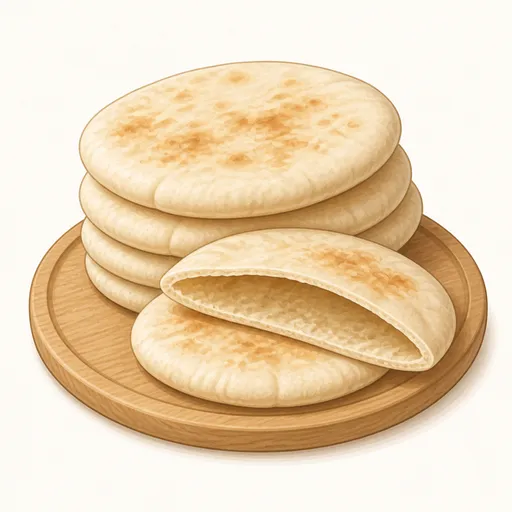
Pita is a Middle Eastern flatbread that, when baked at a very high temperature, puffs up like a balloon as the steam inside expands, leaving a hollow pocket in the middle. The bread is soft and slightly chewy, perfect for stuffing with grilled meat and fresh vegetables or dipping into hummus.
- Difficulty
- Easy
- Prep
- 30 min
- Cook
- 25 min
- Rising or chilling
- 1 hr 30 min
- Total time
- 2 hr 25 min
- Method
- Oven-baked
Ingredients
Instructions
Step 1
Combine 500 g all-purpose flour, 7 g instant yeast and 6 g granulated sugar in a large bowl, pour in 320 g warm water and 20 g olive oil and stir with a wooden spoon, then finally add 10 g salt. A little sugar gets the yeast going quickly and gives the bread pretty golden spots. It's ready once the dough has come together into a shaggy mass with no dry patches left at the bottom of the bowl.
Step 2
Turn the dough out onto the counter and knead by hand for about eight minutes, folding it over and pushing it away with the heel of your hand in a steady rhythm. Pita dough needs enough strength to trap the steam as it puffs in the oven. The dough is ready when it's soft, as smooth as an earlobe and no longer sticks to your palms.
Step 3
Place the dough in a bowl brushed with olive oil, turn it once to coat the surface, cover with plastic wrap and leave it somewhere warm for about an hour. The oil keeps the surface from drying out and cracking as it rises. The dough is ready when it has doubled in size and smells gently of yeast.
Step 4
Put an upside-down baking sheet or a baking stone on the lowest rack of the oven and preheat to 250°C for at least thirty minutes. A very hot baking surface transfers heat instantly into the bottom of the bread, which is what makes it puff up hollow. The oven is ready when the heating light has gone off and the sheet is hot enough that a drop of water sizzles away instantly.
Step 5
Divide the dough into eight pieces, shape each into a ball, cover with a damp towel and let them rest for about 15 minutes. This relaxes the gluten so the dough doesn't spring back when you roll it. The balls are ready when they feel soft and don't bounce back strongly when you press a finger in.
Step 6
Dust the counter lightly with flour and roll each ball into a round about 16 cm across and roughly half a centimeter thick, keeping the thickness even from the center to the edge. An even thickness lets the steam rise evenly so the whole round puffs into a pocket. The rounds are ready when they're flat, with no thin spots, holes or creases.
Step 7
Quickly lay two or three rounds on the hot sheet in the oven and bake at 250°C for about 4 to 6 minutes, without opening the oven door for the first two minutes. Keeping the door shut stops the temperature from dropping while the bread is puffing. The pitas are done when they've puffed up round, the tops are ivory with a few light golden spots and the bottoms are lightly golden.
Step 8
Take the pitas out and wrap them right away in a clean kitchen towel, stacking them on top of each other while you bake the next batches. The warmth trapped in the towel keeps the crust soft and pliable instead of dry and crisp. They're ready when they've deflated slightly but are still soft, and cutting one in half reveals a clear hollow pocket inside.
Equipment
- Oven
- Baking sheet
- Rolling pin
- Kitchen scale
- Mixing bowl
- Bench scraper
- Plastic wrap
Tips
- If you don't have an oven, you can cook pita in a very hot dry cast-iron skillet for about a minute per side; it will still puff if the pan is hot enough.
- Replacing a third of the all-purpose flour with whole wheat flour gives the bread a light brown color and a nuttier flavor.
- Don't dust on too much flour when rolling, because the dry flour on the surface will burn on the hot sheet.
Storage
Once cool, keep the pitas in a sealed bag at room temperature for two days. You can freeze them for up to a month and rewarm them in a dry skillet or hot oven for about a minute per side.
Common problems and how to fix them
- The pitas don't puff and stay flat like thick crackers.
- The baking sheet or oven wasn't hot enough, or the dough was rolled unevenly. Preheat the sheet longer and roll carefully so the dough is about half a centimeter thick all over.
- The pitas turn hard and dry like crackers once cool.
- They baked too long or weren't wrapped up. Take them out as soon as they've puffed up round and wrap them in a clean towel to keep them moist.
This recipe is based on the common ratios for this bake and is written entirely in our own words.