Pear frangipane tart
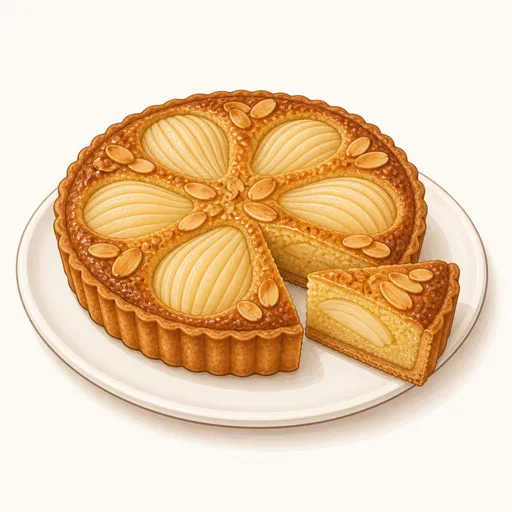
This is a take on the classic French tarte Bourdaloue: a crisp, buttery sweet crust, a frangipane filling (almond cream beaten with butter and eggs) and pear halves sliced and fanned out on top. As it bakes, the almond cream puffs up and hugs the pears, giving you a moist, tender tart that smells of butter and tastes of gently sweet fruit.
- Difficulty
- Medium
- Prep
- 45 min
- Cook
- 1 hr
- Rising or chilling
- 2 hr 20 min
- Total time
- 4 hr 5 min
- Method
- Oven-baked
Ingredients
Sweet pastry crust (pâte sucrée)
Almond cream (frangipane)
Pears
Topping and glaze
Instructions
Step 1
Beat 110 g softened unsalted butter with 70 g powdered sugar and a pinch salt until smooth, add 40 g eggs, then add 200 g all-purpose flour and press it in with a flat spatula just until the dough comes together. Creaming the butter and sugar before adding the flour gives a smooth, cookie-crisp crust that shrinks less. The dough is ready when it's soft and smooth, with no dry streaks of flour, and slightly sticky.
Step 2
Press the dough into a flat disk, wrap it tightly and refrigerate for one hour. Pâte sucrée is rich in butter and very soft, so it needs chilling before you can roll it without it melting and sticking. The dough is ready when it's as firm as cold butter and no longer sticks to the plastic wrap.
Step 3
Roll the dough out between two sheets of parchment paper to about three millimeters thick, line a 23 cm tart pan with a removable bottom, press it snugly into the corners and up the sides, then run the rolling pin over the rim to trim off the excess. Rolling between sheets of paper keeps the dough from sticking without dusting on extra flour. The shell is ready when it hugs the pan, the sides are an even thickness and the edge is neatly trimmed.
Step 4
Prick the bottom of the shell lightly with a fork, then put the whole pan in the freezer for about twenty minutes. A frozen shell holds its sides in the heat instead of slumping. It's ready when it's frozen solid and sounds hard when you tap it.
Step 5
Preheat the oven to 180°C with a rack in the middle, and have parchment paper plus dried beans or pie weights ready to weigh down the shell. A fully heated oven bakes the bottom and sides to an even golden color. The oven is ready when the heating light has gone off and the temperature has held steady for a few minutes.
Step 6
Line the frozen shell with parchment paper, fill it to the rim with beans and bake at 180°C for 15 to 18 minutes, then lift out the paper and beans. Blind baking crisps the bottom of the crust so it doesn't turn soggy under the almond cream. The shell is ready when the sides have set, the bottom is dry and it's a pale golden color.
Step 7
While the shell bakes, beat 100 g softened unsalted butter with 100 g superfine sugar until light and fluffy, add 100 g eggs a little at a time, then mix in 100 g almond flour, 20 g all-purpose flour and 10 g dark rum. Beating the butter and sugar long enough helps the cream bake up light and airy rather than dense. The cream is ready when it's smooth, pale ivory and holds its shape on a spoon.
Step 8
Peel 450 g just-ripe pears, halve them, remove the cores, then slice each half thinly crosswise while keeping its shape, and drizzle with 10 g lemon juice right away. Keeping the slices together lets you move each half onto the tart in one piece and fan it out beautifully. The pears are ready when the slices are evenly thin and each half slides over like a deck of cards when you press it gently.
Step 9
Spread the almond cream evenly in the blind-baked shell, arrange the pear halves on top like the spokes of a fan with the narrow ends pointing to the center, press them in lightly, and scatter 15 g sliced almonds into the gaps. The pears only need to sink in partway, because the cream will rise up around them as it bakes. The tart is ready when the cream sits about half a centimeter below the rim and the pears are spaced evenly around.
Step 10
Bake at 175°C for 35 to 40 minutes, until the almond cream has puffed up between the pear slices. A moderate heat bakes the cream right through to the center without burning the crust. The tart is done when the cream is golden brown, springs back when pressed lightly and a skewer inserted into the cream comes out clean.
Step 11
Warm 40 g apricot jam with a spoonful of water until runny, strain out the solids and brush it lightly over the pears while the tart is still warm. A thin layer of jam keeps the pears from drying out and gives the tart a bakery-style shine. It's done when the pears have a thin, glossy coat with no drips.
Step 12
Let the tart cool in the pan for about an hour, then push up the removable bottom to release the ring. The almond cream needs to cool to set, and the crust cracks easily if you unmold it while hot. The tart is ready when the bottom of the pan feels only slightly warm and the crust comes away from the ring easily.
Equipment
- Oven
- Tart pan
- Rolling pin
- Hand mixer
- Mixing bowl
- Kitchen scale
- Parchment paper
- Plastic wrap
- Pastry brush
- Refrigerator
Tips
- Choose pears that are ripe but still firm; overripe pears release a lot of juice and make the almond cream soggy.
- You can use canned pears in syrup, as long as you pat them very dry with paper towels before slicing.
- If you'd rather skip the rum, use a few drops of almond or vanilla extract instead.
Storage
The tart keeps at room temperature for one day, loosely covered. After that, store it in an airtight container in the fridge for up to four days, and let it sit out for about thirty minutes before serving so the almond cream softens again.
Common problems and how to fix them
- The sides of the crust slumped during blind baking.
- The shell wasn't cold enough or wasn't weighed down enough. Freeze the shell until rock hard and fill it with beans right up to the rim before it goes into the oven.
- The almond cream separated and the top of the tart looks greasy.
- The butter was too soft or the eggs were too cold, so the mixture broke. Have the butter and eggs both at room temperature and add the eggs gradually.
This recipe is based on the common ratios for this bake and is written entirely in our own words.