Paris-Brest
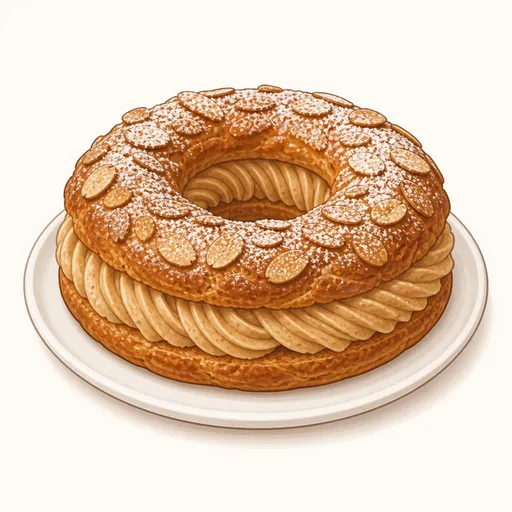
Paris-Brest is a ring-shaped choux pastry created to celebrate the Paris to Brest bicycle race, which is why it looks like a wheel. The choux ring, topped with sliced almonds, is split in half and generously piped with praline mousseline cream (pastry cream whipped with butter and caramelized roasted nut paste). The rich, nutty cream and the lightly crisp shell make an elegant cake for special occasions.
- Difficulty
- Hard
- Prep
- 1 hr
- Cook
- 55 min
- Rising or chilling
- 2 hr
- Total time
- 3 hr 55 min
- Method
- Oven-baked
Ingredients
Choux pastry
Almond topping
Praline mousseline cream
Instructions
Step 1
Use a pencil to draw a 20 cm circle on a sheet of parchment paper, flip it pencil side down and lay it on a baking sheet. The template helps you pipe an even ring so the pastry bakes evenly. This step is done when you can still see the circle clearly through the paper.
Step 2
Preheat the oven to 175°C with a rack in the middle. A large ring needs moderate heat and a long bake to dry out inside without the shell burning. The oven is ready when the temperature has held steady for a few minutes.
Step 3
Bring 125 g whole milk, 125 g water, 100 g unsalted butter, 2 g salt and 5 g granulated sugar to a boil, take the pan off the heat, add 140 g all-purpose flour and stir quickly, then return it to medium heat for about two more minutes. Milk gives the shell a prettier color and a softer texture than water alone. The paste is ready when it forms a smooth ball and leaves a thin film on the bottom of the pan.
Step 4
Put the paste in the bowl of a stand mixer fitted with the paddle, beat slowly to release the heat, then gradually add 230 g beaten eggs, waiting for the paste to absorb each addition before adding more. Paste for a large ring needs to be a little thicker so it can hold its height. The paste is ready when it is glossy and smooth and falls from the paddle in a thick triangular ribbon.
Step 5
Using a piping bag with a large star tip, pipe two rings right next to each other following the template, then pipe a third ring on top, over the seam between the two below. The three rings together make the pastry rise tall and thick enough to split. The ring is right when the circles are joined, even in size, and the joins are not bulging.
Step 6
Beat 25 g eggs, brush lightly over the ring and scatter 30 g sliced almonds all over it. The egg both makes the shell shiny and helps the almonds stick. This step is done when the top is evenly covered in almonds and no egg has dripped onto the tray.
Step 7
Bake the ring at 175°C for about 40 to 45 minutes, without opening the oven door during the first half hour. The long bake dries out the inside completely so the shell does not collapse under the heavy cream. The ring is done when it is a deep golden brown, the almonds smell toasty and the shell sounds hard when tapped.
Step 8
Let the ring cool on a rack for about thirty minutes. Once completely cool, the shell is sturdier and easier to split neatly. It is ready when the bottom is cool and dry.
Step 9
Heat 300 g whole milk; whisk 72 g egg yolks with 60 g granulated sugar and 25 g cornstarch, whisk in the hot milk, then pour it back into the pan and whisk constantly over medium heat until it thickens and bubbles. The base cream needs to be thick enough because a lot of butter will be beaten into it. The cream is ready when it is very thick, glossy and holds its shape when scooped.
Step 10
Spread the cream on a plate, press plastic wrap onto the surface and let it cool to about 20°C, which takes roughly an hour. The cream and butter need to be at the same temperature to blend without splitting. The cream is ready when it feels cool like room temperature, not cold and stiff.
Step 11
Beat 150 g softened unsalted butter with 130 g praline paste until fluffy, then add the pastry cream a spoonful at a time and beat on medium speed for about eight minutes. Long beating makes the cream light, fluffy and paler in color. The mousseline is ready when it is as smooth as buttercream, a light beige and holds a piped rosette shape.
Step 12
Use a serrated knife to slice the ring horizontally in two, with the bottom thicker than the lid, then pipe the mousseline in large swirls close together over the bottom half. Piping the cream higher than the edge of the shell shows off its pretty ridges. The cake is right when the cream forms one continuous ring with no gaps.
Step 13
Set the lid on top of the cream, press very gently, dust with 10 g powdered sugar and refrigerate for about thirty minutes. Chilling firms up the cream so the slices do not slide apart. The cake is finished when the cream has set and the top is covered in a fine white layer of sugar.
Equipment
- Oven
- Small saucepan
- Stand mixer
- Whisk
- Spatula
- Sieve
- Piping bag
- Baking sheet
- Parchment paper
- Pastry brush
- Plastic wrap
- Kitchen scale
- Refrigerator
Tips
- If you cannot find praline paste, toast hazelnuts and almonds, make a caramel, and blend the mixture until it becomes a thick paste.
- You can pipe eight small rings 8 cm across to make individual Paris-Brest; in that case, shorten the baking time to about 25 to 30 minutes.
- If the mousseline splits, warm the side of the bowl gently with a warm towel and keep beating; the cream will turn smooth again.
Storage
Keep the cake in the fridge; it is best within two days. Before serving, let it sit at room temperature for about twenty minutes so the cream softens and the nutty flavor comes through.
Common problems and how to fix them
- The ring collapses when you split it.
- The inside was not dried out completely. Bake it ten minutes longer, then turn off the oven and leave it inside with the door ajar for another ten minutes.
- The mousseline looks curdled.
- The pastry cream and the butter were at different temperatures. Bring both to about 20°C and keep beating on high speed until the cream turns smooth again.
This recipe is based on the common ratios for this bake and is written entirely in our own words.