Panettone
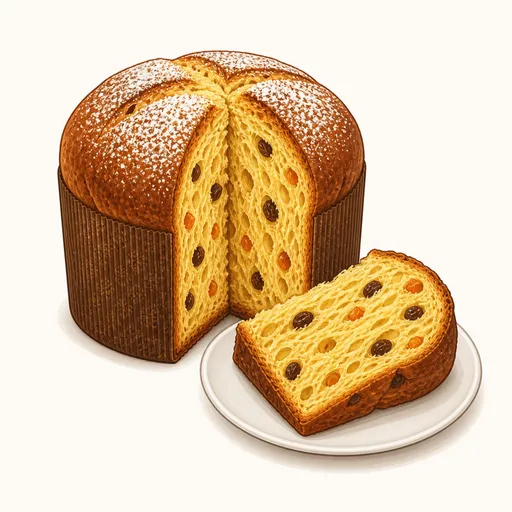
Panettone is the festive sweet bread of Milan, Italy, famous for its tall, hat-like dome and its long-stranded crumb, soft and fluffy as cotton. The dough is kneaded twice with a night in between and is rich with egg yolks, butter and honey, studded with raisins and candied orange peel. This version uses dried yeast instead of a natural starter so it is easier to make at home.
- Difficulty
- Very hard
- Prep
- 1 hr
- Cook
- 50 min
- Rising or chilling
- 12 hr
- Total time
- 13 hr 50 min
- Method
- Oven-baked
Ingredients
First dough (overnight)
Second dough
Dried fruit
Instructions
Step 1
Dissolve 1 g instant yeast in 60 g water and 40 g whole milk, put it in the bowl of a stand mixer with 200 g bread flour, 40 g granulated sugar and 54 g egg yolks and knead until the dough comes together, then gradually add 50 g softened unsalted butter. The very small amount of yeast is intentional, so the dough ferments slowly and develops a deep aroma. The dough is ready when it is smooth, elastic and stretches into a thin windowpane without tearing right away.
Step 2
Put the dough in a lidded container, mark the level of the dough on the side, then leave it at a room temperature of about 24 to 26°C for ten to twelve hours. This long fermentation determines the stranded texture and fragrance of the panettone. The dough is ready when it has tripled in volume and the top dips slightly in the center.
Step 3
Put the fermented dough in the mixer bowl with 200 g bread flour, 4 g instant yeast and 50 g whole milk and knead until smooth again, then add 36 g egg yolks, 50 g eggs, 60 g granulated sugar and 20 g honey one at a time, waiting for the dough to absorb each before adding the next. Next add 5 g salt, 5 g vanilla extract, 6 g orange zest and finally 70 g softened unsalted butter in three additions. Adding a little at a time keeps the dough from breaking down under too much liquid at once. The dough is ready when it is very glossy and stretchy, pulls away from the sides of the bowl and is no warmer than 26°C.
Step 4
Turn the mixer to its lowest speed, add 120 g raisins and 100 g candied fruit and mix for only about a minute. A short mix keeps the fruit from tearing the gluten network you have just built. The dough is ready when the fruit is evenly distributed and the dough is still glossy.
Step 5
Turn the dough out onto a lightly buttered counter, let it rest for twenty minutes, then round it by pulling the surface taut underneath, and set it in an 18 cm paper panettone mold. A taut surface makes the bread rise straight up instead of spreading out. The dough is ready when it is evenly round with a tight, shiny surface and fills only about a third of the height of the mold.
Step 6
Set the mold somewhere warm, around 28°C, cover loosely with plastic wrap and proof for three to four hours. Such a rich dough needs a long time for the yeast to lift its heavy mass. The dough is ready when its edges have risen almost to the rim of the mold and the top is stretched thin like a balloon.
Step 7
Leave the dough uncovered at room temperature for fifteen minutes so the surface dries slightly, score a shallow cross on top and set a small piece of butter in the center, then bake at 175°C for about 45 to 55 minutes. If the top darkens quickly, cover it with foil after about twenty minutes. The panettone is done when a thermometer inserted in the center reads about 94°C.
Step 8
As soon as it comes out of the oven, push two long skewers through the base of the paper mold and hang the panettone upside down between two chairs or two stacks of books for at least six hours. The hot crumb is so soft that if left standing, the bread would collapse under its own weight. It is ready when it is completely cool and keeps its full height when turned upright.
Equipment
- Oven
- Stand mixer
- Mixing bowl
- Kitchen scale
- Thermometer
- Plastic wrap
- Spatula
- Wire cooling rack
- Kitchen twine
Tips
- Use butter that is soft but still cool, because melted butter makes the dough greasy and sticky and it will never form a windowpane.
- If the mixer warms the dough above 26°C, put the whole bowl in the fridge for ten minutes, then continue kneading.
- Soaking the raisins in warm water for ten minutes and patting them very dry keeps them soft without making the dough wet.
Storage
Once cool, panettone stays soft in an airtight bag at room temperature for about a week. When it starts to dry out, you can toast slices or use it for French toast.
Common problems and how to fix them
- The panettone collapses or sinks in the middle after cooling.
- It was not baked through to the center or was not hung upside down right away. Use a thermometer to make sure it is hot enough inside, and hang it within a minute of taking it out of the oven.
- The second dough is slack and will not form a windowpane.
- The eggs or butter went in too fast and the dough broke. Stop adding ingredients and keep kneading until the dough comes back together before adding the next portion.
- The crumb is tight, with no long strands.
- The first dough did not rise enough or the final proof was too short. Go by how much the dough has risen rather than the clock, especially when the room is cold.
This recipe is based on the common ratios for this bake and is written entirely in our own words.