Palmiers
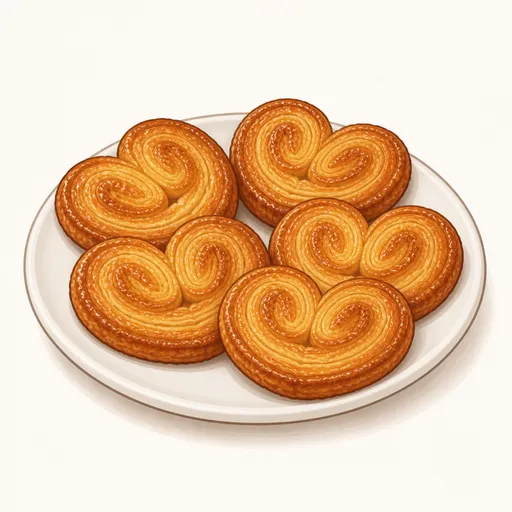
Palmiers, also called elephant ears or butterfly cookies, are puff pastry rolled in from both sides toward the middle into a heart or palm-leaf shape. The sugar layered into the dough melts and caramelizes in the oven, giving a crackly-crisp, sweet cookie that tastes of butter. This recipe uses a quick rough puff, so there is no fussy butter block to roll out.
- Difficulty
- Medium
- Prep
- 45 min
- Cook
- 20 min
- Rising or chilling
- 1 hr 50 min
- Total time
- 2 hr 55 min
- Method
- Oven-baked
Ingredients
Rough puff pastry
Sugar for rolling
Instructions
Step 1
Mix 250 g all-purpose flour with 5 g salt in a large bowl, add 200 g very cold unsalted butter cut into fingertip-sized cubes and toss so the butter is coated in flour. The whole cubes of butter flatten as you roll, forming the puffy, flaky layers. The mixture is ready when every cube is dusted white with flour and still holds its shape.
Step 2
Drizzle 125 g ice water into the bowl and gather and press the mixture lightly with your hands into a shaggy mass still studded with butter. Do not knead it thoroughly, because breaking up the butter loses the layers. The dough is ready when it holds together in a mass with large flecks of butter clearly visible.
Step 3
Press the dough into a flat rectangle, wrap it well and refrigerate for about twenty minutes. A short rest lets the flour absorb the water and firms up the butter before the first roll. The dough is ready when the surface is cold and no longer sticky.
Step 4
Roll the dough into a strip about 45 cm long and 15 cm wide, fold it in thirds like a letter, turn it a quarter turn, then roll and fold it in thirds once more; wrap it again and chill for thirty minutes. The dough looks very shaggy at first but gets smoother with every fold. The round is right when the dough is neatly square and the streaks of butter have stretched into long marbled lines.
Step 5
Repeat the two rolls and letter folds as above, using very little dusting flour, then chill for another thirty minutes. Four folds in total create enough layers for the pastry to rise crisp. The dough is ready when it is smooth, the edges are straight and no large flecks of butter show.
Step 6
Sprinkle half of 200 g granulated sugar on the counter in place of dusting flour, set the dough on it, sprinkle more sugar on top, then roll it into a rectangle about 25 by 35 cm and three millimeters thick. Sugar pressed into both sides of the dough becomes a caramel layer as it bakes. The sheet is ready when it is completely coated in sugar, flat and evenly thick.
Step 7
Fold both long sides in so each one meets the center line, sprinkle on a little of the remaining sugar, fold them in toward the center once more, then fold one half over the other. This folding creates the two symmetrical spirals of the palmier. The dough is ready when it forms a long, six-layer log whose cross-section looks like the letter M.
Step 8
Wrap the log and refrigerate for about thirty minutes. Cold, firm dough slices cleanly and keeps its shape in the oven. The log is ready when it feels as firm as cold butter.
Step 9
With a sharp knife, cut the log into slices about one centimeter thick and place them on a parchment-lined baking sheet, five centimeters apart. The palmiers spread out quite a bit, so leave room so they do not stick together. This step is done when the slices are evenly thick and the cut sides clearly show the spirals.
Step 10
Preheat the oven to 200°C with a rack in the middle. The high heat separates the layers quickly while the sugar has time to caramelize. The oven is ready when the heating light first switches off.
Step 11
Bake at 200°C for about 10 to 12 minutes. The underside touching the tray caramelizes first. This step is done when the bottoms have turned amber and the edges have fanned out.
Step 12
Flip each palmier with a spatula and bake at 200°C for another 5 to 8 minutes, watching closely so the sugar does not burn. Flipping gives both sides a glossy, crisp caramel coating. They are done when both sides are a shiny golden brown.
Step 13
Move the palmiers to a rack while still hot and let them cool completely. The caramel hardens as it cools and makes the cookies shatteringly crisp; left on the tray, they stick fast. They are ready when they snap with a clear crack.
Equipment
- Oven
- Rolling pin
- Bench scraper
- Kitchen scale
- Plastic wrap
- Baking sheet
- Parchment paper
- Refrigerator
- Wire cooling rack
Tips
- Mix a little ground cinnamon into the sugar, or use brown sugar, for a different flavor.
- The folded log freezes for up to a month; when you need it, let it soften slightly, then slice and bake.
- If you use store-bought puff pastry, skip the dough steps and start from rolling it in sugar.
Storage
Palmiers stay crisp for about five days in an airtight container at room temperature. Keep them away from humidity, because the caramel absorbs moisture and turns sticky.
Common problems and how to fix them
- The palmiers unfurl and lose their butterfly shape.
- The log was not cold enough or was not folded tightly. Press lightly as you fold and chill the log more thoroughly before slicing.
- The sugar burns black before the pastry is cooked.
- The bottom heat is too strong or they baked too long before flipping. Move the tray up one rack and flip them sooner.
This recipe is based on the common ratios for this bake and is written entirely in our own words.