Pain aux raisins
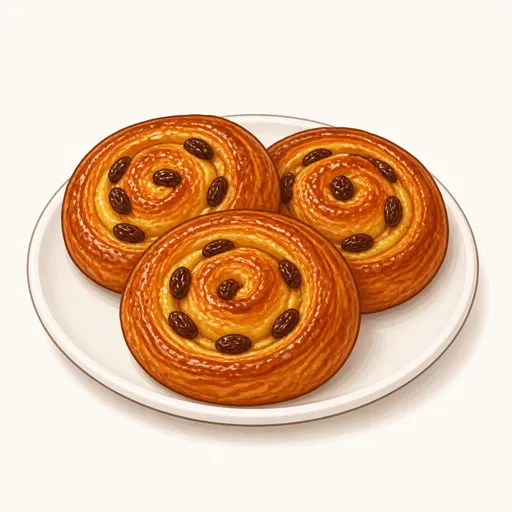
Pain aux raisins is the beloved snail-shaped pastry of the French bakery, made from laminated yeast dough spread with vanilla pastry cream and scattered with rum-soaked raisins. Every swirl is buttery and crisp on the outside, soft and moist inside, with bursts of sweet, chewy raisins.
- Difficulty
- Very hard
- Prep
- 1 hr 15 min
- Cook
- 20 min
- Rising or chilling
- 4 hr 30 min
- Total time
- 6 hr 5 min
- Method
- Oven-baked
Ingredients
Yeast dough
Butter block
Vanilla pastry cream
Soaked raisins
Egg wash and glaze
Instructions
Step 1
Soak 120 g raisins in 40 g hot water with 30 g dark rum, if using, for about thirty minutes, then drain well. Plumped raisins stay soft and juicy and will not draw moisture from the cream or burn in the oven. The raisins are ready when they are plump and feel soft when squeezed gently.
Step 2
Mix 250 g bread flour, 30 g granulated sugar, 6 g instant yeast and 5 g salt, pour in 70 g whole milk and 60 g water, knead for a few minutes, then add 25 g softened unsalted butter and keep kneading until smooth. The dough does not need to be very elastic, because the folds later will keep developing the gluten. The dough is ready when it is smooth, slightly elastic and no longer sticks to the bowl.
Step 3
Roll the dough into a flat rectangle, wrap it well and refrigerate for at least an hour. Chilling slows the yeast and brings the dough to the same temperature as the butter. The dough is ready when it is evenly cold and firm to the touch.
Step 4
Warm 250 g whole milk, whisk 54 g egg yolks with 50 g granulated sugar and 20 g cornstarch, whisk in the milk, then cook over medium heat, stirring constantly; take it off the heat and add 4 g vanilla extract. Cream for rolled pastries needs to be thicker than cream puff filling so it does not bubble out in the oven. The cream is ready when it is very thick, bubbling in the center and smooth and glossy.
Step 5
Spread the cream on a plate, press plastic wrap directly onto the surface and refrigerate for about an hour. Chilled cream sets up and spreads easily into a thin, even layer. The cream is ready when it is fully cold and holds its shape when scooped.
Step 6
Roll 140 g cold unsalted butter between two sheets of parchment into a flat square, set it on one half of the dough, fold the other half over it and press the edges to seal. Cold but pliable butter that matches the firmness of the dough stretches with it into an unbroken layer. The dough is ready when the butter is fully enclosed with no air pockets.
Step 7
Roll the dough into a long strip, fold it in thirds like a towel, turn it a quarter turn and chill for thirty minutes, then repeat with one more letter fold. Each fold triples the layers of butter, building the crisp, flaky tiers. The dough is right when the edges are square and a cut side shows fine, even streaks of butter.
Step 8
Roll the dough into a rectangle about 30 by 40 cm and roughly half a centimeter thick, with a long side parallel to the edge of the counter. An even thickness gives rolls of the same size that bake at the same rate. The dough is ready when it is flat, with square corners and no butter breaking through.
Step 9
Whisk the pastry cream until soft again, spread it evenly over the dough, leaving a strip of about two centimeters bare along the far long edge, then scatter the drained raisins evenly and press them in lightly. The bare strip helps the roll seal shut. The filling is right when it is a thin, even layer with raisins spread all over and no clumps.
Step 10
Roll the dough up tightly from the edge closest to you, press the bare edge against the roll, then cut it into twelve slices about three centimeters thick with a sharp knife. A tight roll keeps the spirals from springing open as they rise. The slices are right when they are evenly round with a clear spiral.
Step 11
Arrange the slices on a lined baking sheet with the tail tucked underneath, cover loosely and proof in a moderately warm spot for about an hour and a half. Keep the proofing temperature no higher than 26°C so the butter does not melt out of the layers. They are ready when they have grown by almost half and wobble slightly when you shake the tray.
Step 12
Preheat the oven to 190°C when the pastries are nearly proofed, with a rack in the middle. The oven must be really hot when the pastries go in so the butter steams and forms the layers right away. The oven is ready when a thermometer shows the right temperature.
Step 13
Beat 50 g eggs with a splash of water and brush it lightly over the exposed dough of each pastry, avoiding the cut sides. Egg that pools on the cut edges glues the layers shut and holds the pastry back from rising. They are right when the dough is lightly and evenly shiny.
Step 14
Bake at 190°C for 16 to 20 minutes, rotating the tray once halfway through if your oven heats unevenly. This moderate heat bakes the pastry crisp without drying out the cream inside. They are done when they are a glossy golden brown, the bottoms are deep golden and the cream has colored slightly.
Step 15
Warm 40 g apricot jam or another light-colored fruit jam with a few drops of water and brush it over the pastries as soon as they come out of the oven. The jam adds an inviting shine and keeps the pastries from drying out. They are finished when the tops glisten and are no longer sticky once cool.
Equipment
- Oven
- Stand mixer
- Rolling pin
- Small saucepan
- Whisk
- Baking sheet
- Parchment paper
- Pastry brush
- Bench scraper
- Kitchen scale
- Plastic wrap
- Refrigerator
Tips
- You can make and laminate the dough the evening before, leave it in the fridge overnight, then roll, fill and proof it the next morning.
- Freeze the unproofed slices on a tray, then transfer them to a bag; when you want some, just thaw them overnight in the fridge and proof as usual.
- Sprinkle a little ground cinnamon over the cream before adding the raisins for a warmer aroma.
Storage
Pain aux raisins is best on the day it is baked. Keep leftovers in a paper bag at room temperature for one day, or freeze them for up to a month, then reheat at 170°C for about six minutes to crisp them up again.
Common problems and how to fix them
- The pastries have no layers and are just soft like sweet bread.
- The butter was too soft and soaked into the dough as you rolled. Keep the dough very cold, give it enough rest between folds and proof somewhere that is not too warm.
- The cream bubbles out and burns around the base.
- The layer of cream was too thick, or the cream was not cooked thick enough. Spread it more thinly and cook the cream until it boils and is clearly thick.
- The rolls spring open as they rise.
- The rolls were not tight enough or the tails were not tucked underneath. Roll snugly and place each roll with its tail pressed against the tray.
This recipe is based on the common ratios for this bake and is written entirely in our own words.