Opera cake
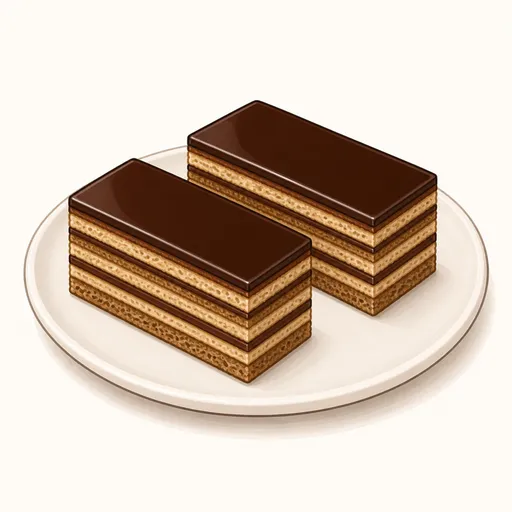
Opera cake is a masterpiece of the French patisserie: layers of almond joconde sponge soaked in coffee syrup, alternating with coffee buttercream and chocolate ganache, all finished with a mirror-shiny chocolate glaze. Every slice shows perfectly even, thin layers, and the gentle bitterness of the coffee balances the richness of the butter and chocolate beautifully.
- Difficulty
- Very hard
- Prep
- 1 hr 30 min
- Cook
- 25 min
- Rising or chilling
- 3 hr
- Total time
- 4 hr 55 min
- Method
- Oven-baked
Ingredients
Almond joconde sponge
Coffee syrup
Coffee buttercream
Chocolate ganache
Chocolate glaze
Instructions
Step 1
Preheat the oven to 220°C, line two baking sheets of about 30 by 40 cm with parchment paper and brush the paper with a thin layer of butter. The high heat bakes the thin sponge quickly while keeping it moist and tender. The oven is ready once it has been at temperature for at least fifteen minutes.
Step 2
Put 150 g almond flour, 150 g powdered sugar and 200 g eggs in the bowl of a stand mixer and beat on high speed for about six minutes, then sift in 40 g all-purpose flour and fold gently. The long beating whips in air so the sponge rises light and airy despite all the ground nuts. The mixture is ready when it turns pale cream, thick, and falls from the whisk in a wide ribbon.
Step 3
In another clean bowl, whisk 130 g egg whites until finely foamy, then gradually add 20 g superfine sugar and keep whisking for about four minutes. The whipped whites are what keep the sponge light and springy. The whites are ready when they are glossy and smooth, with peaks that stand straight but stay soft.
Step 4
Fold the whites into the almond mixture in two additions, then scoop a little of the batter into 30 g melted butter, stir, pour it back in and fold gently until even. Mixing the butter with some batter first keeps it from sinking to the bottom and popping the air bubbles. The batter is ready when it is uniform, light and fluffy, with no streaks of butter.
Step 5
Divide the batter between the two sheets, spread it with an offset spatula into a thin, flat layer about half a centimeter thick, and bake at 220°C for 6 to 8 minutes. Such a thin sponge bakes very quickly, so watch it closely so it does not dry out. The sponge is done when the top is pale golden and springs right back when pressed.
Step 6
Immediately flip each sponge onto a clean sheet of parchment, peel off the baking paper and drape a clean towel loosely over the top for about twenty minutes. The towel holds in moisture so the edges do not turn stiff. The sponges are ready when they are completely cool but still soft and flexible enough to bend without breaking.
Step 7
Bring 150 g water and 100 g granulated sugar to a boil, turn off the heat, stir in 12 g instant coffee and let it cool. The syrup soaks into the sponge, keeping the cake moist and giving it a deep coffee flavor. The syrup is ready when it is clear, lightly syrupy and dark brown.
Step 8
Put 120 g granulated sugar and 40 g water in a small saucepan and cook over medium heat until a thermometer reads 118°C; meanwhile, beat 90 g egg yolks on high speed. Syrup at exactly the right temperature cooks the yolks and gives the buttercream a stable base. The sugar is ready when it is bubbling with small bubbles and the thermometer shows the right temperature.
Step 9
Pour the hot syrup in a thin stream down the side of the bowl into the yolks as they beat, keep beating until the bowl has cooled, then gradually add 250 g softened unsalted butter and 8 g instant coffee dissolved in a few drops of hot water. The bowl must be back to room temperature so the butter does not melt. The buttercream is ready when it is silky, light and an even milky brown.
Step 10
Heat 150 g heavy cream until it just begins to steam, pour it over 150 g finely chopped dark chocolate, wait one minute, then stir from the center outward and add 20 g unsalted butter. Stirring from the center helps the ganache emulsify into a smooth, glossy cream. The ganache is ready when it is glossy and silky, as thick as yogurt at room temperature.
Step 11
Set a 20 by 30 cm rectangular cake frame on the sponges and cut out three pieces that fit the frame snugly. Equal layers give the finished slices even, beautiful tiers. The three pieces are ready when their edges are straight and they fit the frame with no gaps.
Step 12
Place the first sponge in the frame, brush it generously with syrup and spread on half the buttercream; add the second sponge, brush it with syrup and cover it with the ganache; finish with the third sponge, soaked with syrup, and the rest of the buttercream. Smooth each layer of filling flat so the cake does not lean. The cake is ready when the top is perfectly flat and the layers are an even height.
Step 13
Refrigerate the cake for about an hour so the layers of filling set firmly. A cold, firm surface lets the chocolate glaze spread smoothly without melting the buttercream. The cake is ready when the top feels firm and cold to the touch.
Step 14
Melt 120 g dark chocolate with 25 g vegetable oil over a water bath until smooth, let it cool to about 35°C, then pour it over the cake and spread it level with one quick sweep. The oil makes the glaze shiny and keeps it from cracking when you slice. The glaze is right when it is as smooth as a mirror, with no spatula marks.
Step 15
Let the glaze set in the fridge for about thirty minutes, then run a warmed knife around the frame to release the cake and trim off the edges with a knife dipped in hot water and wiped dry. A hot knife slices cleanly through the layers without smearing the filling. The cake is finished when the cut side shows every thin layer crisply.
Equipment
- Oven
- Baking sheet
- Parchment paper
- Stand mixer
- Small saucepan
- Thermometer
- Spatula
- Sieve
- Pastry brush
- Mixing bowl
- Kitchen scale
- Refrigerator
Tips
- You can make the sponge and buttercream the day before, wrap them well and refrigerate, then assemble the cake the next day.
- If you do not have a frame, assemble the cake directly on the sponge sheet and trim the sides square once the cake has chilled firm.
- Pipe the word Opera on top with melted chocolate for true French patisserie style.
Storage
Wrapped well, opera cake keeps in the fridge for four days, and it tastes even better after a night, once the syrup has soaked in evenly. Let it sit at room temperature for about twenty minutes before serving so the buttercream softens again.
Common problems and how to fix them
- The buttercream splits and looks curdled, like cottage cheese.
- The butter and the yolk base were at very different temperatures. Keep beating: if the buttercream is too cold, warm the side of the bowl slightly; if it is too runny, chill it for ten minutes and beat again.
- The sponge is dry and cracks when bent.
- The sponge was overbaked. Shorten the baking time, take it out as soon as the top is pale golden, and cover it with a towel while it cools.
- The chocolate glaze is dull and streaky.
- The chocolate was poured while too hot or was spread too many times. Wait until it cools to about 35°C and spread it with just one single sweep.
This recipe is based on the common ratios for this bake and is written entirely in our own words.