Multigrain bread
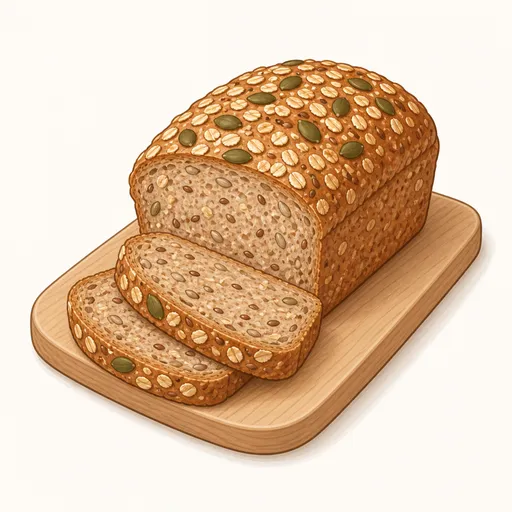
Multigrain bread combines whole wheat flour, oats and a mix of seeds, so every slice is soft yet pleasantly nutty and crunchy to chew. The grains and seeds are soaked first so they don't steal moisture from the crumb. It is the ideal sandwich loaf for a quick breakfast with eggs, peanut butter or cheese.
- Difficulty
- Easy
- Prep
- 30 min
- Cook
- 40 min
- Rising or chilling
- 2 hr 45 min
- Total time
- 3 hr 55 min
- Method
- Oven-baked
Ingredients
Grain soaker
Dough
Seed topping
Instructions
Step 1
Put 40 g rolled oats, 20 g flaxseeds and 30 g sunflower seeds in a small bowl, pour 90 g boiling water over them and cover for about 30 minutes. Soaking softens and hydrates the grains, so the crumb doesn't dry out after baking. The soaker is ready when the grains have absorbed all the water, it feels just barely warm and the flaxseeds have released a light, gel-like coating.
Step 2
In the bowl of a stand mixer, combine 300 g bread flour, 150 g whole wheat flour, 15 g brown sugar and 6 g instant yeast, then add 230 g warm water, 25 g honey, 25 g vegetable oil and finally 9 g salt. Adding the salt last keeps it from touching the yeast directly too early. Stop mixing when the dough comes together in a shaggy mass with no dry flour left.
Step 3
Knead on medium speed for about six minutes, then add all of the soaked grains and knead for four minutes more. Adding the grains later gives the gluten time to form before the hard bits can cut through it. The dough is right when the grains are evenly distributed, the dough is elastic and it stretches into a slightly translucent membrane, even with seeds speckled through it.
Step 4
Shape the dough into a ball, place it in an oiled bowl, cover with plastic wrap and let it rise somewhere warm for about 75 minutes. Whole wheat dough is heavier than white dough, so it needs a long enough rise. It is ready when it has nearly doubled in size and a fingertip dent stays put.
Step 5
Press the dough gently to deflate it slightly, roll it into a rectangle with the short side as long as your loaf pan, then roll it up tightly and pinch the seam closed. Rolling with even pressure keeps holes out of the slices. Place the roll in the oiled pan once the surface is taut and smooth and both ends are neatly tucked under.
Step 6
Lightly brush to taste water over the top of the dough with a pastry brush, then scatter 10 g rolled oats and 10 g pumpkin seeds evenly over it, pressing gently so they stick. The thin layer of water glues the seeds on so they don't fall off when you slice the bread. This step is done when the top is evenly covered with seeds.
Step 7
Set the pan somewhere warm, cover loosely with a towel and let it rise for about 50 minutes, turning the oven on to 190 degrees C in the meantime. The second rise gives the crumb its final lightness. The dough is ready when the top has risen about two centimeters above the rim of the pan.
Step 8
Bake on the middle rack at 190 degrees C for about 35 to 40 minutes, loosely covering with a sheet of foil for the last ten minutes if the seeds darken too soon. Moderate heat cooks the crumb evenly without burning the seeds on top. The bread is done when the crust is golden brown, the bottom sounds hollow when tapped and the center of the crumb reaches about 93 degrees C.
Step 9
Turn the bread out of the pan right away and set it on a wire rack to cool for about one hour. Steam keeps escaping as it cools, and if it stays in the pan the bottom will turn soggy. It is ready to slice when the bottom no longer feels warm and the crumb springs back when pressed.
Equipment
- Oven
- Loaf pan
- Stand mixer
- Kitchen scale
- Mixing bowl
- Bench scraper
- Plastic wrap
- Pastry brush
- Wire cooling rack
Tips
- You can swap the sunflower seeds for chia seeds, sesame seeds or pumpkin seeds, as long as you keep the total amount of seeds and soaking water the same.
- Toasting the sunflower and pumpkin seeds in a skillet before soaking gives the bread a noticeably nuttier aroma.
- For a softer, sandwich-style loaf, you can replace part of the water in the dough with milk.
Storage
The bread keeps for three days at room temperature if you seal it in a plastic bag once it has cooled completely. You can also slice and freeze it for up to a month, then pop the slices straight into the toaster.
Common problems and how to fix them
- The crumb is dry and crumbly when sliced.
- The grains weren't soaked enough, so they drew moisture from the crumb. Soak them in boiling water and give them enough time to absorb all of it before kneading.
- The bread rose poorly and the loaf is low and heavy.
- The gluten was weakened by adding the grains too early or by rising in a cold spot. Knead the dough until smooth before adding the grains, and let it rise somewhere around 27 degrees C.
This recipe is based on the common ratios for this bake and is written entirely in our own words.