Mont Blanc
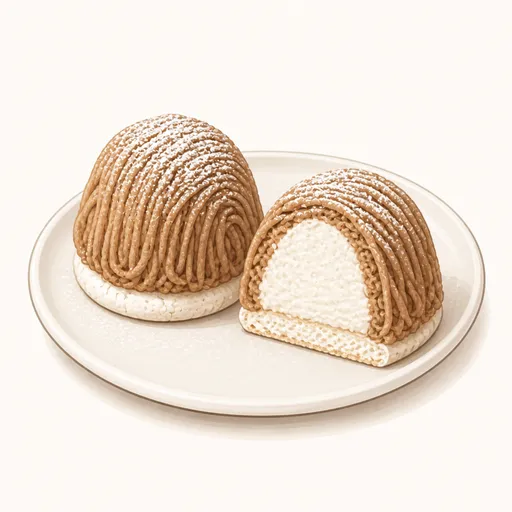
Mont Blanc is named after the highest snow-capped peak in the Alps, with a crisp, airy meringue base (egg whites whipped with sugar), a peak of whipped cream and strands of chestnut cream wound around it like mountain streams. The sweet, nutty chestnut, the cool cream and the crunch of the meringue come together in an elegant autumn dessert.
- Difficulty
- Hard
- Prep
- 50 min
- Cook
- 1 hr 40 min
- Rising or chilling
- 1 hr
- Total time
- 3 hr 30 min
- Method
- Oven-baked
Ingredients
Meringue bases
Chantilly cream
Chestnut cream
Decoration
Instructions
Step 1
Preheat the oven to 100 degrees C, line a baking sheet with parchment paper, draw eight circles about 8 cm across as guides, then flip the paper over. The low heat dries the meringue gradually from the outside in without letting it color. The oven is ready when the thermometer holds steady at the low setting.
Step 2
Whip 100 g egg whites at medium speed until foamy, add 100 g superfine sugar gradually and whip at high speed for about eight minutes, then sift in 100 g powdered sugar and fold gently. The superfine sugar gives a glossy, sturdy meringue, while the powdered sugar makes the bases melt crisply in your mouth. The meringue is right when it shines like satin and the peaks stand straight up.
Step 3
Spoon the meringue into a piping bag with a round tip, pipe a spiral from the center outward to fill each guide circle, then pipe a small ring around the edge. The raised rim keeps the whipped cream from sliding off the base. The bases are right when they are an even thickness of about one centimeter with no gaps.
Step 4
Dry the meringue bases at 100 degrees C for about 90 to 100 minutes. A long, low bake drives off all the moisture so the bases are crisp right through. The meringue is right when it lifts easily off the parchment, sounds crisp when tapped and is still ivory white.
Step 5
Turn off the oven, prop the door open slightly and let the meringues cool slowly inside for about one hour. Slow cooling keeps them from cracking from a sudden change in temperature. The bases are ready when they are completely cool, dry and not sticky to the touch.
Step 6
Put 400 g chestnut puree, 60 g powdered sugar, 50 g softened unsalted butter, 60 g heavy cream and 15 g dark rum, if using, in a blender and blend until smooth. The butter and cream make the chestnut soft and supple enough to pipe into strands. The mixture is right when it is thick and smooth like cream cheese and a light brown color.
Step 7
Use a spatula to press the chestnut cream through a fine sieve into a clean bowl. Sieving removes the tiny fibers that could clog the piping tip. The cream is right when it is perfectly smooth and shows no specks when spread on the back of a spoon.
Step 8
Whip 250 g cold whipping cream with 20 g powdered sugar and 3 g vanilla extract for about four minutes. The cream needs to be stiffer than usual to form a mountain that stands firm. It is right when the peaks stand straight, the surface shows clear ridges and it doesn't slide when you turn the bowl upside down.
Step 9
Pipe a tall cone of whipped cream onto the center of each meringue base, leaving a small border around the edge. The cream cone is the core that gives the chestnut strands their mountain shape. They are right when each cream peak is about five centimeters tall and stands upright.
Step 10
Spoon the chestnut cream into a piping bag fitted with a multi-hole tip and pipe from the base up to the top, spiraling around the cream peak until it is completely covered. The fine strands feel soft and light when you bite in and are the signature of a Mont Blanc. The dessert is right when no white cream shows underneath.
Step 11
Sift a thin layer of to taste powdered sugar over the tops and serve right away, or refrigerate for up to two hours. The powdered sugar evokes snow on the mountain peak. They are finished when the tops are a fine, snowy white and the base is still crisp when you cut into it.
Equipment
- Oven
- Hand mixer
- Piping bag
- Baking sheet
- Parchment paper
- Food processor
- Sieve
- Spatula
- Mixing bowl
- Kitchen scale
- Refrigerator
Tips
- If your chestnut puree is already sweetened, reduce or leave out the powdered sugar in the chestnut cream.
- If you don't have a multi-hole piping tip, you can press the chestnut cream through a potato ricer to make strands.
- Making the meringue bases on a dry day helps them stay crisp longer in humid weather.
Storage
Unassembled meringue bases stay crisp in an airtight container with a desiccant packet for about a week. Assembled desserts should be eaten the same day, as the cream gradually softens the meringue; keep them in the refrigerator and serve within a few hours.
Common problems and how to fix them
- The meringue bases are chewy and sticky in the middle.
- The meringue wasn't dried long enough or the kitchen is too humid. Dry it for twenty minutes more and let it cool completely in the switched-off oven.
- The chestnut strands keep breaking.
- The chestnut cream is too thick or too cold. Add a little more heavy cream and leave it at room temperature for a few minutes before piping.
This recipe is based on the common ratios for this bake and is written entirely in our own words.