Monkey bread
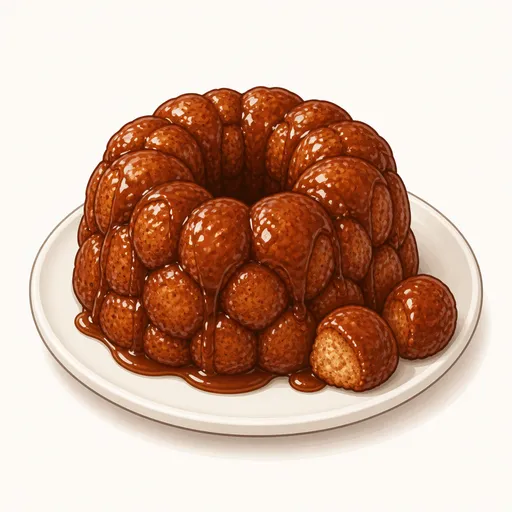
Monkey bread is an American pull-apart bread made of dozens of soft dough balls rolled in melted butter and cinnamon sugar, then piled into a bundt pan (a round pan with a hole in the middle). As it bakes, the brown sugar melts into a glossy caramel that coats every piece. Everyone pulls off pieces by hand while the bread is still warm, which makes it perfect for a weekend breakfast.
- Difficulty
- Easy
- Prep
- 40 min
- Cook
- 35 min
- Rising or chilling
- 1 hr 55 min
- Total time
- 3 hr 10 min
- Method
- Oven-baked
Ingredients
Bread dough
Cinnamon sugar butter coating
Instructions
Step 1
Heat 240 g whole milk, 60 g water and 45 g unsalted butter over low heat until the butter just melts, then turn off the heat and let it cool to about body temperature. Warm liquid gets the yeast working quickly, but liquid that is too hot will kill it. The milk is right when it feels pleasantly warm on your finger, not hot.
Step 2
Put 500 g all-purpose flour, 50 g granulated sugar, 7 g instant yeast and 8 g salt in the bowl of a stand mixer, add 50 g egg and the warm milk mixture, and knead with the dough hook on medium speed for about eight minutes. Kneading long enough develops the gluten so the dough holds gas and the bread turns out soft and fluffy. The dough is right when it is smooth and elastic, pulls away from the sides of the bowl and stretches thin without tearing right away.
Step 3
Shape the dough into a ball, place it in a lightly oiled bowl, cover with plastic wrap and let it rise somewhere warm for about one hour. The rise gives the yeast time to make gas and build flavor. The dough is right when it has doubled in size and a fingertip dent slowly fills back in.
Step 4
Melt 115 g unsalted butter into one bowl, and in another bowl mix 200 g brown sugar with 8 g ground cinnamon. Having both bowls ready lets you coat the dough balls in one smooth run without stopping. You are ready when the butter is completely liquid and the cinnamon sugar is an even brown.
Step 5
Punch down the dough, divide it into about forty equal pieces, each about the size of a small lime, and roll each one into a ball. Same-sized balls bake evenly, so none end up raw while others dry out. The balls are right when they are taut and round, smooth on the surface and nearly equal in weight.
Step 6
Butter a bundt pan thoroughly, dip each dough ball in the melted butter, roll it in the cinnamon sugar and stagger the balls in the pan in three to four layers, then pour the remaining butter and sugar over the top. Staggering helps the balls cling together and lets the caramel seep into every gap. The layering is right when all the balls are evenly coated in cinnamon sugar and fill about half the height of the pan.
Step 7
Cover the pan with plastic wrap and let it rise somewhere warm for about forty-five minutes more. The second rise makes the balls swell and press against each other, forming one seamless loaf. The dough is right when the balls have puffed up and risen almost to the rim of the pan.
Step 8
While the dough has its second rise, preheat the oven to 175 degrees C and set a rack in the middle. Place a tray underneath to catch any caramel that bubbles over onto the oven floor. The oven is ready when it has preheated for at least fifteen minutes.
Step 9
Bake at 175 degrees C for about 30 to 35 minutes, loosely tenting the top with foil if it browns too quickly. A bundt pan is deep, so the balls at the bottom need enough time to cook through. The bread is done when the top is deep brown, the caramel bubbles around the edges and a thermometer inserted in the center reads about 90 degrees C.
Step 10
Let the bread rest in the pan for about ten minutes, set a large plate over the top, then flip it over in one confident motion and lift off the pan. Flip it while the caramel is still warm and runny so the bread comes out whole; if it cools, the caramel sets and sticks to the pan. It is finished when it stands in one piece on the plate, coated in glossy caramel, and the balls pull apart easily.
Equipment
- Oven
- Bundt pan
- Stand mixer
- Small saucepan
- Mixing bowl
- Kitchen scale
- Bench scraper
- Plastic wrap
- Wire cooling rack
Tips
- You can let the assembled pan rise overnight in the refrigerator, then leave it at room temperature for an hour the next morning before baking.
- Sprinkling chopped pecans between the layers adds a nutty flavor and a pleasant crunch.
- Drizzling a little cream cheese mixed with powdered sugar over the warm bread is a crowd-pleasing way to serve it.
Storage
Monkey bread is best eaten warm on the day it is made. Wrap any leftovers tightly and keep them at room temperature for up to two days; reheat in the microwave for about twenty seconds to soften the caramel again.
Common problems and how to fix them
- The bread stuck to the pan when flipped.
- The pan wasn't buttered enough, or you waited too long and the caramel set. Butter every groove of the pan thoroughly and flip the bread after exactly ten minutes.
- The balls at the bottom of the pan are raw and doughy.
- The bread wasn't baked long enough or the pan was too full. Check with a thermometer, and only fill the pan halfway with dough.
This recipe is based on the common ratios for this bake and is written entirely in our own words.