Macarons
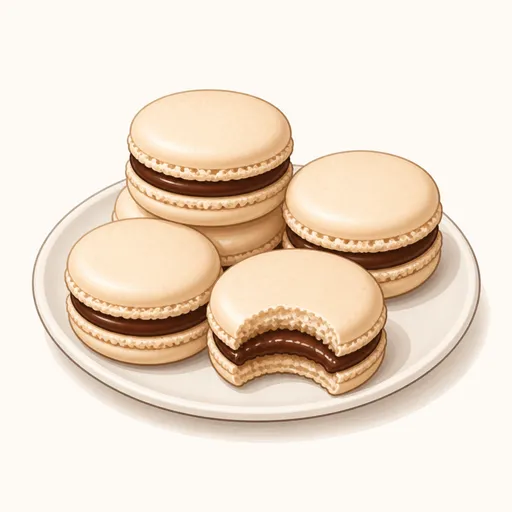
Macarons are small French cookies made of two almond shells, thin and crisp outside and chewy inside, sandwiched with ganache (chocolate melted with heavy cream). They're famously finicky because they demand precise weighing and just the right amount of mixing, but when you succeed, you'll see the beautiful ruffled "feet" around the base of every shell.
- Difficulty
- Very hard
- Prep
- 1 hr
- Cook
- 32 min
- Rising or chilling
- 2 hr
- Total time
- 3 hr 32 min
- Method
- Oven-baked
Ingredients
Shells
Chocolate ganache filling
Instructions
Step 1
Line two baking sheets with parchment paper, slip a template underneath with circles about 3.5 cm across drawn 3 cm apart, and fit a piping bag with a plain round tip. The circle template keeps every shell the same size so they pair up perfectly. The sheets are ready when the parchment lies flat and you can see the circles clearly through it.
Step 2
Sift 100 g almond flour together with 100 g powdered sugar through a fine sieve, discarding any coarse bits left behind. A very fine mixture gives the shells smooth, glossy tops without bumps. It's ready when it's light and airy, evenly colored and free of lumps.
Step 3
Whip 85 g egg whites on low speed until foamy, add 0.5 g cream of tartar, then gradually sprinkle in 70 g superfine sugar while increasing to medium speed. Adding the sugar slowly makes the meringue (egg whites whipped with sugar) firm and fine-textured. The meringue is ready when it's glossy and smooth and the peaks stand straight up when you lift the beaters.
Step 4
Add the almond mixture to the meringue in two additions, using a spatula to press the batter against the side of the bowl and then scrape and fold it back over, repeating until combined. This pressing step, called macaronage, knocks out some of the air so the shells bake up with flat tops and feet. The batter is just right when it flows in an unbroken ribbon like lava and the trail it leaves melts back into the surface within about ten seconds.
Step 5
Spoon the batter into the piping bag, hold the tip straight up about one centimeter above the sheet and squeeze evenly until the batter fills each circle, then stop squeezing and give a little flick as you lift away. Then rap the sheet firmly on the counter a few times to drive out large air bubbles. The shells are right when they're evenly round with flat tops and no pointed tips.
Step 6
Leave the sheets in a cool, airy spot for about 30 to 45 minutes so the tops can dry, preheating the oven to 150°C in the meantime. The dry skin on top forces steam to escape out the bottom, forming the ruffled feet. They're ready when a light fingertip touch on top feels dry and not sticky.
Step 7
Bake one sheet at a time on the middle rack at 150°C for 14 to 16 minutes, without opening the oven door for the first ten minutes. Low, steady heat lets the shells rise evenly without browning. They're done when the feet have clearly formed and the shells no longer wobble on their feet when nudged gently.
Step 8
Heat 70 g heavy cream over low heat until it bubbles gently at the edges, pour it over 80 g finely chopped dark chocolate, wait one minute, then stir from the center outward and add 10 g butter. The hot cream melts the chocolate gradually so the filling is smooth and doesn't split. The ganache is ready when it's glossy and silky, and once cooled it thickens just enough to pipe in peaks.
Step 9
Pair up shells of the same size, pipe a dot of ganache onto the flat side of one shell, then top it with the other and press gently so the filling spreads to the edges. Put the macarons in an airtight container and refrigerate for at least 12 hours, as the filling moistens the inside of the shells, making them chewier and more flavorful. They're ready when the outside of the shells is still lightly crisp and the inside is soft and chewy when you bite in.
Equipment
- Oven
- Hand mixer
- Piping bag
- Sieve
- Spatula
- 0.1 g precision scale
- Baking sheet
- Parchment paper
- Small saucepan
- Mixing bowl
Tips
- Egg whites separated ahead and kept in the fridge for one to two days lose some water, which makes the meringue more stable. Just bring the whites back to room temperature before whipping.
- To color the shells, use gel or powdered food coloring and add it to the meringue at the end of whipping, because liquid coloring will thin the batter.
- Every oven runs at a different real temperature, so bake a test batch of five or six shells before baking a full sheet.
Storage
Filled macarons are best kept in an airtight container in the fridge for three to five days. Let them sit out for about twenty minutes before eating so the filling softens. Unfilled shells can be frozen for up to a month.
Common problems and how to fix them
- The shells are hollow, with a gap under the tops.
- The meringue was overwhipped and dry, or the oven was too hot, making the shells puff up quickly and then collapse inside. Stop whipping as soon as the peaks just stand up, and check your oven temperature with a thermometer.
- The shells have no feet and the tops crack.
- The tops weren't dry enough before baking, or the air bubbles weren't fully tapped out. Let the shells dry longer, especially on humid days, and rap the sheet harder after piping.
- The shells spread out wide and turn thin and flat.
- The batter was overmixed and became too runny. Next time, check how the batter flows every few strokes and stop as soon as it just flows in a ribbon.
This recipe is based on the common ratios for this bake and is written entirely in our own words.