Kouign-amann
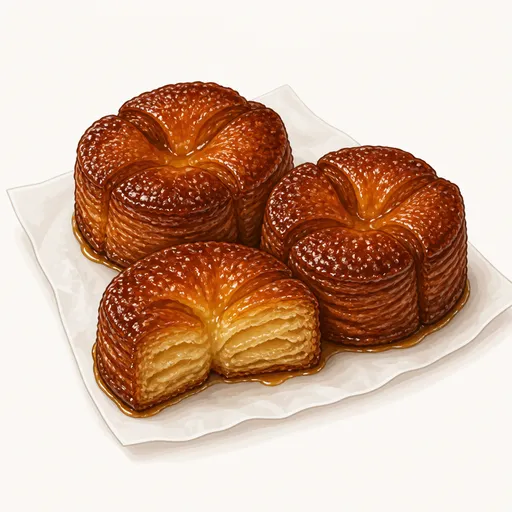
Kouign-amann is a specialty of Brittany in France, and its name simply means "butter cake." A yeasted dough is rolled and folded with generous amounts of butter and sugar, and in the oven the sugar melts into a crisp caramel shell around soft, fragrant layers. It's a challenging bake, but the result is worth every minute of effort.
- Difficulty
- Very hard
- Prep
- 1 hr
- Cook
- 30 min
- Rising or chilling
- 3 hr 15 min
- Total time
- 4 hr 45 min
- Method
- Oven-baked
Ingredients
Yeast dough
Butter and sugar for laminating
Coating the tin
Instructions
Step 1
Combine 300 g all-purpose flour, 4 g instant yeast and 6 g salt, pour in 190 g water along with 20 g softened butter, and knead for about eight minutes. Knead just until smooth but not overly elastic, which makes the laminating easier later on. The dough is ready when the surface is glossy, springy and no longer sticks to your hands.
Step 2
Shape the dough into a ball, place it in a lightly oiled bowl, cover tightly and leave it somewhere warm for about forty-five minutes. This first bit of yeast activity builds flavor and makes the dough softer to roll. It's ready when it has grown by about half its original size.
Step 3
Press the dough flat, roll it into a square about two centimeters thick, wrap it well and refrigerate for thirty minutes. Chilled dough is close to the temperature of the butter, so the two layers roll out together without breaking. The dough is ready when it's cold all the way through and slightly firm.
Step 4
Place 200 g cold butter between two sheets of parchment paper, then pound and roll it into a flat square about 15 cm on each side and return it to the fridge. Butter that is pliable yet still cold spreads into an unbroken layer inside the dough. The butter is ready when it bends without snapping and without turning soft and greasy.
Step 5
Roll the dough into a square one and a half times the size of the butter block, set the butter diagonally in the center, then fold the four corners of the dough over it like an envelope and pinch the seams closed. Fully sealed butter won't poke out as you roll. The packet is ready when the butter sits snugly inside and all the seams are firmly sealed.
Step 6
Roll the packet into a rectangle three times as long as it is wide, fold it in thirds like a letter, wrap it and refrigerate for thirty minutes. This first fold, without sugar, lays the foundation for even butter layers. The dough is right when the edges are neat and square and you can't see any broken patches of butter.
Step 7
Sprinkle half of the 200 g sugar over the work surface and the dough, roll it into a rectangle and fold it in thirds again, chill for thirty minutes, then repeat with the remaining sugar. Sugar pressed between the layers melts into caramel in the oven. The dough is ready when the sugar coats the surface completely and you can still clearly see the layers after rolling.
Step 8
On a sugared work surface, roll the dough into a rectangle about six to seven millimeters thick, then use a sharp knife to cut it into twelve squares about 10 cm on each side. Work quickly, because the sugar draws in moisture and makes the dough sticky. The squares are ready when the cut edges are crisp and the layers clearly visible.
Step 9
Brush the cups of a muffin tin with butter (to taste) and sprinkle 30 g sugar into each cup, then fold the four corners of each square into the center and set it in the tin. The sugar on the bottom gives the pastries a crisp caramel crust all the way around. They're ready when each one sits snugly in its cup like a four-petaled flower.
Step 10
Loosely cover the tin with plastic wrap and let the pastries rise at cool room temperature for about forty minutes, preheating the oven to 200°C in the meantime. The proofing spot must not be too warm, or the butter will melt out before the pastries go into the oven. They're ready when they look slightly puffy and a fingertip pressed into the dough leaves a dent that springs back slowly.
Step 11
Bake at 200°C for 25 to 30 minutes, with an extra tray on the rack below to catch any butter and sugar that bubbles over. The high heat caramelizes the sugar into an amber crust. They're done when the tops and edges are a deep mahogany brown and the sugar is bubbling around the base.
Step 12
Take the tin out, wait a minute or two, then use tongs to lift each pastry onto parchment paper while still hot. As the caramel cools it hardens and glues the pastries to the tin. They're finished when the bottoms are coated in glossy, crunchy caramel and the pastries stand steady on the paper.
Equipment
- Oven
- Muffin tin
- Rolling pin
- Bench scraper
- Mixing bowl
- Kitchen scale
- Parchment paper
- Plastic wrap
- Refrigerator
Tips
- Keep the dough and butter cold at all times; if the butter starts to soften and smear as you roll, put the dough back in the fridge for another fifteen minutes.
- Use a metal muffin tin rather than paper liners so the caramel can form evenly all around the pastries.
- Don't leave the sugared dough sitting too long before baking, because the sugar draws out moisture and makes the dough weep.
Storage
Kouign-amann is best within a few hours of baking, while the caramel is still crisp. Keep leftovers in an open container at room temperature and reheat them at 180°C for about five minutes; avoid the fridge, as the caramel will turn damp and sticky.
Common problems and how to fix them
- Butter pools all over the tray and the pastries turn out dry.
- The pastries proofed somewhere too warm, or the butter layer broke during rolling. Proof them in a cool spot and keep the dough cold throughout the folding.
- The pastries stick fast to the tin once cooled.
- The caramel has set in the tin. Unmold the pastries within the first few minutes while they're still hot, using a thin knife around the edges of each cup if needed.
- The pastries have no layers and are dense like bread.
- The butter was too soft and blended into the dough. Next time, roll the butter while it's cold but pliable, and chill the dough long enough between each fold.
This recipe is based on the common ratios for this bake and is written entirely in our own words.