Irish soda bread
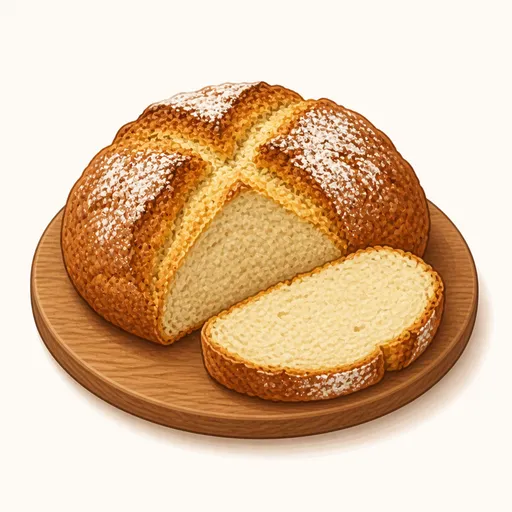
Soda bread is Ireland's everyday loaf, made with just four basic ingredients: flour, baking soda, salt and tangy buttermilk. There's no yeast and no rising time; the bread rises from the reaction between the baking soda and the acidity of the buttermilk, so it goes from mixing bowl to finished loaf in under an hour. The crust is crisp and hard and the crumb dense and soft, and it's best eaten warm with salted butter.
- Difficulty
- Very easy
- Prep
- 10 min
- Cook
- 40 min
- Rising or chilling
- 30 min
- Total time
- 1 hr 20 min
- Method
- Oven-baked
Ingredients
For the dough
Flour for dusting
Instructions
Step 1
Preheat the oven to 230°C for at least twenty minutes before baking, and dust the bottom of a round pan with a thin layer of flour. Soda bread needs high heat right from the start so the baking soda can do its work and the crust forms quickly. The oven is ready when it has reached temperature and the indicator light goes off.
Step 2
Sift 500 g all-purpose flour, 6 g baking soda and 8 g salt into a large bowl, then toss it a few times with your hand, lifting from the bottom, until thoroughly mixed. The baking soda must be spread evenly through the flour, or the bread will have yellow spots and a bitter taste. The mixture is ready when it is fine and loose with no small lumps.
Step 3
Make a well in the center, pour in most of the 420 g buttermilk, and stir in circles from the center outward with your hand spread like a claw, adding the rest of the buttermilk if the dough is still dry. Work quickly, because the reaction that makes the gas starts as soon as the buttermilk touches the baking soda. The dough is ready when it just comes together into a soft, slightly sticky mass with no dry flour left at the bottom of the bowl.
Step 4
Turn the dough out onto a counter dusted with a little of the all-purpose flour for dusting (to taste), fold it gently two or three times, and pat it into a round about four centimeters thick, then set it in the pan. Don't knead it like a yeast bread; too much kneading makes it tough and knocks out the gas. The round is ready when it is neat, slightly rough on top, and still soft when pressed.
Step 5
Use a sharp knife to cut a deep cross almost halfway through the dough, running all the way from one edge to the other. The cuts help heat reach the center faster, and traditionally they divide the loaf into four parts. You're done when the four quarters open slightly along the cuts.
Step 6
Put the pan in the oven and bake at 230°C for the first 15 minutes. This high-heat stage makes the bread burst open along the cuts and forms a hard crust. Move on to the next step once the quarters have clearly puffed up and the top is starting to color.
Step 7
Lower the oven to 200°C and bake for another 20 to 25 minutes, until the bread is cooked through to the center. The lower heat cooks the crumb without burning the crust. The bread is done when the crust is a deep golden brown and the bottom sounds hollow, like knocking on a wooden door, when tapped.
Step 8
Move the bread to a wire rack and let it cool for about thirty minutes; if you like a soft crust, wrap it in a clean towel while it's still hot. The crumb is still cooking in its own steam, so cutting too early will leave it gummy on the knife. The bread is ready when it is just slightly warm and the cut slices look dry.
Equipment
- Oven
- Round cake pan
- Mixing bowl
- Spatula
- Sieve
- Kitchen scale
- Wire cooling rack
Tips
- If you don't have buttermilk, stir about two tablespoons of lemon juice into each half liter of whole milk and let it sit for ten minutes until slightly thickened.
- The traditional brown version uses half whole wheat flour; just add a little more buttermilk, since whole wheat flour absorbs more liquid.
- Add raisins and a little sugar to the dough to make spotted dog, a lightly sweet loaf the Irish adore.
Storage
Soda bread is best on the day it's baked; wrapped in a towel or paper bag, it keeps for two days at room temperature. Day-old bread is still wonderful toasted, and you can freeze individual slices for up to a month.
Common problems and how to fix them
- The bread is heavy, dense and didn't rise.
- The dough was kneaded too much or sat too long before going into the oven. Mix just enough, shape quickly, and get it into the oven as soon as the dough comes together.
- The bread tastes bitter or has yellow spots in the crumb.
- The baking soda was lumpy or you used too much. Weigh it accurately and sift it with the flour so it disperses evenly.
This recipe is based on the common ratios for this bake and is written entirely in our own words.