Galette des rois
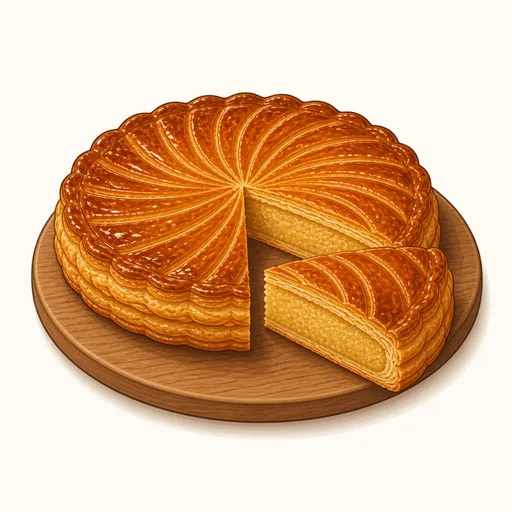
Galette des rois, or king cake, is the cake French families share for Epiphany in early January. Two golden layers of puff pastry encase a frangipane filling (a rich, fragrant almond cream), and the top is scored with a pattern and brushed with a glossy syrup. By tradition, a small bean is hidden in the filling, and whoever finds it gets to wear the crown.
- Difficulty
- Hard
- Prep
- 1 hr
- Cook
- 45 min
- Rising or chilling
- 3 hr
- Total time
- 4 hr 45 min
- Method
- Oven-baked
Ingredients
Puff pastry
Flour for dusting
Almond cream filling (frangipane)
Egg wash
Glossy syrup
Instructions
Step 1
Toss 225 g cold unsalted butter cut into small cubes with 300 g all-purpose flour and 5 g salt, drizzle in 150 g ice water and gather it into a rough dough, then wrap it tightly and chill for about thirty minutes. Keeping the butter in whole pieces creates crisp layers in the oven. The dough is ready when it holds together and you can still see distinct pale yellow patches of butter.
Step 2
Dust the counter with flour, roll the dough into a long strip and fold it in thirds, repeating for six turns in total and chilling for thirty minutes after every two turns. Alternating folding and resting keeps the butter from melting and the layers even. The pastry is finished when it is smooth, has fine streaks of butter and rolls out easily without shrinking back.
Step 3
Beat 100 g softened unsalted butter with 100 g powdered sugar until light and fluffy, then add 100 g eggs, 100 g almond flour, 10 g cornstarch, 10 g dark rum and a pinch almond extract in turn. Cornstarch helps the filling hold its shape so it doesn't leak out in the oven. The frangipane is ready when it is smooth and fluffy and can be scooped into a mound without running.
Step 4
Divide the pastry in two, making the piece for the lid slightly larger, roll each one about three millimeters thick and cut out two circles: a 24 cm base and a 26 cm lid. The larger lid can stretch over the domed filling without being pulled tight. You are done when you have two flat, evenly round circles with clean, sharp edges.
Step 5
Place the base on a parchment-lined baking sheet, spoon the filling into a piping bag and pipe it in a spiral in the center, leaving a border about three centimeters wide, then hide the lucky bean in the filling if you like. The bare border is where the lid gets sealed, and if any filling gets on it, the galette will open up. You are done when the filling forms an even, thick round and the border is still clean.
Step 6
Brush a little egg wash on the border, lay the lid on top, smooth it from the center outward to push out all the air, then press the edges firmly and use the back of a knife to make small notches all around the rim. Put the whole tray in the fridge for about thirty minutes. The galette is ready when the edges are sealed tight, there are no air pockets and the pastry is firm and cold.
Step 7
Preheat the oven to 200°C, brush the top of the galette with a mixture of 18 g egg yolks and 5 g whole milk, let it dry for a few minutes and brush on a second coat, then use the tip of a knife to score a pattern of curves or diamonds and poke a small hole in the center. The steam vent keeps the galette from puffing up and splitting at the edges. You are done when the pattern is clearly visible without cutting all the way through the pastry.
Step 8
Bake the galette at 200°C for about 12 to 15 minutes so the pastry puffs up quickly. The initial high heat makes the layers separate and hold their rise. This stage is done when the galette has clearly puffed and the top is starting to turn pale golden.
Step 9
Lower the oven to 180°C and bake for another 25 to 30 minutes so the filling and the bottom cook through. Lowering the heat keeps the top from burning while the almond filling bakes evenly. The galette is done when the top is a deep golden brown, the edges are crisp and the bottom looks dry and golden when you lift the tray.
Step 10
While the galette bakes, heat 20 g granulated sugar with 20 g water over medium heat until the sugar dissolves, then brush a thin layer of syrup over the top as soon as the galette comes out of the oven. Hot syrup on hot pastry dries quickly into a mirror-like shine. The galette is finished when the top glistens and the pattern stands out clearly.
Equipment
- Oven
- Rolling pin
- Bench scraper
- Hand mixer
- Spatula
- Piping bag
- Pastry brush
- Baking sheet
- Parchment paper
- Kitchen scale
- Plastic wrap
- Refrigerator
Tips
- If you hide a bean or a small porcelain figurine in the filling, remind everyone to eat slowly so nobody bites down on it.
- You can assemble the galette ahead and freeze it; when you are ready to bake, just brush it with egg wash and put it straight into the oven, adding about ten minutes.
- The frangipane is even richer with a little pastry cream (crème pâtissière) folded in, but the almond-cream-only version keeps the traditional flavor.
Storage
The galette is best on the day it is baked, kept at room temperature and loosely covered. You can keep it in the fridge for two days and reheat it at 170°C for about ten minutes to crisp the pastry again.
Common problems and how to fix them
- The filling leaks out at the edges during baking.
- The edges weren't sealed tightly or filling got onto the border. Leave a clean border, brush on a thin layer of egg wash and press the edges very firmly before chilling.
- The galette rises unevenly and the top warps.
- Air was trapped between the two layers or there was no steam vent. Smooth the lid carefully from the center to the edges and remember to poke a small hole in the center.
- The bottom is still pale and soft.
- The galette wasn't baked long enough or the tray was too high in the oven. Move the tray to the lower rack for the last ten minutes or bake it on a preheated baking sheet.
This recipe is based on the common ratios for this bake and is written entirely in our own words.