Fruit tart
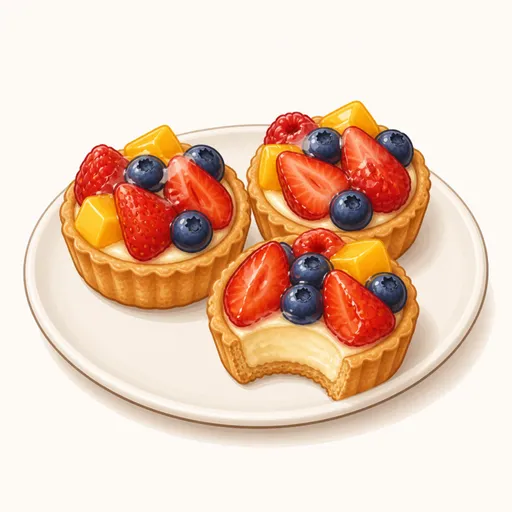
These pretty little fruit tarts have crisp, buttery shells filled with a light, cool diplomat cream (pastry cream folded with whipped cream) and piled high with strawberries, blueberries, raspberries and ripe mango. Each one is just one or two bites, which makes them perfect for parties. The bright fruit under a glossy jam glaze makes them look like they came straight from a bakery.
- Difficulty
- Medium
- Prep
- 1 hr 10 min
- Cook
- 30 min
- Rising or chilling
- 2 hr 45 min
- Total time
- 4 hr 25 min
- Method
- Oven-baked
Ingredients
Tart shells
Diplomat cream
Fruit
Glaze
Instructions
Step 1
Mix 250 g all-purpose flour, 80 g powdered sugar and a pinch salt, then add 125 g cold unsalted butter cut into small cubes and rub it in with your fingertips. Rubbing the butter in coats the flour with fat and limits gluten, so the shells turn out crisp and crumbly like a cookie. The mixture is ready when it looks like fine damp sand with no large lumps of butter left.
Step 2
Beat 50 g eggs with 3 g vanilla extract, pour it into the center of the flour mixture and cut it in with a spatula, then smear the dough lightly across the counter with the heel of your hand two or three times. This gentle smearing brings the butter and flour together without kneading. The dough is ready when it is smooth, even in color and holds together in a ball.
Step 3
Shape the dough into a flat rectangle, wrap it tightly and refrigerate for about an hour. Chilled dough is easier to cut and shrinks less in the oven. It is ready when it is firm but still bends without breaking.
Step 4
Roll the dough out about three millimeters thick and use a round cutter about two centimeters wider than your tart molds to cut twelve rounds. Cutting them wider than the molds gives you enough dough to cover both the bottom and the sides. This step is done when you have enough neat, untorn rounds.
Step 5
Place each round in an 8 cm tartlet mold, press it gently so it hugs the bottom and sides, then trim the edge flush with a knife. Prick the bottoms with a fork so they don't puff up. The shells are ready when the sides are fully covered and the dough is level with the rim.
Step 6
Set the lined molds on a tray and freeze for about fifteen minutes. Frozen shells keep their sides upright and their fluted edges sharp in the oven. They are ready when they feel firm when tapped.
Step 7
Heat the oven to 180°C and set a rack in the middle so the tarts get even heat from above and below. Small shells bake quickly, so the oven has to be fully hot from the start. The oven is ready when the temperature inside has stabilized.
Step 8
Bake the shells at 180°C for about 15 to 18 minutes, rotating the tray halfway through. Rotating keeps the shells in the corners of the oven from browning more than those in the middle. They are done when the edges are golden brown, the bottoms are dry and they pull away from the sides of the molds on their own.
Step 9
Warm 350 g whole milk, whisk 72 g egg yolks with 75 g granulated sugar and 30 g cornstarch, then temper the hot milk into the yolks and cook over medium heat, whisking constantly. Once the cream boils, take it off the heat and whisk in 20 g unsalted butter and 4 g vanilla extract. Cornstarch has to boil to cook through and give the cream a thick, stable set. The cream is ready when it is glossy and thick and leaves a clear trail when you drag the whisk through it.
Step 10
Scrape the cream into a shallow dish, press plastic wrap directly onto the surface and refrigerate for about an hour and a half. A thin layer cools quickly, which is safer and keeps a skin from forming. The cream is ready when it is cold all the way through to the center.
Step 11
Whip 150 g cold whipping cream to soft peaks, then whisk the pastry cream until loose and fold in the whipped cream in two additions. The whipped cream makes the filling lighter and cooler than plain pastry cream. The diplomat cream is ready when it is even in color, smooth and holds its shape on a spoon.
Step 12
Gently rinse and pat dry 200 g fresh strawberries, 100 g fresh blueberries and 100 g fresh raspberries, then peel and dice 150 g ripe mangoes. Dry fruit won't water down the cream. This step is done when all the fruit is cut into bite-size pieces and kept separate by type.
Step 13
Spoon the diplomat cream into a piping bag, pipe it into each shell until level with the rim, then pile the fruit generously on top. Piping keeps the filling even and the cream neat. The tarts are ready when each one has a smooth layer of cream and the fruit covers the whole top.
Step 14
Heat 60 g fruit jam with 15 g water over low heat until thin, strain out any solids and brush it lightly over the fruit. A thin layer of jam keeps the fruit looking fresh and stops it from wilting. The tarts are finished when the fruit glistens and the cream underneath is still clean.
Equipment
- Oven
- Tart pan
- Cookie cutter
- Rolling pin
- Small saucepan
- Whisk
- Hand mixer
- Piping bag
- Pastry brush
- Baking sheet
- Plastic wrap
- Refrigerator
- Kitchen scale
Tips
- Baked tart shells keep in an airtight container for up to three days, so you can spread the work over several sessions.
- Choose fruit in contrasting colors such as red, purple and yellow to make the tarts more eye-catching.
- Avoid leaving fresh pineapple or kiwi on the cream for long, because the enzymes in the fruit can make the cream turn watery.
Storage
The tarts are best eaten the same day while the shells are still crisp. If needed, keep them in a covered container in the fridge for up to one day; the cream and the baked shells can be stored separately for longer.
Common problems and how to fix them
- The shells shrink and sit below the rim of the molds.
- The dough was stretched while lining the molds or wasn't chilled long enough. Ease the dough gently into the molds, pressing rather than pulling, and freeze the shells before baking.
- The diplomat cream is runny and loose.
- The cream wasn't whipped enough or the pastry cream was still warm when you folded them together. Let the pastry cream chill completely and whip the cream until it holds soft peaks.
This recipe is based on the common ratios for this bake and is written entirely in our own words.