French crepes
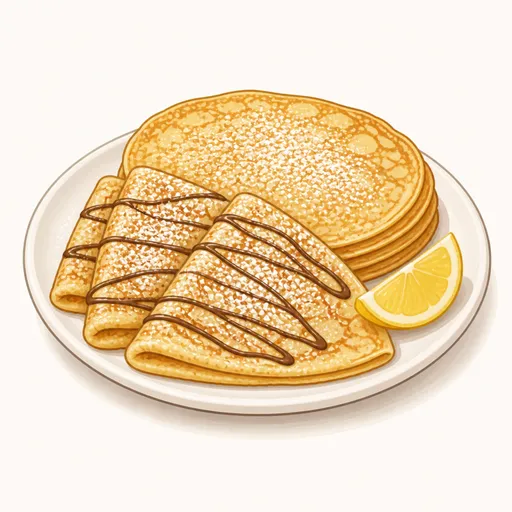
Crepes are silky-thin pancakes that come from Brittany in France. They're soft and fragrant with butter and egg, with slightly crisp, lacy edges, and you can roll them up with sugar and lemon, jam, chocolate or whipped cream. The batter is very easy to make; just let it rest long enough and keep the pan at medium heat.
- Difficulty
- Easy
- Prep
- 15 min
- Cook
- 30 min
- Rising or chilling
- 1 hr
- Total time
- 1 hr 45 min
- Method
- Pan-cooked or waffle iron
Ingredients
For the crepe batter
Oil for the pan
Instructions
Step 1
Sift 250 g all-purpose flour into a large bowl, mix in 25 g granulated sugar and a pinch salt, then make a well in the center. The well lets you work the liquid in gradually so the batter doesn't turn lumpy. The bowl is ready when the dry mix is light and loose and the well is big enough to hold the eggs.
Step 2
Crack 200 g eggs into the well and whisk from the center outward to gradually draw in the flour, then pour in 500 g whole milk in a thin stream while whisking constantly. Adding the milk a little at a time keeps the batter smooth from the start. The batter is ready when it's as thin as heavy cream with no lumps of flour left.
Step 3
Melt 40 g unsalted butter over low heat until it turns light golden brown and smells nutty, then stir it into the batter along with 4 g vanilla extract if using. Brown butter makes the crepes more fragrant and helps them stick less to the pan. The batter is ready when it's evenly glossy with no streaks of butter floating on top.
Step 4
Cover the bowl with plastic wrap and let the batter rest in the fridge for at least 60 minutes, or overnight. Resting lets the starch absorb the liquid and the bubbles disappear, so the crepes turn out thinner and more tender. The batter is ready when it has thickened slightly; if it's too thick, whisk in a little more milk.
Step 5
Heat a 22 cm nonstick pan over medium heat for about two minutes, dab a paper towel in to taste vegetable oil and wipe a very thin layer over the pan. A hot enough pan sets the batter the instant it touches the surface, creating pretty little holes. The pan is ready when a drop of water sizzles gently and evaporates immediately.
Step 6
Lift the pan off the heat, pour a small ladle of batter into the center and tilt and swirl with your wrist so the batter covers the bottom of the pan in a thin layer, then return it to the heat for about a minute. Working quickly makes the crepe evenly thin before the batter sets. The top is ready when it looks dry and matte and the edges curl up on their own and turn golden.
Step 7
Slide a thin spatula under the edge of the crepe, flip it quickly and cook the other side for about 30 seconds more. The second side only needs to cook through, so don't leave it long or the crepe will turn dry and stiff. The crepe is done when the underside has small golden brown spots and it slides easily in the pan.
Step 8
Stack the crepes on a plate and cover with a clean towel, then keep cooking the rest of the batter, wiping the pan with oil every few crepes. The warmth of the stack keeps the crepes soft rather than rubbery. They're ready when you can fold one into quarters without it cracking, and you can serve them right away with any filling you like.
Equipment
- Nonstick skillet
- Whisk
- Mixing bowl
- Sieve
- Spatula
- Kitchen scale
- Plastic wrap
- Refrigerator
Tips
- The first crepe often doesn't look great because the pan's heat hasn't settled yet; don't be discouraged, just adjust the heat for the following ones.
- For a quick smooth batter, you can put all the ingredients in a blender and blend for about ten seconds.
- To make savory crepes, simply leave out the sugar and vanilla and keep everything else the same.
Storage
Layer cooled crepes between sheets of parchment paper, wrap tightly and keep them in the fridge for three days or the freezer for a month. To serve, warm each crepe in a hot pan for about twenty seconds per side.
Common problems and how to fix them
- The crepes tear when flipped.
- The batter didn't rest long enough or the underside wasn't cooked yet. Let the batter rest for at least an hour and wait until the edges curl up on their own before flipping.
- The crepes are thick and rubbery like pancakes.
- The batter is too thick or you poured too much. Whisk in a little more milk until the batter is as thin as heavy cream and pour just enough to coat the pan in a thin layer.
This recipe is based on the common ratios for this bake and is written entirely in our own words.