Fougasse
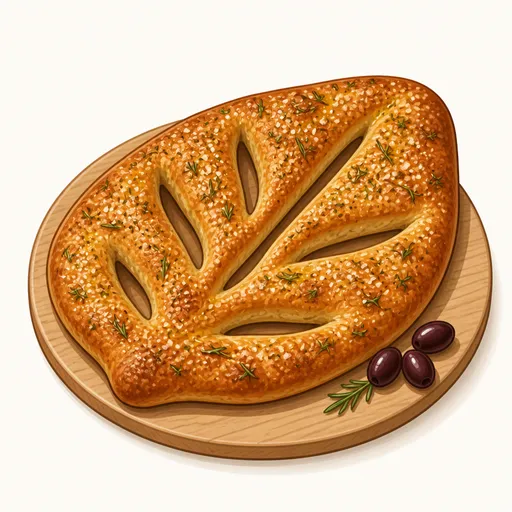
Fougasse is a flatbread from Provence in France, slashed with openings that make it look like a leaf or an ear of wheat. Thanks to all those edges, it has plenty of crisp crust fragrant with olive oil and a thin, soft crumb, and it's perfect for tearing and eating with cheese or soup.
- Difficulty
- Medium
- Prep
- 30 min
- Cook
- 20 min
- Rising or chilling
- 2 hr 15 min
- Total time
- 3 hr 5 min
- Method
- Oven-baked
Ingredients
For the dough
For the topping
Instructions
Step 1
Put 500 g bread flour, 5 g instant yeast and 10 g salt in the bowl of a stand mixer, add 340 g warm water along with 20 g olive oil and knead with the dough hook on low speed for about eight minutes. Kneading long enough builds the gluten network so the bread holds its openings when stretched. The dough is ready when it's smooth and elastic and a small piece stretches thin enough to be almost translucent.
Step 2
Shape the dough into a round ball, place it in a lightly oiled bowl, cover tightly and let it rise somewhere warm for about an hour and a half. This rise gives the yeast time to make gas and develop the wheat flavor. The dough is ready when it has doubled in size and a fingertip dent springs back very slowly.
Step 3
Turn the dough out onto the counter, divide it into two equal pieces, shape each gently into an oval, then cover with a towel and let them rest for about 15 minutes. Relaxed gluten makes the dough easy to shape without it shrinking back. The dough is ready when it's soft, the surface is smooth and taut and it no longer springs back when pressed.
Step 4
Set each piece on parchment paper, press and stretch it by hand into a triangle or teardrop about 1.5 cm thick, then use a dough scraper to cut one line down the middle and three or four diagonal cuts on each side like the veins of a leaf, and stretch the openings wide. The openings must be wide, because the dough will rise again and close them up if they're too narrow. The shape is right when it clearly looks like a leaf with openings about 3 cm wide.
Step 5
Cover the shaped dough loosely with plastic wrap and let it proof for about 30 minutes more. This short proof makes the bread puff slightly so the crumb isn't dense. It's ready when it has risen by about half and the openings are still clearly open.
Step 6
During the second proof, put an upside-down baking sheet in the oven and heat the oven to 230°C. The hot sheet makes the bottom of the bread puff and crisp the moment it touches it. The oven is ready when it has been heating for at least twenty minutes.
Step 7
Brush 25 g olive oil over the bread, sprinkle with 6 g chopped mixed fresh herbs such as rosemary, press in 60 g sliced pitted Kalamata olives if using and sprinkle with to taste flaky sea salt. The oil gives a golden, crisp crust while the herbs release their aroma as the bread bakes. The top is ready when it's evenly glossy with oil and the herbs are stuck firmly to the dough.
Step 8
Slide the parchment and bread onto the hot sheet and bake at 230°C for 16 to 20 minutes. A very hot oven cooks this thin bread quickly, so the crust crisps without drying out the crumb. It's done when it's a deep golden brown, the edges of the openings are darker and the bottom sounds hollow when tapped.
Step 9
Move the fougasse to a rack and let it cool for about ten minutes before tearing into it. Letting the steam escape keeps the crust crisp instead of soft and soggy. It's ready when it's just warm to the touch and tears open to show a soft crumb with even air holes.
Equipment
- Oven
- Baking sheet
- Parchment paper
- Stand mixer
- Mixing bowl
- Bench scraper
- Pastry brush
- Kitchen scale
- Plastic wrap
Tips
- Rosemary, thyme and oregano are the classic herbs of Provence.
- If the dough shrinks back when you stretch the openings, let it rest a few more minutes and then keep stretching.
- You can knead pan-fried bacon or cheese into the dough for a hearty savory version.
Storage
Fougasse is best on the day it's baked. You can keep it in a paper bag at room temperature for one day, then reheat it in a hot oven for five minutes to crisp the crust again.
Common problems and how to fix them
- The openings closed up during baking.
- The openings weren't stretched wide enough or the second proof went on too long. Stretch them wider and shorten the proofing time before baking.
- The crust is pale and soft.
- The oven wasn't hot enough or there was no hot sheet underneath. Preheat the oven longer and set the bread on a sheet that has been heated through.
This recipe is based on the common ratios for this bake and is written entirely in our own words.