Focaccia
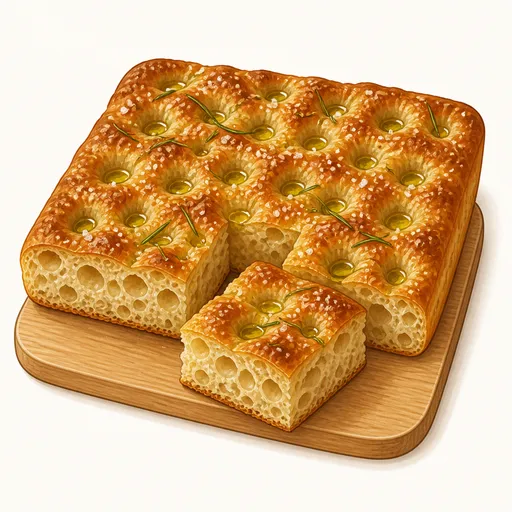
Focaccia is an Italian flatbread baked in a pan with plenty of olive oil, so the bottom turns as crisp as if it were fried while the inside stays moist and full of big air holes. The dough is very wet but needs no kneading; you just stretch and fold it a few times and let time do the rest.
- Difficulty
- Easy
- Prep
- 25 min
- Cook
- 24 min
- Rising or chilling
- 2 hr 45 min
- Total time
- 3 hr 34 min
- Method
- Oven-baked
Ingredients
For the dough
For the oil and seasoning topping
Instructions
Step 1
Dissolve 4 g instant yeast in 400 g warm water in a large bowl, add 500 g bread flour and 10 g salt and stir well with a spatula or your hand, then drizzle in 30 g olive oil and mix for another minute. The dough is very wet, so there's no need to knead it on the counter. It's ready when it's sticky and shaggy with no dry flour left.
Step 2
Cover the bowl, and every fifteen minutes dip your hand in water, grab one edge of the dough, stretch it up and fold it over to the opposite side, then turn the bowl and repeat on all four sides; do three rounds in total. Stretching and folding builds gluten gently while keeping the air bubbles. The dough is ready when it's smoother, tighter and holds a round shape in the bowl.
Step 3
Cover the bowl tightly and let the dough rise at room temperature for about 75 minutes. The long rise develops flavor and big air bubbles. It's ready when it has doubled in size, the top has puffed up and large bubbles show along the sides of the bowl.
Step 4
Pour about half of the 50 g olive oil into a 23 x 33 cm rectangular pan, tip in the dough, turn it over once so both sides are coated in oil and gently stretch it toward the corners. The oil on the bottom is what creates the signature crisp, golden crust. If the dough springs back, let it rest for ten minutes and then keep stretching until it nearly fills the pan.
Step 5
Cover the pan and let the dough proof for about 45 minutes more; meanwhile, heat the oven to 220°C with a rack in the lower position. This proof lets the dough puff up again after being stretched out. It's ready when it has risen noticeably, looks soft and jiggles slightly when you shake the pan.
Step 6
Drizzle the remaining olive oil over the top, spread your fingers and press them straight down to the bottom of the pan to make dimples all over the dough, then sprinkle with 4 g fresh herbs such as rosemary and 4 g flaky sea salt. The dimples hold pools of oil and keep the bread from puffing up like a pillow. The top is ready when it's full of little pools of oil and the big air bubbles are still there.
Step 7
Bake on the lower rack at 220°C for about 22 to 25 minutes. The lower rack gives the bottom strong heat so it crisps evenly. The focaccia is done when the top is a deep golden brown, the edges are crisp and the bottom looks golden when you lift a corner.
Step 8
Use a spatula to move the focaccia to a rack right away and let it cool for about 15 minutes before cutting. If it sits in the pan too long, steam will soften the bottom. It's ready when it's still warm, the bottom is crisp and the cut crumb is moist with lots of big holes.
Equipment
- Oven
- Rectangular pan
- Mixing bowl
- Spatula
- Bench scraper
- Kitchen scale
- Plastic wrap
- Wire cooling rack
Tips
- For more flavor, you can let the dough rise overnight in the fridge after the stretch and folds, then let it come to room temperature for about two hours before putting it in the pan.
- Besides rosemary, you can press cherry tomatoes, black olives or thinly sliced onion into the top.
- Use good-quality extra-virgin olive oil, since the oil is the main flavor of focaccia.
Storage
Focaccia is best on the day it's baked; wrap leftovers in foil and keep them at room temperature for about two days. To serve, reheat at 200°C for about five minutes to crisp the bottom again, or cut it into pieces and freeze for up to a month.
Common problems and how to fix them
- The focaccia is flat with a dense crumb and few air holes.
- The dough didn't rise enough or was pressed too hard, popping all the bubbles. Wait until the dough has doubled and press your fingers straight down only, without dragging them sideways.
- The bottom is pale and soft.
- The pan was too high in the oven or there wasn't enough oil on the bottom. Next time, bake on the lowest rack and use enough oil to cover the bottom of the pan completely.
This recipe is based on the common ratios for this bake and is written entirely in our own words.