Far breton
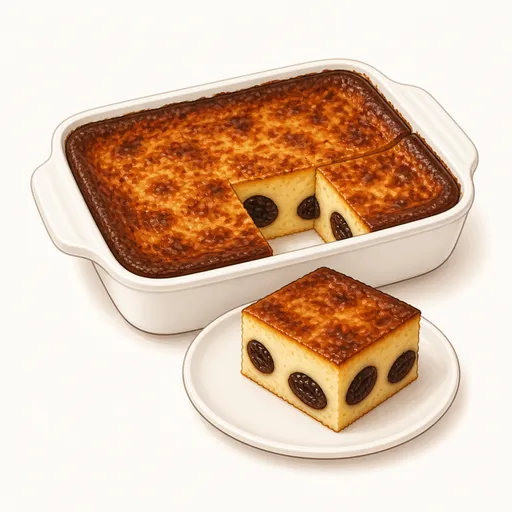
Far breton is a custardy cake from Brittany, a region where salted butter goes into almost every sweet. It's thick, soft yet dense and slightly chewy like a baked flan, with deep golden, buttery edges and rum-soaked prunes dotted throughout. Enjoy it warm or chilled, cut into squares, and it's perfect with afternoon tea.
- Difficulty
- Easy
- Prep
- 20 min
- Cook
- 55 min
- Rising or chilling
- 2 hr 30 min
- Total time
- 3 hr 45 min
- Method
- Oven-baked
Ingredients
For the soaked prunes
For the custard batter
Butter for the dish
Instructions
Step 1
Put 220 g pitted prunes in a small saucepan with 80 g hot brewed tea and 30 g dark rum, warm over low heat until it just starts to steam, then turn off the heat and let them soak for about thirty minutes. Plumped-up prunes stay juicy and won't draw moisture from the cake as it bakes. The prunes are ready when they're plump, soft and springy when pressed; lift them out and let them drain.
Step 2
Whisk 200 g eggs with 120 g granulated sugar and a pinch salt, then sift in 125 g all-purpose flour and whisk into a thick paste. Starting with a thick batter lets you work out every lump of flour before thinning it. The mixture is ready when it's smooth, glossy and free of lumps.
Step 3
Pour 750 g whole milk into the bowl in three additions, whisking well after each one, then add 50 g melted salted butter and 5 g vanilla extract. Adding the milk gradually keeps the batter from clumping and makes it smooth and even. The batter is finished when it's as thin as milk, has a light golden sheen and no butter floating on top.
Step 4
Cover the bowl and refrigerate the batter for at least an hour, or overnight if you have time. Resting lets the starch absorb the liquid, so the cake turns out smoother with its characteristic chewiness. The batter is ready when the foam on top has disappeared and it has thickened slightly.
Step 5
Heat the oven to 210°C, butter a baking dish very generously with salted butter and put the dish in the oven for about five minutes. A hot dish and sizzling butter give the bottom of the cake a crisp, fragrant golden crust. The dish is ready when the butter has melted and is bubbling all over the bottom.
Step 6
Stir the batter again since the starch tends to settle at the bottom, pour it into the hot dish, then scatter the prunes evenly over the top. Stirring again helps the cake cook evenly without a dense layer at the bottom. You're done when the prunes have slowly sunk and are evenly spread through the batter.
Step 7
Bake the cake at 210°C for the first 10 to 15 minutes. The high initial heat sets the edges quickly and creates the signature deep golden color. This stage is done when the edges start to puff slightly and turn golden brown.
Step 8
Lower the oven to 180°C and bake for about 35 to 45 minutes more, until the cake has puffed up high with a mottled golden brown top. A moderate temperature cooks the center through without burning the top. It's done when the center no longer jiggles when you gently shake the dish and a skewer comes out only slightly moist.
Step 9
Set the dish on a rack and let the cake cool for at least an hour; it will sink and firm up. If you cut it while hot, the center will be gooey and run. It's ready when it's just barely warm and slices cleanly with a smooth cut face that holds its shape.
Equipment
- Oven
- Pie dish
- Small saucepan
- Whisk
- Mixing bowl
- Sieve
- Kitchen scale
- Refrigerator
- Wire cooling rack
Tips
- If you use unsalted butter instead of salted, add a little salt to the batter to keep the sweet-salty balance typical of Brittany.
- You can swap the prunes for rum-soaked raisins, or make a plain version, which is also delicious.
- If you'd rather not use alcohol, simply soaking the prunes in hot tea gives plenty of flavor.
Storage
Covered, the cake keeps at room temperature for one day. You can refrigerate it for up to three days; many people prefer it cold, since it turns chewier and more flavorful after a night in the fridge.
Common problems and how to fix them
- There's a dense, raw layer at the bottom of the cake.
- The starch settled before pouring or the cake didn't bake long enough. Stir the batter again right before pouring and bake a few minutes longer until the center is fully set.
- The cake puffed up very high, then sank dramatically and the top cracked.
- Puffing and sinking is normal for far breton, but a lot of cracking means the oven was too hot. Lower the temperature sooner and bake the cake on the middle rack.
This recipe is based on the common ratios for this bake and is written entirely in our own words.