English muffins
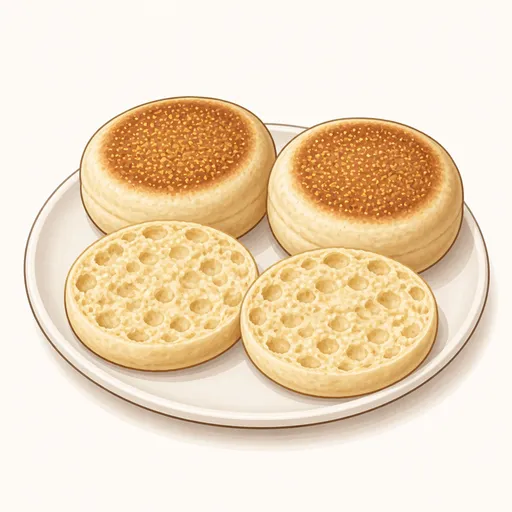
English muffins are flat, round British breads cooked on a griddle instead of baked in the oven, so they have two flat, golden brown sides coated in crunchy cornmeal. Split them open with a fork and you'll find a crumb full of tiny holes, perfect for catching butter and jam once they're toasted. They're also the essential base for eggs Benedict.
- Difficulty
- Easy
- Prep
- 35 min
- Cook
- 30 min
- Rising or chilling
- 2 hr
- Total time
- 3 hr 5 min
- Method
- Pan-cooked or waffle iron
Ingredients
For the dough
Cornmeal for dusting
Instructions
Step 1
Put 320 g whole milk and 30 g unsalted butter in a small saucepan and heat over low heat until the butter melts, then turn off the heat and let it cool slightly. Warm milk helps the yeast work well, but milk that's too hot will kill it. The milk is ready when it's just as warm as bathwater, about 40°C.
Step 2
Combine 500 g bread flour, 7 g instant yeast, 20 g granulated sugar and 9 g salt in the bowl of a stand mixer, pour in the warm milk along with 50 g beaten eggs and mix on low speed. The eggs make the muffins tender and give the crumb a lovely pale yellow color. The mixture is ready when the flour is evenly moistened and clinging to the dough hook.
Step 3
Knead the dough on medium speed for about eight minutes. English muffin dough is quite soft and a little sticky, and that high moisture is what creates the holes in the crumb. The dough is ready when it's smooth and elastic and pulls away from the sides of the bowl while still sticking slightly at the bottom.
Step 4
Move the dough to an oiled bowl, cover with plastic wrap and leave it somewhere warm for about an hour and fifteen minutes. The yeast needs time to produce gas and lighten the dough. The dough is ready when it has doubled in size and the surface is puffed and taut with a few large bubbles.
Step 5
Sprinkle half of the to taste yellow cornmeal over a baking sheet, turn the dough out onto a lightly floured counter, roll it about two centimeters thick, then cut it into rounds with an eight-centimeter cutter and arrange them on the sheet. Gather up the scraps, let them rest for five minutes, then roll and cut again. The muffins are right when they're evenly thick and the cut edges are clean, not stretched out of shape.
Step 6
Sprinkle the rest of the cornmeal over the tops, cover with a towel and let them proof for about forty-five minutes more. The second proof makes the muffins puff up and gives them a light, airy crumb. They're ready when they've visibly puffed and feel as soft as a pillow when gently pressed.
Step 7
Heat a nonstick pan over low heat, add the muffins and cook them uncovered for about seven minutes per side. Low heat gives the warmth time to reach the center of these thick muffins without burning the outside. They're done when both sides are golden brown, the sides feel dry and a thermometer inserted into the center reads about 93°C.
Step 8
Let the muffins cool on a rack for at least fifteen minutes, then poke a fork all around the sides and pull them apart instead of slicing with a knife. Splitting with a fork keeps the craggy surface full of little holes, which makes them crisper when toasted. They're ready when the halves pull apart easily and the crumb is no longer damp.
Equipment
- Nonstick skillet
- Small saucepan
- Mixing bowl
- Stand mixer
- Rolling pin
- Cookie cutter
- Baking sheet
- Thermometer
- Kitchen scale
- Plastic wrap
- Wire cooling rack
Tips
- If the outsides are golden but the centers are still raw, you can move the muffins to a 180°C oven for five minutes to finish cooking.
- Using semolina instead of cornmeal for dusting gives a finer crust and a paler golden color.
- Knead a few raisins and a little ground cinnamon into the dough for a sweet breakfast version of English muffins.
Storage
Keep cooled muffins in a sealed bag at room temperature for about three days. For longer storage, split them in half, freeze for up to three months and toast them straight from the freezer until crisp and golden.
Common problems and how to fix them
- The outsides are burnt but the centers are still wet.
- The heat was too high, so the outside cooked first. Turn the heat to the lowest setting and cook them longer, or finish them in the oven.
- The crumb is dense with no holes.
- The dough was too dry or didn't proof long enough. Keep the dough slightly sticky, don't add extra flour while kneading and wait until the muffins have clearly puffed during the second proof.
This recipe is based on the common ratios for this bake and is written entirely in our own words.