English custard tart
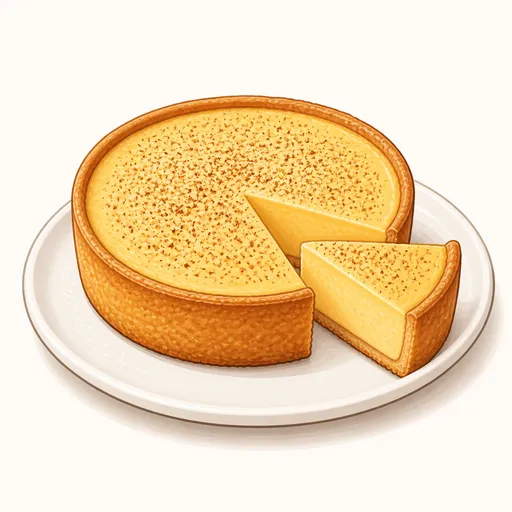
An English custard tart has a thin, crisp butter crust wrapped around a silky-smooth egg custard that trembles gently when you slice it. A dusting of freshly grated nutmeg on top gives it its signature warm aroma. The secret is baking the custard very slowly at a low temperature so it doesn't turn pitted.
- Difficulty
- Medium
- Prep
- 45 min
- Cook
- 1 hr 15 min
- Rising or chilling
- 3 hr 20 min
- Total time
- 5 hr 20 min
- Method
- Oven-baked
Ingredients
For the sweet pastry crust
For the custard filling
Instructions
Step 1
Mix 200 g all-purpose flour, 50 g powdered sugar and a pinch salt, then add 110 g cold unsalted butter cut into small cubes and rub it in with your fingertips. Butter that's still cold creates little pockets of fat that make the crust crisp and flaky. Once the mixture looks like damp sand with no lumps of butter bigger than a pea, add 36 g egg yolks along with 15 g cold water and gather it into a dough.
Step 2
Press the dough into a flat disk about two finger-widths thick, wrap it tightly in plastic wrap and refrigerate for an hour. The rest lets the gluten relax, so the crust shrinks less in the oven. The dough is ready when it feels firm and a fingertip pressed into it leaves only a shallow dent.
Step 3
Roll the dough out on a lightly floured counter into a sheet about 3 mm thick, drape it over the rolling pin and ease it into a 20 cm tart pan, pressing it snugly into the bottom corners. Leave a little extra dough overhanging the rim, since the crust shrinks slightly as it bakes. The pan is lined properly when the dough hugs the sides with no air pockets underneath.
Step 4
Prick a few small holes in the bottom of the crust with a fork, then refrigerate the pan for another twenty minutes. A cold, firm crust holds its tall sides in the oven instead of slumping. The shell is ready when it feels firm and cold, as if straight from the fridge.
Step 5
Heat the oven to 190°C with a rack in the middle while the crust chills. The oven needs to be evenly hot so the crust turns golden right away instead of the butter melting out. You can start baking when an oven thermometer shows the right temperature.
Step 6
Line the crust with a sheet of parchment paper, fill it to the top with rice or dried beans as weights and bake at 190°C for about 15 to 18 minutes. The weights keep the bottom flat and stop the sides from sliding down. The crust is ready when the edges are dry and starting to turn pale golden.
Step 7
Lift out the parchment and weights, lower the oven to 180°C and bake the empty shell for another 5 to 8 minutes. This dries out the bottom so the liquid custard doesn't soak in and make it soggy. The bottom is ready when it's evenly golden with no shiny, damp spots; then lower the oven to 130°C.
Step 8
Pour 300 g heavy cream and 200 g whole milk into a saucepan and heat over medium heat until small bubbles appear around the edge, then turn off the heat. Warm milk dissolves the sugar quickly and helps the custard cook more evenly in the oven. The mixture is ready when it steams gently but hasn't boiled up.
Step 9
Whisk 160 g egg yolks with 75 g superfine sugar and 4 g vanilla extract just until combined, then pour in the warm cream in a thin stream while whisking constantly. Pouring slowly warms the yolks gradually so they don't set into curds. The mixture is ready when it's an even pale yellow with little foam and thinly coats the back of a spoon.
Step 10
Strain the custard through a fine sieve into a pouring jug, skim off all the foam from the surface, then set the tart shell on an oven rack pulled halfway out. Careful straining removes the stringy bits of egg and air bubbles that would pit the top. The custard is ready when it's smooth and clear with a flat surface free of bubbles.
Step 11
Pour the custard into the shell right on the oven rack until it's filled to the brim, dust 1.5 g ground nutmeg evenly over the top and gently slide the rack in. Bake at 130°C for about 40 to 50 minutes so the custard sets slowly and turns silky. The tart is done when the edges of the custard are set while the very center still wobbles like jelly when you shake the pan.
Step 12
Let the tart cool in its pan on a rack at room temperature for about two hours before removing it from the pan. The custard keeps setting as it cools, so cutting too early makes it run. The tart is ready when the custard is firm and a knife passes through to leave a clean, neat slice.
Equipment
- Oven
- Tart pan
- Rolling pin
- Small saucepan
- Whisk
- Sieve
- Mixing bowl
- Kitchen scale
- Parchment paper
- Plastic wrap
- Refrigerator
Tips
- Pouring the custard while the shell is already on the oven rack lets you fill it right to the top without sloshing it over the edge.
- If you have whole nutmeg, grate it fresh right over the tart, since its aroma is far stronger than pre-ground.
- Don't overbake the custard; it's enough for the center to still wobble slightly, and the rest will set as it cools.
Storage
The tart is best on the day it's baked, kept at room temperature. Cover any leftovers and refrigerate for up to two days; the crust will soften a little, but the custard stays smooth and is lovely served cool.
Common problems and how to fix them
- The custard top cracked or has bubbles.
- The oven was too hot, making the eggs boil and contract. Use an oven thermometer to hold it at exactly 130°C and take the tart out while the center still wobbles slightly.
- The bottom of the crust is wet and soggy after baking.
- The crust wasn't baked dry before the custard went in. Next time, extend the empty-shell bake until the bottom is evenly golden.
- The sides of the crust slumped during blind baking.
- The dough wasn't cold enough or the weights didn't reach up the sides. Chill the shell longer and fill it with rice all the way to the rim.
This recipe is based on the common ratios for this bake and is written entirely in our own words.