Dacquoise
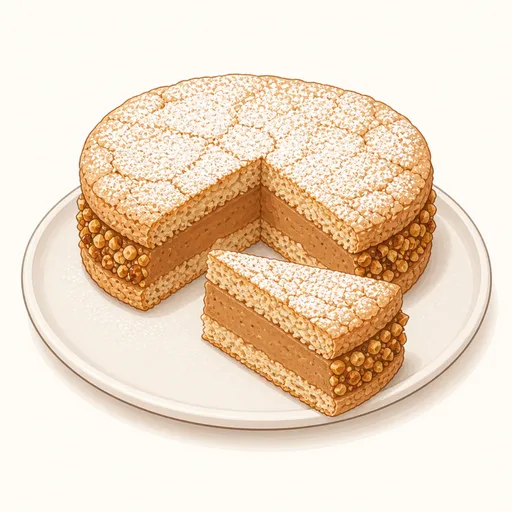
Dacquoise is a cake from the Landes region of France, made of almond meringue discs that are crisp outside and lightly chewy inside, sandwiched with praline buttercream (praline being caramelized toasted nuts ground into a paste). It uses very little flour, so the nut flavor is intense, and each bite is crisp and airy before slowly melting in your mouth.
- Difficulty
- Hard
- Prep
- 1 hr
- Cook
- 30 min
- Rising or chilling
- 3 hr
- Total time
- 4 hr 30 min
- Method
- Oven-baked
Ingredients
Almond meringue discs
Praline buttercream
Decoration
Instructions
Step 1
Draw two 20 cm circles on the back of two sheets of baking paper, flip them over onto two trays, then preheat the oven to 170 degrees Celsius. The drawn circles help you pipe two discs of the same size. The oven is ready when it has held a steady heat for fifteen minutes.
Step 2
Sift 150 g almond flour, 150 g powdered sugar and 20 g cake flour together twice, discarding any coarse bits left in the sieve. Sifting thoroughly makes the mixture light and lump-free, so the meringue is less likely to deflate when you fold. The mixture is ready when it is as fine as powder and evenly colored.
Step 3
Beat 180 g egg whites at medium speed until foamy, then gradually sprinkle in 60 g superfine sugar and increase the speed, beating for about six minutes. Adding the sugar a little at a time makes the meringue firm and glossy, strong enough to hold the fairly heavy nut flour. The meringue is ready when it holds stiff, upright peaks and doesn't slide when you turn the bowl upside down.
Step 4
Add the almond flour mixture to the meringue in three additions, each time cutting down through the middle with a spatula, sweeping up from the bottom and turning the bowl a quarter turn. Decisive yet gentle movements keep as many air bubbles as possible. The mixture is ready when no streaks of flour remain and it is still thick enough to hold its shape when scooped.
Step 5
Put the mixture in a piping bag fitted with a 1 cm round tip and pipe a spiral from the center outward to fill the circle drawn on each sheet. Piping in one continuous line gives evenly thick discs with no holes. The discs are ready when they are flat, about 1 cm thick and the spirals touch each other.
Step 6
Bake both trays at 170 degrees Celsius for 25 to 30 minutes, swapping their positions halfway through. A moderate heat dries the outside to a crisp while the center stays chewy. The discs are done when the tops are pale golden brown, dry to the touch and peel easily from the paper.
Step 7
Spread 50 g hazelnuts on a tray and toast them at 170 degrees Celsius for 8 to 10 minutes, then rub them in a towel to remove the skins and chop them coarsely. Toasting brings out their aroma and makes them crunchier. The hazelnuts are ready when the insides turn ivory gold and smell like browned butter.
Step 8
Put 100 g egg whites, 150 g granulated sugar and a pinch salt in a bowl set over a pan of barely simmering water, and whisk constantly until the mixture reaches 70 degrees Celsius. Heating the whites dissolves the sugar completely and makes them safe to eat without further baking. The mixture is ready when you can no longer feel grains of sugar when rubbed between two fingers.
Step 9
Move the bowl to the mixer and beat on high speed until the bowl is completely cool, then add 225 g softened unsalted butter one piece at a time, and finally add 80 g praline paste. The meringue must be cool so the butter doesn't melt. The buttercream is ready when it is smooth, an even beige-brown and holds its shape when piped.
Step 10
Place one dacquoise disc flat side up on a serving plate, pipe a layer of buttercream about 2 cm thick, sprinkle on half the hazelnuts, then set the second disc on top. Press gently so the layers stick together without cracking the meringue. The cake is ready when it stands straight with the buttercream showing evenly around the edge.
Step 11
Spread a thin layer of buttercream around the sides, press the remaining hazelnuts into it, refrigerate the cake for two hours, then dust to taste powdered sugar over the top before serving. Chilling firms up the buttercream and softens the meringue discs just enough to slice. The cake is ready when a knife cuts through it cleanly without squeezing out the buttercream.
Equipment
- Oven
- Baking sheet
- Stand mixer
- Spatula
- Sieve
- Piping bag
- Small saucepan
- Thermometer
- Parchment paper
- Kitchen scale
- Refrigerator
Tips
- Egg whites kept overnight in the fridge and brought back to room temperature whip up faster and hold better than freshly separated ones.
- On humid days, dacquoise discs soften easily; keep them in an airtight container and assemble the cake only a few hours before serving.
- You can replace half the almond flour with hazelnut flour for a deeper toasted-nut flavor.
Storage
Unassembled dacquoise discs stay crisp in an airtight container in a dry place for up to three days. The assembled cake keeps in a container in the fridge for three days; take it out fifteen minutes before serving.
Common problems and how to fix them
- The mixture spreads when piped onto the paper.
- The meringue wasn't stiff enough or was overmixed. Beat until the peaks stand straight up and stop folding as soon as you can no longer see dry flour.
- The buttercream looks curdled, like crumbled cheese.
- The butter was colder than the meringue. Keep beating for a few more minutes or warm the side of the bowl gently with a warm towel until the buttercream turns smooth again.
This recipe is based on the common ratios for this bake and is written entirely in our own words.