Crumpets
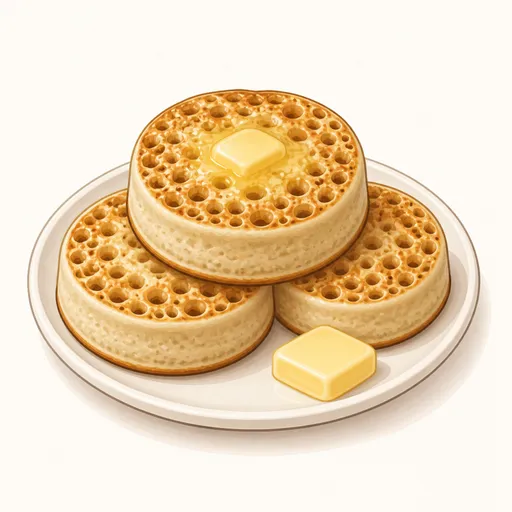
Crumpets are a traditional British treat made from a yeasted batter cooked on a dry griddle inside metal rings. The tops are riddled with tiny holes like a honeycomb, the bottoms are golden and crisp, and the insides are soft and chewy. Toasted and spread with butter, they let the butter melt into every little hole, making a warm, unforgettable breakfast.
- Difficulty
- Easy
- Prep
- 15 min
- Cook
- 40 min
- Rising or chilling
- 1 hr
- Total time
- 1 hr 55 min
- Method
- Pan-cooked or waffle iron
Ingredients
Batter
Finishing
Instructions
Step 1
Put 350 g whole milk and 175 g water in a saucepan, warm it over low heat to about 37 degrees Celsius, then turn off the heat. Liquid that is just warm enough gets the yeast working vigorously without killing it. The liquid is ready when it feels pleasantly warm, not hot, when you dip a finger in.
Step 2
Mix 175 g bread flour, 175 g all-purpose flour, 7 g instant yeast and 5 g superfine sugar in a large bowl, pour in the warm milk and beat hard with a whisk for about four minutes. Beating this long develops the gluten that gives crumpets their signature chew. The batter is ready when it is smooth, thick like heavy cream and free of lumps.
Step 3
Cover the bowl with plastic wrap and leave it in a warm spot for about an hour. The yeast needs time to produce gas that will form the holes on top. The batter is ready when it has risen to nearly double, the surface is covered in bubbles and it smells pleasantly yeasty.
Step 4
Dissolve 4 g baking soda and 6 g salt in 30 g warm water, pour it into the batter, whisk well and leave it for ten minutes. Baking soda reacts quickly and creates even more holes that rise to the surface. The batter is ready when it is covered in tiny bubbles again and falls in a thick stream from the ladle.
Step 5
Set a nonstick pan over low heat, brush to taste vegetable oil over the pan and the insides of rings about 9 cm across, then set the rings in the pan to heat up. Oiled rings make it easy to release the crumpets once cooked. The pan is ready when a drop of batter sets in about ten seconds without burning.
Step 6
Spoon batter into each ring to a depth of about one and a half centimeters and cook over low heat for about eight to ten minutes. Low heat browns the bottoms slowly while the bubbles have time to rise and pop on the surface. The crumpets are ready when the tops have dried, are no longer shiny and wet, and are covered in little holes.
Step 7
Lift off the rings with tongs, flip the crumpets and cook them holey side down over medium heat for about a minute. This cooks the very top layer through without sealing the holes. The crumpets are ready when the tops are just barely golden and the bottoms are a lovely golden brown.
Step 8
Let the crumpets cool on a rack, and when you're ready to eat, toast them in a toaster or a pan until the edges are crisp, then butter them right away. Freshly cooked crumpets are still a little chewy, and toasting gives them their crisp outside and soft inside. They're ready when the butter melts and soaks down into the holes on top.
Equipment
- Nonstick skillet
- Shaping molds
- Mixing bowl
- Whisk
- Kitchen scale
- Pastry brush
- Wire cooling rack
- Plastic wrap
Tips
- If you don't have crumpet rings, use metal cookie cutters or clean tuna cans with both ends removed.
- Cook one test crumpet first to adjust the batter: if the top has no holes, add a little warm water to the batter.
- Crumpets are delicious with butter and honey or strawberry jam, or with grated cheese for a savory version.
Storage
Cooled crumpets keep in an airtight container at room temperature for two days. You can freeze them for up to a month and toast them straight from the freezer, just toasting a little longer.
Common problems and how to fix them
- The tops are flat and smooth with no holes.
- The batter was too thick or the yeast wasn't active enough. Thin the batter with a little warm water and make sure it is very bubbly before cooking.
- The bottoms burned while the tops were still raw.
- The heat was too high or the batter was poured too thick. Turn the heat down to its lowest and fill the rings only about one and a half centimeters deep.
This recipe is based on the common ratios for this bake and is written entirely in our own words.