Cornish pasties
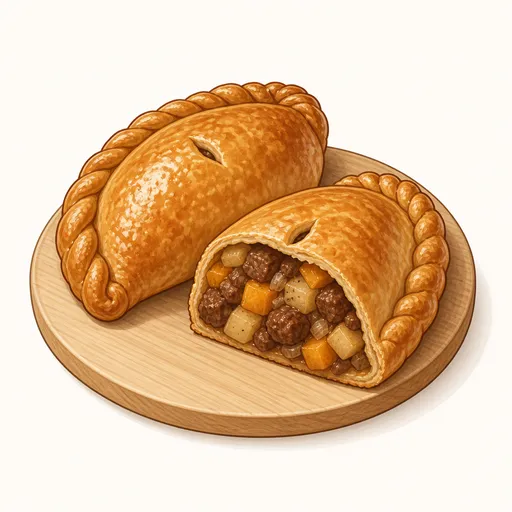
The Cornish pasty is a half-moon pastry with a signature crimped edge, originally the packed lunch of miners in Cornwall, England. The filling of beef, potatoes, rutabaga and onions goes in raw and cooks inside the crust, so the meat juices soak into the vegetables and create a deep, sweet flavor even though it's seasoned only with salt and pepper.
- Difficulty
- Medium
- Prep
- 50 min
- Cook
- 55 min
- Rising or chilling
- 1 hr 10 min
- Total time
- 2 hr 55 min
- Method
- Oven-baked
Ingredients
Pastry
Beef and vegetable filling
Egg wash
Instructions
Step 1
Mix 500 g bread flour with 5 g salt, add 120 g cold unsalted butter and 125 g cold lard, both cut into small pieces, then rub them in with your fingertips. Lard makes the pastry crisp and flaky while butter adds flavor, and working quickly keeps the fat from melting. The mixture is ready when it looks like breadcrumbs with no large pieces of fat left.
Step 2
Pour in 175 g cold water, bring it together into a dough, then knead gently on the counter for about two minutes. Unlike tart pastry, pasty dough needs a little gluten so it is pliable enough to crimp without cracking and strong enough to hold the heavy filling. The dough is ready when it is smooth, slightly elastic and a corner stretches without tearing right away.
Step 3
Wrap the dough in plastic wrap and refrigerate for at least an hour. The freshly kneaded gluten needs to relax so it doesn't shrink when rolled and baked. The dough is ready when it is firm, cold and keeps its size when you test-roll it.
Step 4
Cut 450 g beef chuck into small pieces about one centimeter across, peel 450 g potatoes and 250 g rutabaga and slice them thinly and irregularly, and finely chop 200 g onions, keeping each one separate. Thin slices let the raw vegetables cook in time with the meat. The ingredients are ready when the potato and rutabaga slices are about three millimeters thick.
Step 5
Preheat the oven to 200 degrees Celsius and line a large baking tray with parchment paper. A high starting temperature sets the crust quickly before juices from the filling soak in. The oven is ready when the heat indicator light goes off.
Step 6
Divide the dough into six equal pieces and roll each into a circle about 20 cm across and about four millimeters thick, using an upturned plate as a guide to cut it round. The pastry must be thick enough to bear the weight of the raw filling without tearing. Each round is ready when it is evenly circular, with smooth edges and no holes.
Step 7
Layer the filling over half of each round in this order: rutabaga, onion, potato and then beef, sprinkling 6 g salt and 3 g ground black pepper evenly over each layer. Putting the vegetables at the bottom and the meat on top lets the juices run down into the vegetables as it bakes. The filling is ready when it is piled high in the middle and stays about two centimeters from the edge.
Step 8
Brush a little water on the edge, fold the other half of the pastry over the filling, press firmly, then use your thumb and forefinger to twist and fold the edge from one end to the other into a rope. A tightly crimped edge traps the steam inside so the filling cooks in its own juices. The pasty is ready when the edge has about twenty even twists and no gaps.
Step 9
Arrange the pasties on the tray, brush 50 g beaten eggs over the tops and edges, then cut a small slit in the top of each one. The egg gives a glossy golden finish, and the slit keeps the pasty from bursting at the sides. The pasties are ready when the tops are evenly glossy with no egg pooling underneath.
Step 10
Bake at 200 degrees Celsius for the first 20 minutes. This high-heat stage cooks the crust and sets its shape before the filling starts releasing juices. The crust is ready when it has firmed up and is starting to turn pale golden.
Step 11
Lower the oven to 165 degrees Celsius and bake for another 30 to 35 minutes so the raw filling cooks slowly. The lower heat makes the meat and vegetables tender without burning the crust. The pasties are done when the crust is evenly golden brown and a skewer pushed through the slit finds the potatoes soft, with no resistance.
Step 12
Let the pasties rest on the tray for about ten minutes before eating. The heat inside keeps cooking the filling and gives the meat juices time to soak back into the vegetables. They're ready when you can hold one in your hand and the crust is still crisp when broken.
Equipment
- Oven
- Baking sheet
- Parchment paper
- Rolling pin
- Mixing bowl
- Kitchen scale
- Pastry brush
- Plastic wrap
- Refrigerator
Tips
- If you can't find rutabaga, use daikon radish or carrot instead, though the flavor will differ a little from the original.
- Use a cut of beef with some fat, such as chuck or shank, because very lean meat dries out in the oven.
- You can place a small knob of butter on top of the meat before folding the pastry for an even richer filling.
Storage
Cooled pasties keep for three days in the fridge when tightly wrapped. Eat them cold as a packed lunch or reheat them in the oven at 180 degrees Celsius for about fifteen minutes. Unbaked, assembled pasties can be frozen and baked straight from frozen, adding about fifteen minutes to the baking time.
Common problems and how to fix them
- The potatoes in the filling are still raw when the crust is golden.
- The potato slices were too thick. Next time, slice them thinner and extend the low-heat baking stage, covering the pasties with foil if the crust darkens too quickly.
- The edge burst open and the meat juices ran onto the tray.
- The edges weren't pressed firmly enough or had dry flour on them. Brush off any flour from the edges, brush on a little water and press well before crimping.
This recipe is based on the common ratios for this bake and is written entirely in our own words.