Coconut cream pie
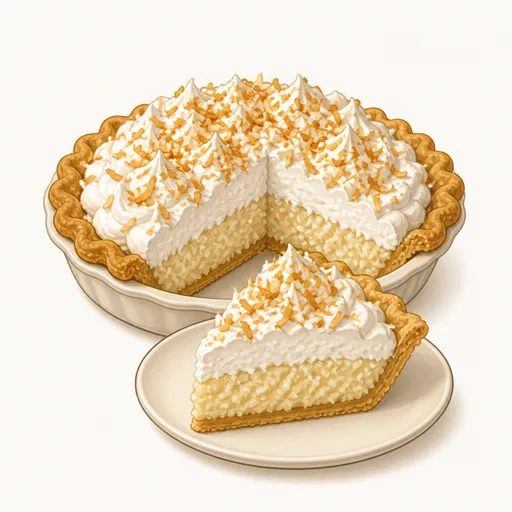
Coconut cream pie is an American cream pie with a crisp, buttery baked crust, a custard filling cooked with milk and coconut milk, and a billowy layer of whipped cream topped with golden toasted coconut. It is served chilled, so it is cool, rich and creamy without being heavy, perfect for hot days.
- Difficulty
- Medium
- Prep
- 45 min
- Cook
- 45 min
- Rising or chilling
- 5 hr
- Total time
- 6 hr 30 min
- Method
- Oven-baked
Ingredients
Pie crust
Coconut custard filling
Whipped cream topping
Instructions
Step 1
Mix 160 g all-purpose flour, 8 g granulated sugar and 2 g salt, add 110 g cold unsalted butter cut into small cubes and quickly rub it in, then drizzle in 45 g ice water a little at a time and gather it into a ball. Keeping the butter very cold gives a crust with lots of crisp, flaky layers that is sturdy enough to hold the soft cream. The dough is ready when it just holds together and you can still see small flecks of butter.
Step 2
Press the dough into a flat disk, wrap it in plastic wrap and refrigerate for an hour. Chilling lets the gluten relax so the crust does not shrink when blind baked. The dough is ready when it feels firm and does not crack at the edges when you start rolling it.
Step 3
Roll the dough about three millimeters thick, line a 23 cm pie dish with it, fold the overhang under and crimp a wavy edge, prick the bottom with a fork and place it in the freezer for fifteen minutes. Folding the edge under makes a thicker rim that is less likely to burn and keeps its shape. The shell is ready when the rim stands a little above the edge of the dish and the whole crust is cold and firm.
Step 4
Preheat the oven to 200 degrees Celsius with a rack in the lower middle position. An unfilled crust needs strong heat from below so the bottom bakes through completely, since the filling will not be baked afterward. The oven is ready when the heating light goes off.
Step 5
Line the crust with parchment paper, fill it with dried beans or rice as pie weights and bake at 200 degrees Celsius for 15 to 18 minutes. The weights keep the sides standing straight and the bottom from puffing up. The crust is ready when the rim has set and is starting to turn light golden.
Step 6
Lift out the paper and beans, lower the oven to 180 degrees Celsius and bake for 10 to 12 minutes more until the bottom of the crust is golden, then let it cool completely. The crust must be fully crisp, because the moist cream filling will turn an underbaked crust soggy. The crust is ready when both the bottom and sides are an even golden brown.
Step 7
Toast 20 g desiccated coconut in a dry skillet over medium heat, stirring constantly for about three to four minutes, then tip it onto a plate. Toasting brings out its rich, nutty aroma and gives the garnish some crunch. The coconut is ready when it turns light golden brown and smells fragrant; remember to tip it out right away so it does not burn.
Step 8
Whisk 72 g egg yolks with 130 g granulated sugar, 40 g cornstarch and a pinch salt in a saucepan, slowly pour in 360 g whole milk and 240 g coconut milk, then cook over medium heat, whisking constantly. Constant whisking keeps the yolks from clumping and lets the cornstarch thicken evenly. The custard is ready when it has bubbled gently for one minute and is as thick as yogurt.
Step 9
Take the pan off the heat and stir 20 g unsalted butter, 5 g vanilla extract and 70 g desiccated coconut into the hot custard. Adding the butter while the custard is hot lets it melt completely and makes the filling glossier and smoother. The filling is ready when it is glossy and uniform with the coconut evenly distributed.
Step 10
Pour the still-warm filling into the cooled crust, smooth the top, press plastic wrap right onto the surface of the custard and refrigerate for at least four hours. Wrap pressed onto the surface keeps a dry skin from forming, and the chilling time lets the filling set firm. The filling is ready when it no longer wobbles when you gently shake the dish and a test cut holds a straight edge.
Step 11
Whip 300 g cold whipping cream with 30 g powdered sugar on medium speed for about four minutes. When both the cream and the bowl are cold, the bubbles last longer and the cream does not weep. The cream is ready when it forms soft peaks whose tips droop slightly as you lift the beaters.
Step 12
Spread or pipe the whipped cream over the pie in swirls, sprinkle the toasted coconut on top and slice with a knife dipped in hot water and wiped dry. A warm knife cuts cleanly through the cream without dragging the layers out of place. A slice is ready when it stands firm and clearly shows three layers: golden crust, ivory filling and white cream.
Equipment
- Oven
- Pie dish
- Rolling pin
- Small saucepan
- Whisk
- Hand mixer
- Mixing bowl
- Kitchen scale
- Parchment paper
- Refrigerator
Tips
- For a stronger coconut flavor, you can replace some of the milk with coconut milk, but keep the total amount of liquid the same.
- A small spoonful of white rum stirred into the filling once it is cooked will deepen the coconut flavor.
- If the pie needs to sit out of the fridge for a while, whip the cream with a little mascarpone so the topping holds its shape better.
Storage
The pie must be kept chilled and is best within the first two days. Cover it loosely with plastic wrap or a large upturned container so the cream does not absorb fridge odors, and do not freeze it, because the cream filling will weep when thawed.
Common problems and how to fix them
- The cream filling is runny and oozes out when sliced.
- The custard was not boiled long enough, so the cornstarch did not fully thicken. Cook until the custard bubbles with large bubbles and keep stirring for one more minute.
- The filling has grainy bits like cooked egg.
- The heat was too high or the bottom of the pan was not stirred evenly. Use a heavy-bottomed pan, keep the heat at medium and, if needed, strain the custard through a sieve before adding the coconut.
This recipe is based on the common ratios for this bake and is written entirely in our own words.