Coconut bread
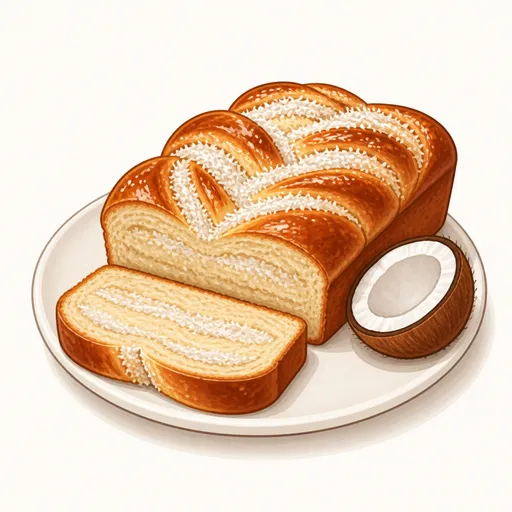
This loaf uses coconut milk instead of milk, so the crumb is soft with a gentle, rich coconut aroma. Inside is a filling of desiccated coconut mixed with butter and milk powder, braided into beautiful swirls. It is perfect for breakfast or with afternoon tea.
- Difficulty
- Medium
- Prep
- 45 min
- Cook
- 38 min
- Rising or chilling
- 2 hr
- Total time
- 3 hr 23 min
- Method
- Oven-baked
Ingredients
Dough
Coconut filling
Egg wash
Instructions
Step 1
Gently warm 230 g coconut milk and pour it into a bowl with 350 g bread flour, 45 g granulated sugar, 6 g instant yeast, 5 g salt and 50 g eggs, then knead on low speed for about five minutes. Warm coconut milk helps the yeast get to work faster. The dough is ready when it comes together into a soft mass with no dry flour left in the bottom of the bowl.
Step 2
Add 30 g softened unsalted butter and knead on medium speed for about twelve minutes. The fat in the coconut milk makes the dough a little heavy, so knead it thoroughly to build strong gluten. The dough is ready when it is glossy and elastic and stretches into a thin, slightly translucent windowpane.
Step 3
Shape the dough into a ball, place it in a bowl, cover with plastic wrap and let it rise somewhere warm for about an hour. Well-proofed dough is easy to roll out and rises beautifully in the oven. The dough is ready when it has doubled and smells pleasantly of yeast.
Step 4
Mix 80 g desiccated coconut with 50 g granulated sugar and 15 g milk powder, add 40 g softened unsalted butter and 30 g coconut milk, then rub it all together by hand. The coconut milk moistens the desiccated coconut so the filling does not draw moisture from the crumb. The filling is ready when it clumps together when squeezed but crumbles apart with a light press.
Step 5
Roll the dough into a rectangle of about 25 x 35 cm, scatter the coconut filling evenly over it, roll it up from a long side into a log, slice the log in half lengthwise with a knife, then twist the two halves together with the cut sides facing up, coil it neatly and place it in a 12 x 23 cm loaf pan. Keeping the cut sides up shows off the layers of filling as the bread rises. You will see streaks of white coconut filling alternating with dough across the top of the loaf.
Step 6
Cover with a towel and let it rise for about fifty minutes more, preheating the oven to 175 degrees Celsius in the meantime. A full proof makes the loaf light and keeps the twists from pulling apart in the oven. The dough is ready when it has risen almost to the rim of the pan.
Step 7
Beat 25 g eggs and brush very lightly over the dough, avoiding letting egg pool in the gaps of the filling. The egg wash gives the crust a shine and a lovely color. The top is ready when it has a thin, even coat of egg with no drips running into the pan.
Step 8
Bake at 175 degrees Celsius for 35 to 40 minutes, covering with foil once the top has browned, since the coconut on top burns very quickly. With so much filling, this bread needs longer in the oven than a regular loaf. The bread is done when the crust is golden brown, the coconut on top is light golden and the center reads about 90 degrees Celsius.
Step 9
Let the bread rest in the pan for five minutes, then turn it out onto a rack and let it cool for about forty-five minutes before slicing. The buttery coconut filling needs time to set, and if you cut it too soon, the filling will crumble out. The bread is ready when it feels cool to the touch and slices cleanly.
Equipment
- Oven
- Loaf pan
- Stand mixer
- Mixing bowl
- Rolling pin
- Pastry brush
- Kitchen scale
- Plastic wrap
Tips
- You can use freshly grated coconut toasted dry instead of desiccated coconut; the filling will be more fragrant, but the bread is best eaten the same day.
- Shake the can of coconut milk well before weighing so the cream and liquid are blended together.
- For a shinier crust, brush on a thin layer of sugar syrup as soon as the bread comes out of the oven.
Storage
The bread keeps in an airtight container at room temperature for two days. To keep it longer, slice and freeze it for up to three weeks, then reheat in a 160 degree Celsius oven for about five minutes before eating.
Common problems and how to fix them
- The coconut filling is dry and falls out when sliced.
- The filling lacked moisture or the butter was not soft enough to bind it. Add a little more coconut milk to the filling and rub it together more thoroughly before scattering it over the dough.
- The loaf rises lopsided and the twists burst open.
- The two halves were twisted too loosely or the pan was too large. Twist more tightly and fit the loaf snugly into a pan of the suggested size.
This recipe is based on the common ratios for this bake and is written entirely in our own words.