Ciabatta
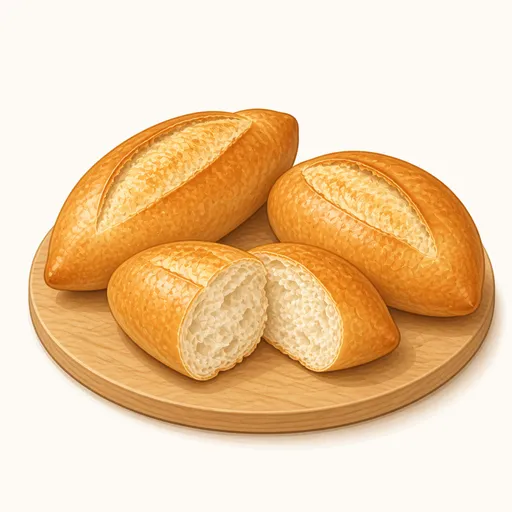
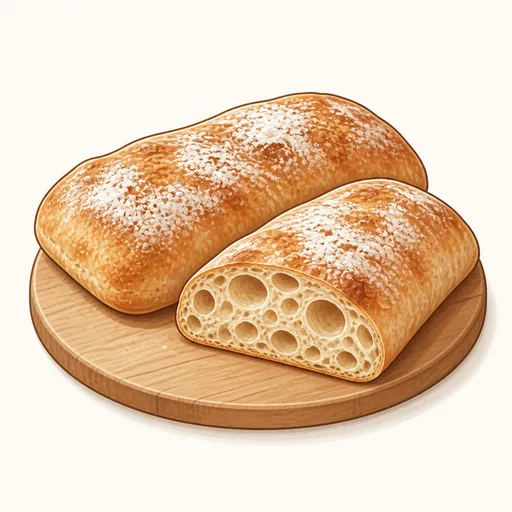
Ciabatta is a flat Italian bread whose name means "slipper," after its long, wide shape. The dough is very wet and made with a biga (a stiff yeasted starter left overnight), so the crumb is full of big, glossy holes and is soft yet chewy, while the thin, crisp crust has a rustic dusting of flour. It is perfect for sandwiches or for dipping in olive oil.
- Difficulty
- Hard
- Prep
- 30 min
- Cook
- 25 min
- Rising or chilling
- 15 hr
- Total time
- 15 hr 55 min
- Method
- Oven-baked
Ingredients
Overnight starter (biga)
Main dough
Instructions
Step 1
The night before, mix 200 g bread flour, 120 g water and 0.5 g instant yeast into a fairly stiff, shaggy dough, cover tightly and leave at room temperature for about twelve hours. A low-hydration biga ferments slowly, adding a gentle tang and giving the crumb a fragrant chew. The biga is ready when it has grown two to three times in size, the surface is full of small holes and it smells faintly of wine.
Step 2
Tear the biga into small pieces in a large bowl, pour in 280 g water and squeeze to break it up, then add 300 g bread flour, 2.5 g instant yeast, 11 g salt and 10 g olive oil and mix vigorously with a wet hand for about five minutes. Ciabatta dough is very wet, so instead of kneading it on the counter, you mix it right in the bowl. The dough is ready when it is sticky like thick paste but starts to pull into stretchy strands as you lift your hand.
Step 3
Cover the bowl and let the dough rise for about two hours; during the first forty minutes, every ten minutes dip your hand in water, lift one edge of the dough, stretch it up and fold it into the center, turning the bowl and repeating four times. Folding replaces kneading, gradually strengthening the gluten while keeping the large air bubbles intact. The dough is ready when it has nearly doubled, the surface is smooth and domed and large bubbles show under the skin.
Step 4
Dust the counter generously with to taste semolina, gently tip the dough out so it spreads into a rectangle on its own, dust the top as well, then use a bench scraper to divide it into two long pieces and gently fold each one in thirds. Handle the dough as little as possible so you do not burst the air pockets that have formed. The pieces are ready when they are flat rectangles coated in flour and still soft and puffy.
Step 5
Move the two pieces onto floured parchment paper, folded side down, cover with a towel and let them rise for about forty minutes. Turning the folded side underneath exposes the taut surface of the dough and gives a more evenly open crumb. The dough is ready when it is slightly puffed, soft and jiggly, with a few large bubbles on the surface.
Step 6
Place a steel baking sheet or baking stone in the oven along with an empty pan on a low rack, and preheat to 230 degrees Celsius for at least forty-five minutes. A blazing hot baking surface helps the wet dough spring up quickly before it has a chance to spread flat. The oven is ready when the stone or steel sheet is heated all the way through.
Step 7
Slide the whole sheet of parchment onto the hot surface, pour half a cup of hot water into the empty pan to create steam and bake at 230 degrees Celsius for 22 to 26 minutes. The steam helps the bread rise high in the first ten minutes, after which the crust gradually dries and turns crisp. The bread is done when the crust is golden brown with patches of white flour, the bottom sounds hollow when tapped and the loaf feels noticeably light when lifted.
Step 8
Move the bread to a rack and let it cool for at least thirty minutes before cutting it with a serrated knife. The moist crumb needs to cool to set its structure, and if you cut it too soon it will be gummy. The bread is ready when the cut face shows large, glossy holes and the crumb is no longer wet.
Equipment
- Oven
- Mixing bowl
- Kitchen scale
- Bench scraper
- Baking sheet
- Parchment paper
- Plastic wrap
- Wire cooling rack
Tips
- Ciabatta dough sticking to your hands is perfectly normal; always dip your hands or bench scraper in water instead of adding flour to the dough.
- Using a square lidded container for folding helps the dough keep a rectangular shape and makes it easier to divide.
- If you do not have semolina, you can dust the counter with regular flour or rice flour.
Storage
Ciabatta is best on the day it is baked; keep it in a paper bag at room temperature for up to two days. To keep it longer, slice it in half horizontally, wrap tightly and freeze for up to a month, then reheat at 200 degrees Celsius for about seven minutes.
Common problems and how to fix them
- The crumb is dense, with small, even holes like sandwich bread.
- The dough was pressed too hard while dividing, or the gluten was not strong enough. Do all four folds and handle the dough very gently when dividing and moving it to the baking sheet.
- The bread spreads flat and does not rise high.
- The final proof was too long or the oven was not hot enough. Shorten the proofing time and heat the baking stone or steel sheet for the full forty-five minutes.
This recipe is based on the common ratios for this bake and is written entirely in our own words.