Chocolate bread loaf
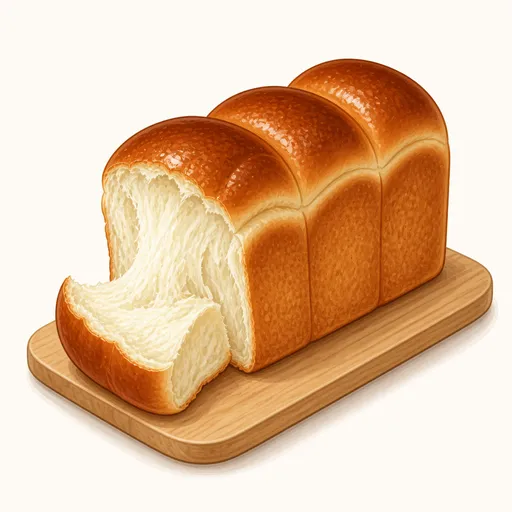
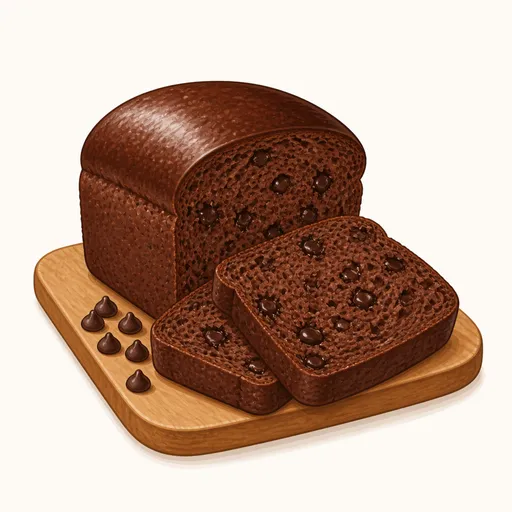
This milk bread loaf is kneaded with cocoa powder, giving it a deep brown crumb and a gentle chocolate aroma, studded with chocolate chips that melt while the bread is still warm. It is soft and just sweet enough, perfect toasted with butter or turned into French toast.
- Difficulty
- Medium
- Prep
- 40 min
- Cook
- 33 min
- Rising or chilling
- 2 hr
- Total time
- 3 hr 13 min
- Method
- Oven-baked
Ingredients
Instructions
Step 1
Sift 280 g bread flour and 25 g cocoa powder into the bowl of a stand mixer, then add 50 g granulated sugar, 5 g instant yeast and 4 g salt and stir to combine. Cocoa clumps easily, so sift it well for an evenly colored crumb. The mixture is ready when it is a uniform brown with no dark specks of cocoa.
Step 2
Pour 200 g warm whole milk and 50 g eggs into the dry ingredients and knead on low speed for about five minutes. Cocoa soaks up quite a lot of liquid, so this dough needs more milk than a regular loaf. The dough is ready when it comes together into a soft, slightly sticky mass with no dry flour left.
Step 3
Add 35 g softened unsalted butter and knead on medium speed for about twelve minutes. The fat in cocoa makes gluten slower to develop, so be patient and knead for the full time. The dough is ready when it is glossy, smooth and elastic and stretches into a thin, light brown windowpane.
Step 4
Shape the dough into a ball, place it in a bowl, cover tightly and let it rise somewhere warm for about an hour and ten minutes. Cocoa dough rises more slowly than plain white dough, so it needs a little extra time. The dough is ready when it has doubled in size and a fingertip pressed into it leaves a dent.
Step 5
Roll the dough into a rectangle of about 20 x 28 cm, scatter 70 g chocolate chips evenly over it, roll it up tightly from a short side and place it seam side down in a buttered 10 x 20 cm loaf pan. Adding the chocolate at the shaping stage keeps the chips from being crushed during kneading so they hold their shape. The loaf is ready when it is evenly rolled and the chocolate is fully sealed inside.
Step 6
Cover with a towel and let it rise for about fifty minutes more, preheating the oven to 170 degrees Celsius in the meantime. A full proof gives a light loaf with a nicely domed top. The dough is ready when it has risen about one centimeter above the rim of the pan.
Step 7
Bake at 170 degrees Celsius for 30 to 35 minutes, covering the loaf with foil after the first fifteen minutes. The brown dough makes it hard to tell when the top is burning, so the foil is your safeguard. The bread is done when the bottom sounds hollow when tapped and a thermometer in the center reads about 90 degrees Celsius.
Step 8
Turn the loaf out of the pan and let it cool on a rack for about an hour. The chocolate chips inside need to set, and if you slice it hot, the chocolate will smear across the cut surface. The bread is ready when the crumb has cooled and the slices cut cleanly.
Equipment
- Oven
- Loaf pan
- Stand mixer
- Sieve
- Rolling pin
- Kitchen scale
- Plastic wrap
- Wire cooling rack
Tips
- Dutch-process cocoa gives a darker color and a milder flavor, while natural cocoa adds a slight tang and a reddish-brown color.
- You can swap the chocolate chips for chopped dark chocolate to get bigger pockets of chocolate.
- Day-old bread is perfect for French toast dipped in an egg and milk mixture.
Storage
Keep the bread in a sealed bag at room temperature for up to three days. You can also slice and freeze it for up to a month, then toast the slices straight from frozen without thawing.
Common problems and how to fix them
- The bread rose poorly and the crumb is dense.
- The dough was not kneaded enough or did not proof long enough. Check the windowpane carefully before proofing, and let the dough fully double even if it takes longer than expected.
- The chocolate chips melted into patches and tore the crust.
- The chips were too close to the surface, so they melted out during baking. Leave a border of dough when scattering the chocolate and roll it up tightly so the chips sit deep inside the crumb.
This recipe is based on the common ratios for this bake and is written entirely in our own words.