Chocolate babka
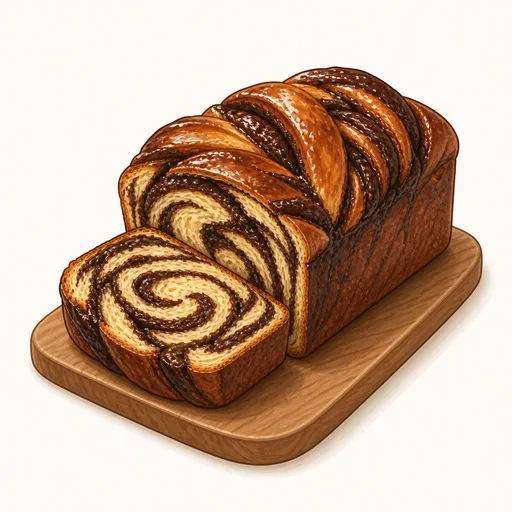
Babka is a sweet bread that comes from the Jewish communities of Eastern Europe, famous for the layer upon layer of chocolate swirls you see when you slice it. The dough is rich with eggs and butter, so it's as soft as brioche; it's rolled up with a dark chocolate filling, then cut in half and twisted before baking. A syrup brushed over the top after baking gives it a beautiful shine and keeps it moist for days.
- Difficulty
- Hard
- Prep
- 1 hr
- Cook
- 45 min
- Rising or chilling
- 3 hr 30 min
- Total time
- 5 hr 15 min
- Method
- Oven-baked
Ingredients
For the bread dough
For the chocolate filling
For the syrup glaze
Instructions
Step 1
Put 300 g bread flour, 50 g granulated sugar, 6 g instant yeast and 5 g salt in the bowl of a stand mixer, add 100 g eggs, 80 g whole milk and 3 g vanilla extract and knead on low to medium speed for about eight minutes. Kneading before adding the butter helps the gluten develop faster and stronger. The dough is ready when it comes together in a mass that's slightly sticky but starting to pull away from the bottom of the bowl.
Step 2
Cut 85 g softened unsalted butter into small pieces, add them one at a time with the mixer running and keep kneading for about eight minutes after the last piece goes in. Adding the butter gradually lets the dough absorb the fat without turning greasy and slack. The dough is ready when it's glossy, smooth and elastic and stretches into a thin, almost translucent windowpane.
Step 3
Shape the dough into a ball, place it in an oiled bowl, cover with plastic wrap and let it rise somewhere warm for about an hour and a half. Dough rich in butter and eggs rises more slowly than regular bread, so be patient. The dough is ready when it has nearly doubled and the surface looks taut and puffy.
Step 4
Punch down the dough, press it into a flat rectangle, wrap it well and refrigerate for about thirty minutes. As the butter in the dough firms up, you can roll it thin and tight without it sticking. The dough is ready when it feels firm, cool and no longer tacky.
Step 5
Melt 100 g dark chocolate with 80 g unsalted butter over low heat, take it off the heat and stir in 40 g powdered sugar and 20 g cocoa powder, then let it cool until thick. The filling should be as thick as a spread; if it's still runny, it will ooze out when you roll the dough. The filling is ready when it's glossy and smooth and spreads without running.
Step 6
On a lightly floured counter, roll the dough into a rectangle about 30 by 40 cm with a long side facing you, then spread the chocolate filling evenly over the whole surface, leaving a two-centimeter strip bare along the far edge. An even layer of filling gives every slice beautiful chocolate swirls. You've done it right when the dough is evenly thin and the filling reaches right to the edges.
Step 7
Roll the dough up tightly from the long side nearest you toward the bare edge, press the edge to seal it, then set the roll on a tray and refrigerate for about fifteen minutes. Rolling tightly creates lots of swirls, and chilling firms up the roll so it cuts cleanly. The roll is ready when it's even and firm and the seam is sealed shut.
Step 8
Use a sharp knife to cut the roll in half lengthwise to expose the layers of filling, lay the two halves side by side with the cut sides facing up, twist them over each other, then place the twist in a parchment-lined 23 cm loaf pan. Keeping the cut sides up shows off gorgeous chocolate swirls after baking. You've done it right when the two strands are tightly twisted, the layers of filling clearly show and the loaf sits snugly in the pan.
Step 9
Cover the pan with plastic wrap and let it rise for about another hour and a half, preheating the oven to 180°C during the last half hour. This rise lets the dough puff up to fill the pan so the bread is soft and airy. The dough is ready when it has grown by about half and a gentle press leaves a dent that fills back slowly.
Step 10
Bake at 180°C for about 35 to 45 minutes, loosely tenting with foil after twenty minutes if the top is already brown. Babka is thick and full of filling, so it needs a long bake to keep the center from being raw. It's done when the top is a deep brown and a toothpick inserted into the bread part comes out free of wet dough.
Step 11
While the babka bakes, heat 60 g granulated sugar with 60 g water over medium heat until it boils and the sugar dissolves completely, then turn off the heat. Having the syrup ready means you can brush it on the hot bread as soon as it comes out of the oven. The syrup is ready when it's completely clear with no sugar crystals at the bottom of the pot.
Step 12
As soon as you take the babka out of the oven, brush the warm syrup evenly over the top, wait for it to soak in and then brush on another coat. Hot bread absorbs syrup best, which keeps the crumb moist longer and gives the top an irresistible shine. You've done it right when the top is glossy and no syrup is pooling.
Step 13
Leave the babka in the pan for about twenty minutes, then lift it onto a rack to cool for at least forty minutes more before slicing. The hot chocolate filling is very runny, so cutting too soon will smear the swirls. The babka is ready when it's nearly cool and each slice shows clear spirals of chocolate.
Equipment
- Oven
- Loaf pan
- Stand mixer
- Rolling pin
- Small saucepan
- Spatula
- Pastry brush
- Kitchen scale
- Mixing bowl
- Parchment paper
- Plastic wrap
- Refrigerator
- Wire cooling rack
Tips
- You can give the dough its first rise overnight in the fridge instead of an hour and a half at room temperature, and the cold dough is even easier to roll.
- Sprinkle some chopped toasted hazelnuts over the filling before rolling for a nutty crunch.
- Day-old slices of babka, toasted in a little butter, make wonderfully fragrant chocolate toast.
Storage
Wrapped tightly in plastic wrap, babka stays soft at room temperature for about three days. You can freeze the whole loaf or individual slices for up to a month; just thaw and warm gently before serving.
Common problems and how to fix them
- The chocolate filling oozes out when rolling and cutting.
- The filling was still runny or the dough had warmed up. Let the filling cool until it's as thick as a spread, and chill the roll before cutting it in half.
- The center of the loaf is still damp and gummy.
- The bread was underbaked, since the thick filling holds heat slowly. Bake it five to ten minutes longer and tent it with foil so the top doesn't burn.
This recipe is based on the common ratios for this bake and is written entirely in our own words.