Chicken pot pie
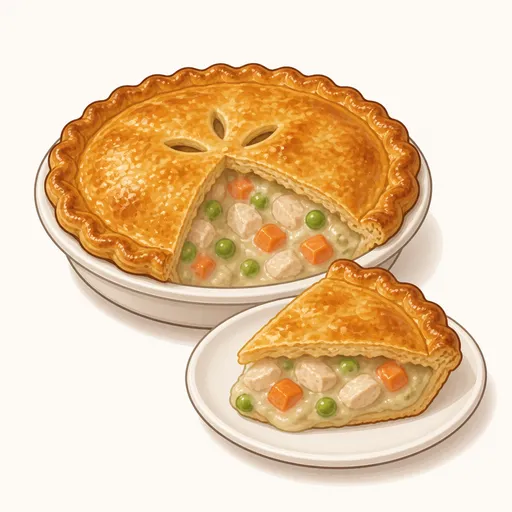
Chicken pot pie is a cozy savory pie from America and Britain, with chicken and vegetables cooked in a silky cream sauce and sealed between two flaky, buttery crusts. When you cut the first slice, a cloud of herb-scented steam rises up, making it perfect for a weekend family dinner.
- Difficulty
- Medium
- Prep
- 1 hr
- Cook
- 1 hr 15 min
- Rising or chilling
- 1 hr 50 min
- Total time
- 4 hr 5 min
- Method
- Oven-baked
Ingredients
For the crust
For the creamy chicken filling
For the egg wash
Instructions
Step 1
Mix 325 g all-purpose flour with 8 g granulated sugar and 5 g salt, add 225 g cold diced unsalted butter and quickly rub it in with your fingertips. The pieces of butter that stay whole turn to steam in the oven and create flaky, crisp layers. The mixture is ready when it looks like coarse breadcrumbs with a few pea-sized bits of butter.
Step 2
Drizzle 95 g ice water over the flour mixture a little at a time, tossing gently with a fork until the dough just comes together. Adding the water bit by bit lets you stop at the right moment, since too much water makes the crust tough and prone to shrinking. The dough is ready when a handful squeezed in your hand holds together without feeling wet.
Step 3
Divide the dough in two, making one piece slightly larger for the bottom, flatten them into two discs, wrap them in plastic wrap and refrigerate for an hour. Chilling firms up the butter and relaxes the gluten, so the crust is easy to roll and shrinks less. The dough is ready when it feels firm and a pressed finger leaves only a slight dent.
Step 4
Cut 600 g boneless chicken thighs into two-centimeter cubes, season with 5 g salt and a pinch ground black pepper, then sear them in a pot with half the butter for the filling until browned on all sides and lift them out. The browned surface gives the whole pot of sauce a deep, savory flavor. The chicken is ready when it's golden brown outside; it doesn't need to be cooked through yet, since it will cook more later.
Step 5
Add the remaining butter to the pot with 150 g onions, 120 g diced carrots and 10 g minced garlic and sauté over medium heat for about six minutes. Cooking them thoroughly brings out their sweetness and lifts all the chicken bits from the bottom of the pot. The vegetables are ready when the onions are translucent, soft and fragrant.
Step 6
Sprinkle 45 g all-purpose flour into the pot, stir for a minute, then slowly pour in 360 g chicken stock and 180 g whole milk, stirring until it comes to a gentle simmer, then add the chicken, 150 g mixed vegetables and 3 g fresh herbs such as thyme and cook for three more minutes. Cooking the flour in butter first makes the sauce smooth and thick without lumps. The filling is ready when the sauce coats the back of a spoon and a finger drawn through it leaves a clean line.
Step 7
Spread the filling out on a wide tray and let it cool for about thirty minutes, tasting and adding more salt if needed. Hot filling would melt the butter in the raw crust and make the bottom soggy. The filling is ready when it feels only slightly warm to the touch.
Step 8
Preheat the oven to 200°C with a baking sheet on the lowest rack so it heats up too. The hot sheet sends heat straight into the bottom of the dish so the lower crust bakes up crisp. The oven is ready when the heating light turns off and the sheet inside is thoroughly hot.
Step 9
Roll the larger disc into a round about three millimeters thick and about four centimeters wider than a 23 cm pie dish, then lay it in the dish, pressing it gently against the bottom and sides without stretching the dough. Letting the dough settle in loosely keeps the crust from shrinking in the heat. The crust is ready when it evenly lines the dish with some overhang draping over the rim.
Step 10
Pour the cooled filling into the dish, roll out the other disc and lay it on top, trim the excess, then fold the edge under and crimp it with your fingers or a fork. A tightly crimped edge keeps the sauce from bubbling out in the oven. The pie is ready when the top and bottom crusts are sealed together in an even wavy edge.
Step 11
Beat 25 g eggs and brush a thin layer over the whole top, then cut four small slits in the center to let steam escape. The egg gives a glossy golden color, and the vents keep the top crust from blistering. The top is ready when it's evenly glossy and the slits go all the way through the crust.
Step 12
Set the pie dish on the hot baking sheet and bake at 200°C for about 40 to 50 minutes, covering the edge with foil if it darkens too soon. The high heat puffs and crisps the crust while the filling comes back to a bubble inside. The pie is done when the crust is a deep golden brown and you can see the sauce bubbling through the slits.
Step 13
Let the pie rest on a rack for about twenty minutes before cutting. Resting thickens the sauce so each slice holds its shape when served. It's ready when a cut reveals a thick filling that doesn't run out onto the plate.
Equipment
- Oven
- Pie dish
- Rolling pin
- Small saucepan
- Mixing bowl
- Kitchen scale
- Pastry brush
- Plastic wrap
- Refrigerator
- Baking sheet
Tips
- You can use leftover shredded boiled or roast chicken; just skip the searing step and add the chicken when you make the sauce.
- If you'd rather not make two crusts, pour the filling into the dish and cover it with just a top crust, cutting the baking time by about ten minutes.
- The filling can be made a day ahead and refrigerated, and cold filling even helps the crust bake up crisper.
Storage
Covered tightly, the baked pie keeps for three days in the fridge. Reheat it in a 180°C oven for about twenty minutes to re-crisp the crust, and avoid the microwave, which will turn the crust soggy.
Common problems and how to fix them
- The bottom crust is wet and undercooked.
- The filling was still hot when it went in, or the dish wasn't set on a hot baking sheet. Let the filling cool completely and bake the pie on the lowest rack of the oven.
- The sauce is thin and runs out when the pie is cut.
- The sauce wasn't cooked thick enough or the pie was cut too soon. Cook the sauce until it clearly coats the spoon, and let the pie rest for the full twenty minutes.
This recipe is based on the common ratios for this bake and is written entirely in our own words.