Chess pie
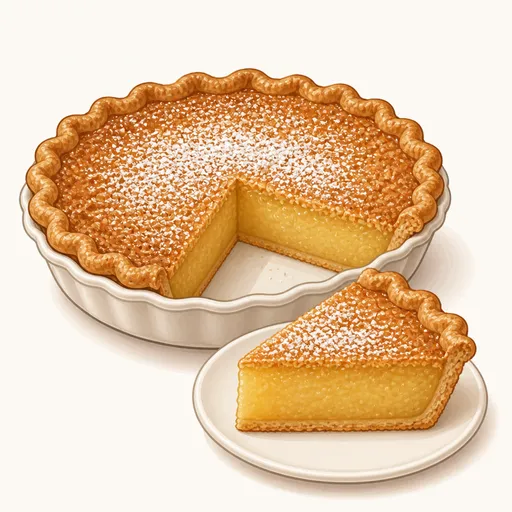
Chess pie is a humble pie from the American South that needs only pantry staples like eggs, sugar, butter and a little cornmeal. As it bakes, the top forms a thin, crackly sugar crust over a smooth, deeply sweet filling with a gentle tang from a splash of lemon juice.
- Difficulty
- Easy
- Prep
- 30 min
- Cook
- 1 hr 10 min
- Rising or chilling
- 3 hr
- Total time
- 4 hr 40 min
- Method
- Oven-baked
Ingredients
For the crust
For the butter and egg filling
Instructions
Step 1
Mix 160 g all-purpose flour with 5 g granulated sugar and 2 g salt, cut in 115 g cold unsalted butter until the mixture looks like breadcrumbs with pea-sized bits of butter, then add 45 g ice water, gather it into a ball and chill for about forty-five minutes. Keeping everything very cold makes the pie crust bake up in crisp, flaky layers. The dough is ready when it's just pliable enough to gather together without sticking to your hands.
Step 2
Roll the dough into a round about five centimeters wider than the pie dish, line a 23 cm dish with it, fold the overhang under and crimp the edge with your fingers, then prick the bottom with a fork. A thick edge keeps the crust from slumping in the oven, and the holes let steam escape so the bottom doesn't puff up. The dish is ready when the crust fits snugly against the bottom and the edge stands evenly around the rim.
Step 3
Line the crust with parchment paper, fill it with pie weights or rice and bake at 200°C for about 15 to 20 minutes, then remove the paper and weights. Blind baking cooks the bottom first so it doesn't turn soggy when the liquid filling goes in. The crust is ready when the bottom is dry and matte and the edge is starting to turn golden; after this step, lower the oven to 165°C.
Step 4
Mix 300 g granulated sugar, 15 g yellow cornmeal, 10 g all-purpose flour and a pinch salt, pour in 115 g melted unsalted butter, then add 200 g eggs, 60 g whole milk, 15 g lemon juice and 5 g vanilla extract one at a time and stir well. The cornmeal thickens the filling and creates the signature crackly top, while the lemon balances the sweetness. The filling is ready when it's uniform, glossy and smooth and the sugar has nearly dissolved.
Step 5
Pour the filling into the blind-baked crust and bake at 165°C for about 45 to 55 minutes; if the edge of the crust darkens early, cover it with foil. The low temperature sets the eggs smoothly without making them pitted or watery. The pie is done when the top is glossy gold and slightly puffed and only a coin-sized spot in the center still wobbles when you shake the dish.
Step 6
Set the dish on a rack and let the pie cool completely, about three hours, before slicing. The filling keeps setting as it cools, and cutting too soon will make it run. The pie is ready when the top has settled flat, feels firm to the touch and a slice holds clean edges.
Equipment
- Oven
- Pie dish
- Rolling pin
- Mixing bowl
- Whisk
- Kitchen scale
- Parchment paper
- Plastic wrap
- Wire cooling rack
Tips
- You can swap the lemon juice for a spoonful of white vinegar, as Southern home cooks did in the old days, and the flavor won't change much.
- Dust the top with a little powdered sugar or serve it with unsweetened whipped cream to tame the sweetness.
- For a caramel flavor, replace half the white sugar with brown sugar.
Storage
In cool weather, the pie keeps at room temperature for a day. Otherwise, cover it well and refrigerate it for up to four days, taking it out about twenty minutes before serving so the filling softens again.
Common problems and how to fix them
- The filling weeps and leaves a layer of syrup at the bottom.
- The pie baked too long or the oven was too hot, so the eggs overcooked. Take the pie out while the center still wobbles slightly and check your oven temperature with a thermometer.
- The top cracks wide open.
- Too much air was beaten into the filling or the oven was too hot. Stir gently when mixing the filling and keep the oven at 165°C.
This recipe is based on the common ratios for this bake and is written entirely in our own words.