Challah
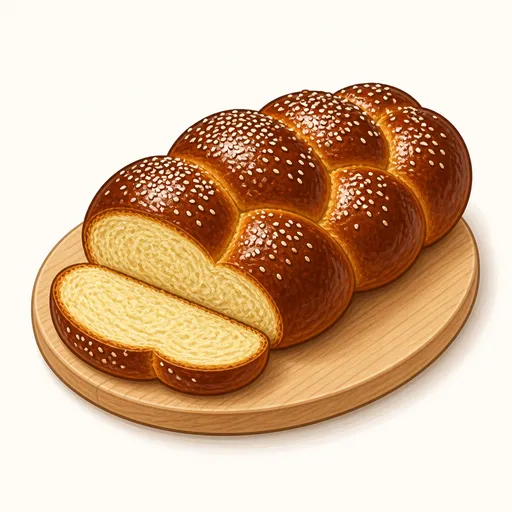
Challah is the traditional Jewish braided bread that graces the table on the Sabbath and holidays. The dough uses oil instead of butter, plus plenty of egg yolks, so the crumb is a bright yellow, soft, fluffy and lightly sweet, while the crust is shiny with beautifully raised braids.
- Difficulty
- Medium
- Prep
- 40 min
- Cook
- 30 min
- Rising or chilling
- 2 hr 30 min
- Total time
- 3 hr 40 min
- Method
- Oven-baked
Ingredients
For the dough
Egg wash and sesame topping
Instructions
Step 1
Pour 180 g warm water into a bowl, sprinkle 7 g instant yeast and 50 g granulated sugar over it, then add 20 g honey, 100 g eggs, 36 g egg yolks and 60 g vegetable oil and whisk everything together. Water that's just warm enough wakes up the yeast quickly without killing it. The mixture is ready when it's an even bright yellow and the eggs are fully blended in.
Step 2
Add 500 g bread flour and 10 g salt to the liquid and knead with a mixer on low speed for about ten minutes, or a little longer by hand. Challah dough needs to be firmer than other soft breads so the braids keep their shape. The dough is ready when it's smooth, slightly dry on the surface, not sticky and springs back nicely when pressed.
Step 3
Place the dough in an oiled bowl, turn it to coat it with a thin layer of oil, cover tightly and let it rise somewhere warm for about ninety minutes. The thin coat of oil keeps the surface from drying out and cracking as it rises. The dough is ready when it has doubled in size and a fingertip pressed into it leaves a dent that doesn't spring back.
Step 4
Gently press the dough down, divide it in half for two loaves, then divide each half into three equal pieces, roll them into short logs and let them rest under a towel for about ten minutes. Weighing each piece keeps the strands even and the loaves well balanced. The dough is ready when the logs have relaxed and stretch out without shrinking back.
Step 5
Roll each log into a strand about forty centimeters long, slightly thicker in the middle than at the ends, lay three strands side by side, pinch them together at one end and braid them like hair, then pinch the other end tightly and tuck both ends underneath. Strands that are thicker in the middle give a loaf that's tall in the center and tapers toward the ends. The braid is ready when the strands are even and snug but not stretched too tight.
Step 6
Move the two braided loaves onto a parchment-lined baking sheet, well apart, cover loosely with plastic wrap and let them rise for about fifty minutes. Just the right amount of proofing makes the bread soft and airy without the braids blurring into each other. The loaves are ready when they've grown by about half and the lines of the braid are still clearly visible.
Step 7
Preheat the oven to 180°C about twenty minutes before baking, with a rack in the middle. A steady, fully heated oven helps the loaves rise evenly from the very first minutes. The oven is ready when the heating light has turned off and an oven thermometer reads the right temperature.
Step 8
Beat 50 g eggs with a pinch of salt, brush it evenly over the whole loaf, including the crevices of the braid, then sprinkle 8 g white sesame seeds on top. The egg wash creates the classic glossy brown crust and helps the seeds stick. The loaves are ready when they're evenly glossy and wet all over, with no dry patches and no egg pooling at the base.
Step 9
Bake at 180°C for 25 to 30 minutes, rotating the tray once halfway through so both loaves brown evenly. The sugar and eggs in the dough make the crust color quickly, so keep an eye on it from the twentieth minute. The bread is done when the crust is a glossy mahogany brown, the bottom sounds hollow when tapped and the inside reaches about 88°C.
Step 10
Transfer the loaves to a rack and let them cool for at least thirty minutes before tearing or slicing. The steam inside needs to escape so the crumb can set and turn soft and fluffy. The bread is ready when the bottom is dry and the loaf is only slightly warm.
Equipment
- Oven
- Stand mixer
- Mixing bowl
- Kitchen scale
- Bench scraper
- Baking sheet
- Parchment paper
- Pastry brush
- Plastic wrap
- Wire cooling rack
Tips
- Brush on the egg wash twice, once before the second rise and again just before baking, for an even deeper shine.
- Once you get the hang of it, try braiding four or six strands, or coil the braid into a round loaf for the new year.
- Day-old challah makes wonderful French toast or bread pudding.
Storage
Put the cooled bread in a tightly sealed plastic bag and keep it at room temperature for about three days. It freezes for up to three months; thaw it at room temperature, then warm it in the oven at 160°C for about ten minutes.
Common problems and how to fix them
- The braids burst open or split during baking.
- The dough was underproofed in the second rise, or the strands were pulled too tight while braiding. Braid more loosely and let the loaves rise until visibly puffed before they go into the oven.
- The crust is too dark but the inside is still wet.
- The oven was too hot or the tray sat too high. Move the tray down one level and cover the top with foil once the crust has enough color.
This recipe is based on the common ratios for this bake and is written entirely in our own words.