Burger buns
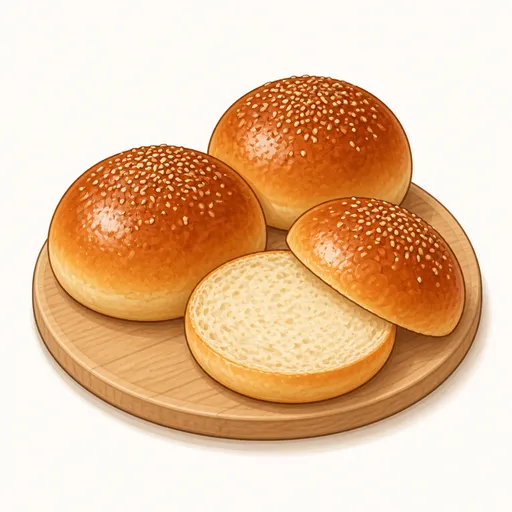
Homemade burger buns have a shiny golden, sesame-topped crust and a soft, fluffy crumb that's sturdy enough to hold a grilled patty and all the sauce without going soggy. Whole milk, eggs and butter give them a gentle richness that tastes far better than store-bought.
- Difficulty
- Easy
- Prep
- 30 min
- Cook
- 18 min
- Rising or chilling
- 2 hr
- Total time
- 2 hr 48 min
- Method
- Oven-baked
Ingredients
Dough
Egg wash and sesame topping
Instructions
Step 1
Warm 200 g whole milk with 100 g water and pour it into a stand mixer bowl with 500 g bread flour, 40 g granulated sugar, 7 g instant yeast and 50 g beaten eggs, then mix on low speed. Liquid at about 35°C gets the yeast working quickly without killing it. It's ready when there's no dry flour left in the bowl and the mixture has come together into a shaggy dough.
Step 2
Add 9 g salt and knead for a few minutes, then add 50 g soft unsalted butter a little at a time and keep kneading on medium speed for about twelve minutes. Adding the butter later lets the gluten form first, so the buns are soft yet hold a nice round shape. The dough is ready when it's smooth, glossy, not sticky and stretches into a thin, almost translucent windowpane.
Step 3
Gather the dough into a ball, place it in a clean bowl, cover with plastic wrap and let it rise somewhere warm for about an hour. The first rise lets the yeast produce gas and develop flavor in the crumb. You'll know the dough has risen enough when it has doubled in size and the top is puffed up like a pillow.
Step 4
Punch the dough down, divide it into eight equal pieces using a scale, then roll each piece into a tight ball by cupping your hand over it and circling it on the counter. Dividing by weight helps the buns bake at the same rate and fit the patties perfectly. A ball is ready when the top is taut and smooth, with just one small seam underneath.
Step 5
Arrange the balls on a parchment-lined baking sheet at least five centimeters apart, press each one with your palm to about two centimeters thick, then cover with plastic wrap and let rise for about 45 minutes more. Flattening before proofing makes the buns rise outward into proper burger-bun disks instead of round balls. They're ready when they've grown about one and a half times and a gentle press leaves a dent that slowly fills back in.
Step 6
Meanwhile, preheat the oven to 190°C, then beat 25 g eggs with 10 g whole milk, brush a thin layer over the buns and sprinkle evenly with 10 g white sesame seeds. The egg and milk wash gives the crust a shiny golden color and helps the sesame seeds stick. The tops are ready when they have a thin, even wet coat with no drips running onto the sheet.
Step 7
Bake the buns on the middle rack at 190°C for about 15 to 18 minutes, rotating the sheet after ten minutes if your oven heats unevenly. A moderate temperature bakes the crumb through without the crust turning thick and hard. The buns are done when the tops are evenly golden brown, the bottoms are light brown and they sound hollow when tapped.
Step 8
Move the buns to a wire rack and let them cool for about half an hour, then slice them in half horizontally with a serrated knife. Cooling lets the crumb settle so it doesn't squash when cut. The buns are ready when the cut surface is dry and the crumb is ivory white with small, even holes.
Equipment
- Oven
- Stand mixer
- Kitchen scale
- Mixing bowl
- Baking sheet
- Parchment paper
- Pastry brush
- Plastic wrap
- Wire cooling rack
Tips
- Before building your burger, toast the cut sides of the buns in a skillet with a little butter to create a crisp layer that keeps the sauce from soaking in.
- For even softer buns, replace the water with whole milk, but keep an eye on the crust since it will brown faster.
- Placing a ring mold about 10 cm wide around each ball during the second rise gives you perfectly uniform buns.
Storage
Once cool, keep the buns in a sealed bag at room temperature for two days. You can freeze them for up to a month; thaw them at room temperature, then warm them in a 160°C oven for about five minutes to make them soft and fragrant again.
Common problems and how to fix them
- The buns rose into round balls instead of flat disks.
- The balls weren't flattened before the second rise. Press each one to about two centimeters thick right after shaping, and you can also rest a light baking sheet on top for the first five minutes of baking.
- The crust is dark but the inside is still damp.
- The oven is too hot or the sheet was too high. Lower the temperature to about 180°C, set the sheet in the middle of the oven and bake a few minutes longer so the crumb cooks through.
This recipe is based on the common ratios for this bake and is written entirely in our own words.