Bagels
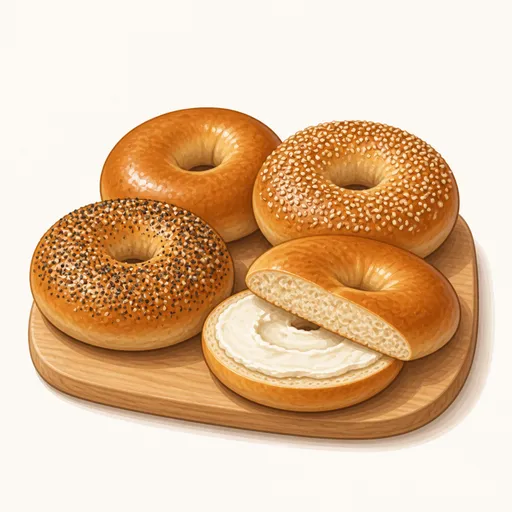
Bagels are ring-shaped breads with a thin, glossy, slightly crisp crust and a dense, wonderfully chewy crumb. What sets them apart is a quick boil in water before baking, which sets the crust and gives it a beautiful shine. An overnight cold proof deepens the flavor, and you can enjoy your bagels with cream cheese and smoked salmon or turn them into sandwiches.
- Difficulty
- Medium
- Prep
- 40 min
- Cook
- 25 min
- Rising or chilling
- 13 hr 20 min
- Total time
- 14 hr 25 min
- Method
- Oven-baked
Ingredients
Dough
Boiling bath
Topping (optional)
Instructions
Step 1
Put 500 g bread flour, 5 g instant yeast and 10 g salt in the bowl of a stand mixer, stir 20 g honey into 285 g warm water, pour it in and mix on low speed. Bagel dough contains very little water, so it looks dry and crumbly at first, and that is perfectly normal. The mixture is ready when no dry flour remains at the bottom of the bowl and it has started to come together into a stiff mass.
Step 2
Knead with the dough hook on low to medium speed for about ten minutes; if the mixer shakes hard, you can finish kneading by hand on the counter. Stiff dough needs long kneading to develop gluten, which gives bagels their signature chew. The dough is ready when it is smooth, firm, not sticky and stretches thin without tearing right away.
Step 3
Shape the dough into a ball, place it in a lightly oiled bowl, cover with plastic wrap and leave it at room temperature for about an hour. This short rest relaxes the dough so it is easier to shape. It is ready when it has grown by about half and the surface is smooth and taut.
Step 4
Divide the dough into eight equal pieces, roll each into a very tight ball, then poke your thumb through the center and twirl it to stretch the hole to about four centimeters. The hole shrinks as the bagels rise, so make it wider than you think. The rings are ready when they are evenly thick all around the hole; set them on a parchment-lined tray dusted with a little flour.
Step 5
Cover the tray with plastic wrap and refrigerate for about twelve hours or overnight. A cold proof slows fermentation, creating a faintly sweet, malty flavor and a crust covered in pretty little blisters. The bagels are ready when one dropped into a bowl of cold water floats to the top within ten seconds.
Step 6
Preheat the oven to 230°C, and meanwhile put to taste water in a wide pot, add 30 g honey and bring it to a boil. Honey in the boiling water gives the crust a glossy brown color and a hint of sweetness. The water is ready when it is at a steady boil but not bubbling too violently.
Step 7
Drop two or three bagels at a time into the boiling water, boil for about one minute per side, then lift them onto a rack to drain. A quick boil gelatinizes the starch on the surface, creating a chewy, glossy crust and helping the bagels keep their shape in the oven. They are right when they are slightly puffed, the surface is taut and shiny and they wrinkle a little as they drain.
Step 8
Set the boiled bagels on a parchment-lined tray, brush with a thin layer of 32 g beaten egg whites and sprinkle with 25 g white sesame seeds if you like. The egg white helps the seeds stick firmly and makes the crust shinier. They are ready when the tops are evenly covered in seeds with no puddles of water left.
Step 9
Bake on the middle rack at 230°C for 18 to 22 minutes, rotating the tray once halfway through. High heat browns the crust quickly while the inside stays moist. The bagels are done when the crust is deep golden brown and the bottoms sound hollow when tapped.
Step 10
Move the bagels to a rack and let them cool for at least twenty minutes before slicing. The crumb is still finishing cooking in its own heat, and cutting too soon makes it gummy and sticky. They are ready when only slightly warm and the crust has crisped up again.
Equipment
- Oven
- Baking sheet
- Parchment paper
- Deep skillet
- Mixing bowl
- Stand mixer
- Bench scraper
- Kitchen scale
- Plastic wrap
- Pastry brush
- Wire cooling rack
- Refrigerator
Tips
- If you have barley malt syrup, use it instead of honey in both the dough and the boiling water for authentic New York-style flavor.
- Swap the sesame for poppy seeds, dried garlic or dried onion flakes, or mix them all for everything bagels.
- Boiling longer, about two minutes per side, gives a thicker, chewier crust.
Storage
Bagels are best on the day they are baked; cooled bagels keep in an airtight bag at room temperature for two days. For longer storage, slice them in half, freeze for up to three months and toast them straight from the freezer.
Common problems and how to fix them
- The bagels wrinkle and deflate after boiling.
- The dough overproofed and lost its strength. Do the float test earlier and boil the bagels as soon as one floats within ten seconds.
- The hole in the middle closes up.
- The hole was stretched too small during shaping. Next time, twirl it to about four centimeters, since the bagels puff up and shrink the hole as they boil and bake.
This recipe is based on the common ratios for this bake and is written entirely in our own words.