Yakgwa honey cookies
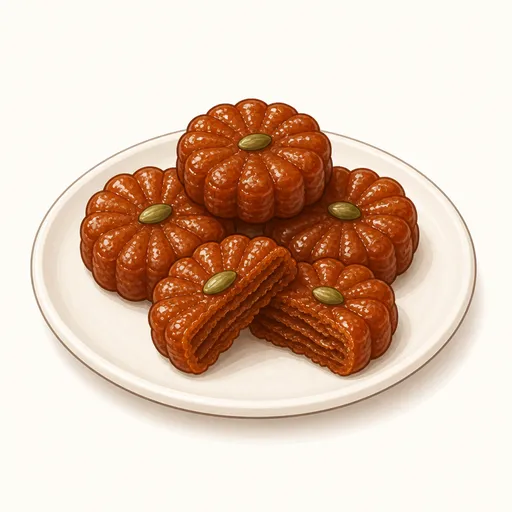
Yakgwa is a traditional Korean sweet that is slowly fried in oil, then soaked in a honey ginger syrup until it is saturated right to the core. Thanks to the sesame oil worked into the dough, the cookies have many thin, flaky layers that are crisp outside and soft and chewy inside. Koreans often serve yakgwa at holidays and festivals and enjoy it with hot tea.
- Difficulty
- Medium
- Prep
- 40 min
- Cook
- 40 min
- Rising or chilling
- 6 hr
- Total time
- 7 hr 20 min
- Method
- Fried
Ingredients
Soaking syrup
Cookie dough
Frying oil
Garnish
Instructions
Step 1
Thinly slice 15 g fresh ginger and put it in a pot with 120 g maltose, 100 g honey, 80 g water and 3 g cinnamon sticks, simmer over low heat for about ten minutes, then let it cool. Make the syrup first so it has time to cool, because hot cookies soak up cool syrup deeply without going soggy. The syrup is ready when it has thickened, smells clearly of ginger and cinnamon and flows slowly off a lifted spoon.
Step 2
Sift 250 g all-purpose flour with a pinch salt and a pinch ground black pepper into a bowl, drizzle 45 g sesame oil over it and rub the flour between your palms until the oil is evenly absorbed. The sesame oil coats each particle of flour and keeps gluten from developing, giving the cookies a crumbly, layered texture. Stop when the flour looks like damp sand and holds its shape when squeezed in your hand.
Step 3
Grate or pound 10 g fresh ginger, squeeze out the juice and mix it with 50 g honey and 35 g water, then pour it into the flour and cut it in gently with a flat spatula. Do not knead hard, because a tough dough loses its signature flaky layers. The dough is ready when the moist clumps stick together when pressed, even though it still looks a little crumbly.
Step 4
Gather the dough into a block, roll it about one centimeter thick, cut it in half, stack the two halves and roll again, repeating this three times. Stacking creates thin sheets of dough that separate during frying, much like puff pastry. This step is done when the block is about one centimeter thick and the cut edges show clearly stacked layers.
Step 5
Use a four-centimeter flower-shaped cutter, or a knife to cut squares, then prick a few holes through each piece with a toothpick. The holes let heat and oil reach the center so the core cooks evenly and absorbs the syrup better. You are finished when you have about twenty-four pieces of even thickness.
Step 6
Pour to taste oil for deep-frying into a deep pan, heat it to about 110°C, then add the cookies and fry over low heat for about twelve minutes, stirring gently now and then. Frying at a low temperature lets the layers puff open gradually before the outside can burn. The cookies are ready when they float to the surface, the layers have clearly separated and the outside has turned pale golden.
Step 7
Lift the cookies out, raise the heat to medium until the oil reaches about 150°C, then return the cookies and fry for about four minutes more. The second fry firms up the crust and gives it a beautiful amber-brown color. They are done when both sides are an even deep chestnut brown and they feel light and firm when picked up.
Step 8
Drop the hot cookies into the cooled syrup, press them gently to submerge and soak for at least six hours or overnight. The long soak lets the syrup seep into every layer, so the center turns moist, soft and gently sweet. They have soaked enough when a broken cookie is evenly dark inside with no dry white core.
Step 9
Lift the cookies onto a rack to drain off the syrup for about fifteen minutes, then, if you like, divide 10 g pumpkin seeds among them and press them onto the center of each cookie. Draining lets the surface firm up so they are not sticky when you arrange them on a plate. They are ready when the tops are glossy but no syrup is dripping.
Equipment
- Deep skillet
- Thermometer
- Small saucepan
- Mixing bowl
- Sieve
- Rolling pin
- Cookie cutter
- Kitchen scale
- Wire cooling rack
Tips
- Use a thermometer to watch the oil, because if it is just about 20°C too hot, the cookies will burn outside while the core stays hard.
- If you have soju, you can use it in place of the water in the dough for crisper, flakier cookies with a subtle aroma.
- Leftover syrup from soaking can be stirred into warm water for a fragrant honey ginger tea.
Storage
Arrange the cookies in an airtight container and keep them at room temperature in a cool, dry place for about a week. To keep them longer, wrap each one and freeze for up to two months, then thaw at room temperature for about thirty minutes before eating.
Common problems and how to fix them
- The cookies are rock hard with no flaky layers.
- The dough was overworked or the frying oil was too hot from the start. Only cut in and fold the dough gently, and start frying at about 110°C.
- The cookies come apart and crumble in the oil.
- The dough lacked enough binder or the layers were not pressed together firmly. Add a few spoonfuls of the ginger honey liquid and roll more firmly when stacking the layers.
- The cookies turn soggy and lose their crunch after soaking.
- The syrup was still hot or too thin when you soaked them. Let the syrup cool completely and simmer it a little thicker before adding the cookies.
This recipe is based on the common ratios for this bake and is written entirely in our own words.