Dorayaki
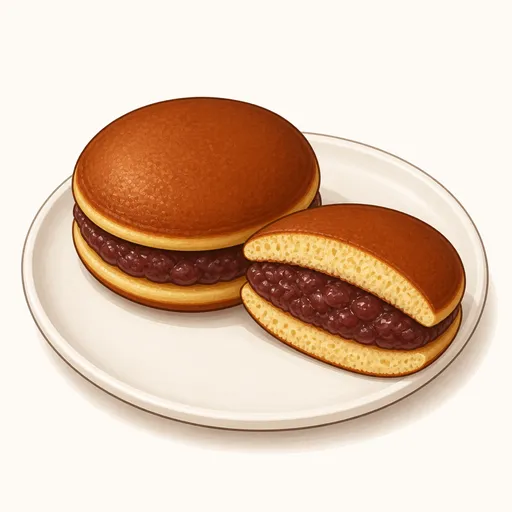
Dorayaki is a Japanese treat made of two soft, fluffy griddle pancakes sandwiched around a sweet red bean filling, famous with many people as the favorite snack of the robot cat Doraemon. Honey in the batter gives the pancakes an even, deep amber color and a gently sweet aroma, while the inside stays moist and springy.
- Difficulty
- Easy
- Prep
- 20 min
- Cook
- 25 min
- Rising or chilling
- 20 min
- Total time
- 1 hr 5 min
- Method
- Pan-cooked or waffle iron
Ingredients
For the batter
For the filling and greasing
Instructions
Step 1
Crack 200 g eggs into a bowl, add 140 g granulated sugar and 30 g honey, and whisk for about three minutes. Fully dissolving the sugar in the eggs helps the pancakes brown evenly without speckled tops. The mixture is ready when it turns pale yellow, looks slightly foamy and no longer feels gritty with sugar.
Step 2
Sift 160 g all-purpose flour and 2 g baking soda into the egg mixture and stir gently in one direction with the whisk until just combined. The baking soda reacts with the honey to make the pancakes puffy and light with a beautiful brown color. Stop when the batter is smooth and thick with no dry lumps left.
Step 3
Cover the bowl with plastic wrap and let the batter rest at room temperature for about fifteen minutes. This rest lets the flour absorb the liquid and the gluten relax, so the pancakes turn out softer with smoother tops. The batter has rested enough when it looks glossier and a few tiny bubbles have risen to the surface.
Step 4
Add 50 g water to the rested batter a spoonful at a time, stirring well before adding more. The right consistency lets the batter spread into a neat circle on its own in the pan. It's ready when it falls from the spoon in an unbroken ribbon like thin honey and the ribbon slowly melts back into the surface.
Step 5
Set a nonstick pan over low heat, dip a paper towel in to taste vegetable oil and wipe a very thin layer over the pan, then wipe it again with a dry towel. Too much oil leaves the pancakes blotchy instead of evenly browned. The pan is hot enough when a drop of water rolls around in a bead and evaporates after a few seconds.
Step 6
Scoop about three tablespoons of batter and pour it from a height of about ten centimeters into the center of the pan so it spreads into a circle of about 9 cm, then cook over low heat until lots of bubbles appear on top, flip and cook for about thirty seconds more. Low heat cooks the pancake evenly inside without burning the bottom. It's done when the first side is an even golden brown and the second side is just lightly golden.
Step 7
Stack each pancake on a plate as it finishes and immediately cover it with a clean, slightly damp towel, then carry on cooking the rest of the batter. The damp towel traps steam so the pancakes stay soft and the edges don't dry out. They're ready to fill once they've cooled to room temperature but still feel soft and pliable when pressed.
Step 8
Divide 300 g sweet red bean paste into six portions, pair up pancakes of similar size, then spread one portion over the paler side of one pancake, keeping it thick in the middle and thinner toward the edge, and top with its partner. A thick center gives dorayaki its signature domed shape. They're finished when the edges stick together with a gentle press and no filling squeezes out.
Equipment
- Nonstick skillet
- Whisk
- Sieve
- Mixing bowl
- Spatula
- Kitchen scale
- Plastic wrap
Tips
- Cook one small test pancake first to get the heat right, since every stove and pan browns quite differently.
- Besides red bean paste, you can add a layer of whipped cream or a few strawberry slices for a lighter flavor.
- Wrapping each dorayaki in plastic wrap right after filling lets the pancakes absorb moisture from the filling, making them even softer after a few hours.
Storage
Individually wrapped dorayaki keep for one day at room temperature or three days in the fridge. You can freeze them for up to two weeks; to serve, let them thaw on their own and then warm them in the microwave for about ten seconds.
Common problems and how to fix them
- The pancakes have blotchy spots and uneven color.
- There was too much oil left in the pan or it wasn't evenly hot. Wipe the oil on very thinly with a paper towel and let the pan heat over low heat for another minute before pouring the batter.
- The pancakes are thick, dry and don't spread into circles.
- The batter is too thick. Add water a spoonful at a time until it flows in an unbroken ribbon, and pour it from a height so it spreads on its own.
This recipe is based on the common ratios for this bake and is written entirely in our own words.