Castella
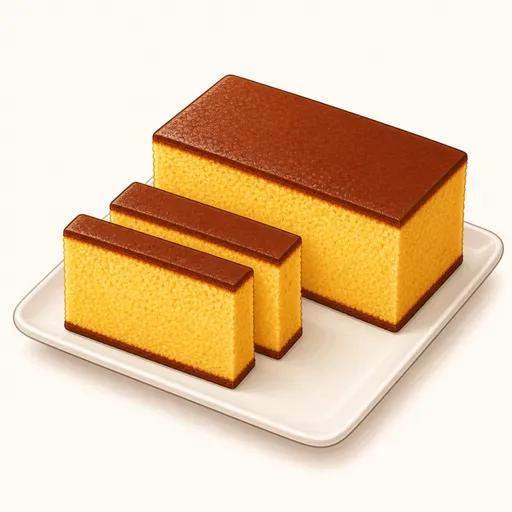
Castella is the famous honey sponge cake from Nagasaki, Japan, with a golden, fine and moist crumb that's so tender it almost clings to your teeth. All it takes is eggs, sugar, honey and flour, but the secret lies in whipping the eggs thoroughly and letting the cake rest overnight so the honey soaks in evenly.
- Difficulty
- Medium
- Prep
- 35 min
- Cook
- 55 min
- Rising or chilling
- 12 hr
- Total time
- 13 hr 30 min
- Method
- Oven-baked
Ingredients
For the batter
For the honey glaze
Instructions
Step 1
Preheat the oven to 160°C with a rack in the lower-middle position for at least fifteen minutes before baking. Castella needs steady, gentle heat to rise evenly without cracking on top. The oven is ready when an oven thermometer has read exactly 160°C for a few minutes.
Step 2
Line the bottom and all four sides of an 18 cm square pan with parchment paper, letting the paper stand about two centimeters above the rim. The paper lets you lift the cake out easily and keeps the sides straight as it rises. The pan is ready when the paper hugs the corners snugly without puffing up.
Step 3
Put 40 g honey, 30 g whole milk and 20 g vegetable oil in a small bowl and warm it over low heat or a water bath. A warm mixture blends into the egg foam faster and knocks out fewer bubbles. Stop once the honey has fully dissolved and the mixture feels just barely warm against your lip.
Step 4
Crack 300 g eggs into a bowl, add 160 g granulated sugar and set the bowl over a pot of hot water, stirring until the eggs reach about 40°C, then take it off and whip with a mixer on high speed for about ten minutes. Warm eggs gain more volume and form a fine foam. The mixture is ready when it's pale ivory, tripled in volume and falls in a ribbon that sits on the surface for a few seconds.
Step 5
Turn the mixer down to its lowest speed, sift in 120 g bread flour in three additions and mix only until the flour disappears. The high-protein flour gives castella its signature chewy, moist texture, but overmixing will burst the bubbles. Stop as soon as you no longer see any streaks of dry flour.
Step 6
Spoon about two tablespoons of the egg mixture into the warm honey bowl and stir well, then pour it back into the big bowl and gently fold from the bottom up with a spatula. Loosening the honey first keeps the heavy mixture from sinking to the bottom of the bowl. The batter is ready when it's uniform, glossy and smooth, with no dark yellow streaks at the bottom.
Step 7
Pour the batter into the pan, drag a skewer back and forth through it in a zigzag pattern, then tap the pan on the counter twice. This pops any large air bubbles so the crumb comes out fine and free of holes. It's ready when the surface is smooth and no large bubbles rise to the top.
Step 8
Bake at 160°C for about 45 to 55 minutes; if the top browns too quickly, loosely tent it with a sheet of foil. Gentle heat cooks the cake slowly, giving it a moist, evenly colored crumb. It's done when the top is a deep brown, the edges pull slightly away from the paper and a skewer inserted in the center comes out clean.
Step 9
Mix 10 g honey with 5 g warm water and brush it over the top of the cake as soon as it comes out of the oven, then turn the cake top-side down onto a sheet of plastic wrap and wrap it tightly while it's still hot. The trapped steam softens the crust and helps the honey soak in. It's wrapped properly when the plastic clings snugly and fogs up with condensation inside.
Step 10
Leave the wrapped cake at room temperature or in the fridge overnight, for at least twelve hours, before trimming off all four edges and cutting it into slices. This rest makes the crumb evenly moist and fine, just like castella from a bakery. It's ready when the slices are golden with a fine texture and the brown crust clings tightly to the crumb.
Equipment
- Oven
- Square pan
- Hand mixer
- Sieve
- Spatula
- Kitchen scale
- Mixing bowl
- Parchment paper
- Pastry brush
- Plastic wrap
Tips
- Dip a long knife in hot water and wipe it dry before every cut so the slices come out clean and don't stick.
- For the crunchy sugar layer on the bottom of traditional castella, sprinkle a thin layer of coarse sugar over the parchment on the bottom of the pan before pouring in the batter.
- Mild honeys such as longan blossom or coffee blossom honey suit castella better than very strong, dark honeys.
Storage
Wrapped tightly, castella keeps for about three days at room temperature and about five days in the fridge. You can freeze individual slices for up to three weeks; let them thaw at room temperature for a few hours and they'll be soft and moist again.
Common problems and how to fix them
- The cake sinks and shrinks a lot after baking.
- The eggs weren't whipped enough or the batter was overmixed. Whip the eggs until the ribbon clearly holds its shape, and fold in the flour very gently, stopping as soon as it's just combined.
- There's a dense, wet layer at the bottom of the cake.
- The honey mixture sank before the cake had time to set. Loosen the honey with a little egg foam before folding it in, and put the cake in the oven right after filling the pan.
This recipe is based on the common ratios for this bake and is written entirely in our own words.