Warabi mochi
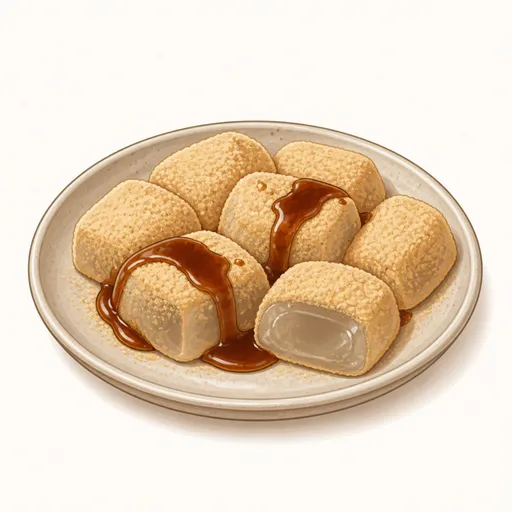
Warabi mochi is a Japanese summer sweet made by cooking warabi starch with water and sugar into a clear, wobbly, refreshingly cool jelly. The pieces are rolled in roasted soybean flour (kinako) and drizzled with brown sugar syrup, giving a delicately sweet, nutty flavor that melts gently in your mouth.
- Difficulty
- Easy
- Prep
- 10 min
- Cook
- 15 min
- Rising or chilling
- 30 min
- Total time
- 55 min
- Method
- Boiled or simmered
Ingredients
Mochi
Kinako coating
Brown sugar syrup
Instructions
Step 1
Put 50 g brown sugar and 40 g water in a small saucepan, heat over medium heat and stir until the sugar dissolves, let it simmer gently for about three more minutes, then turn off the heat. Simmering a few extra minutes thickens the syrup and gives it a light caramel flavor. The syrup is ready when it is glossy, as thick as runny honey and flows slowly off a tilted spoon.
Step 2
Mix 25 g roasted soybean flour with 8 g granulated sugar and a pinch salt, then sift half of it over the bottom of a small square dish to cover it completely. This layer of kinako keeps the hot mochi from sticking to the dish. You will have a fine, even layer of golden-brown powder covering the bottom.
Step 3
Put 50 g warabi starch in a saucepan, slowly pour in 250 g water and stir until the starch has completely dissolved, then add 40 g granulated sugar. Warabi starch usually comes in lumps, so it needs to dissolve thoroughly before heating or the mochi will be lumpy. The mixture is ready when it is milky white, as thin as milk and there are no granules at the bottom of the pan.
Step 4
Set the pan over medium heat and stir constantly with a flat spatula for about ten minutes; once the mixture starts to thicken, stir more vigorously and scrape the bottom of the pan well. Constant stirring cooks the starch evenly and keeps it from scorching. The mochi is ready when it has turned completely translucent, very stretchy and pulls into long ribbons when you lift the spatula.
Step 5
Immediately turn the hot mochi out onto the kinako in the dish, smooth it flat with a wet spatula, sift the remaining kinako over the top and chill in the fridge for about thirty minutes. A short chill firms the mochi up for cutting, but leaving it too long will make it hard and cloudy. It is ready when it feels cool, springy and holds its shape.
Step 6
Using a wet knife or spoon, cut the mochi into squares about the size of your thumb tip, then roll each piece in the kinako in the dish. A full coating of kinako keeps the pieces from sticking together. They are ready when every piece has a thin coat of powder and they separate easily.
Step 7
Arrange the mochi on small plates and drizzle with the brown sugar syrup just before serving. Drizzling at the last moment keeps the kinako from getting soggy and preserves its nutty flavor. The mochi is best while still cool, wobbling softly when you shake the plate.
Equipment
- Small saucepan
- Spatula
- Whisk
- Square pan
- Kitchen scale
- Sieve
- Refrigerator
Tips
- Pure warabi starch is very expensive and grayish brown; the common kind sold in stores is usually blended with sweet potato starch and makes clearer mochi, and both work well.
- If you cannot find warabi starch, you can use potato starch or tapioca starch instead; the mochi will still be chewy but less melt-in-your-mouth tender.
- You can add a small spoonful of matcha powder to the kinako for a green tea version.
Storage
Warabi mochi is best on the day it is made. You can keep it at cool room temperature for a few hours or in the fridge for no more than a day, since it hardens and loses its clarity over time.
Common problems and how to fix them
- The mochi stays cloudy and is not stretchy.
- The starch has not cooked through. Keep stirring over medium heat for a few more minutes until the whole mass is translucent.
- The mochi turns hard and crumbly after chilling.
- It was chilled too long, so the starch retrograded. Chill it for only about thirty minutes and eat it the same day; if it has already hardened, leave it at room temperature for a while to soften somewhat.
This recipe is based on the common ratios for this bake and is written entirely in our own words.