Vietnamese rolled wafers (banh que)
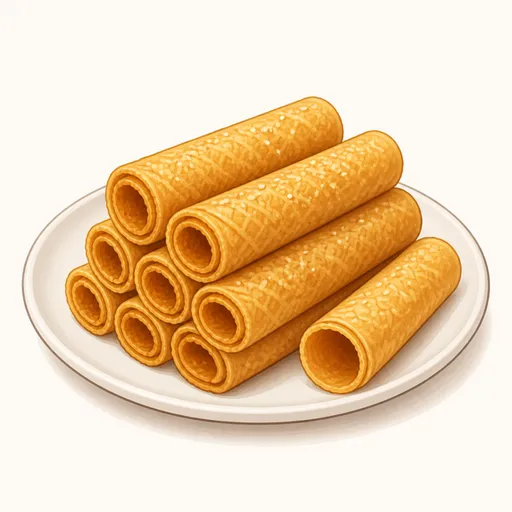
Banh que are paper-thin wafers cooked in a waffle iron and rolled while still hot into little golden tubes. They are shatteringly crisp and rich with coconut milk and egg, a childhood snack for generations of Vietnamese and lovely alongside ice cream or afternoon tea.
- Difficulty
- Medium
- Prep
- 15 min
- Cook
- 45 min
- Rising or chilling
- 30 min
- Total time
- 1 hr 30 min
- Method
- Pan-cooked or waffle iron
Ingredients
Wafer batter
Oil for the iron
Instructions
Step 1
Crack 100 g eggs into a bowl, add 100 g granulated sugar and a pinch salt and whisk for about two minutes. Dissolving the sugar first gives the wafers an even crispness, without speckles of burnt sugar. The mixture is ready when it turns pale yellow, thickens slightly and you no longer hear the sugar grating.
Step 2
Pour 150 g coconut milk, 30 g melted unsalted butter that is still slightly warm and 3 g vanilla extract into the eggs and stir gently to combine. The warm butter and coconut milk add a rich aroma and help the wafers stay crisp longer. You are done stirring when the mixture is an even color with no film of butter floating on top.
Step 3
Sift 80 g all-purpose flour and 20 g tapioca starch into the bowl, whisk until smooth, then sprinkle in 10 g white sesame seeds if you like. Tapioca starch makes the wafers crisper and lighter than flour alone. The batter is ready when it is smooth, flows in a continuous stream like thin cream and has no specks of dry flour.
Step 4
Cover the bowl and let the batter rest for about 30 minutes at room temperature. Resting lets the flour absorb the liquid and the air bubbles settle, so the wafers spread out thin and smooth. The batter is ready when its surface is calm and almost free of bubbles.
Step 5
Set a waffle iron over medium heat on the stove or switch on an electric one, heat both sides, then brush on a very thin layer of to taste vegetable oil. An evenly hot, lightly oiled iron keeps the wafers from sticking and browns them evenly. The iron is hot enough when a drop of water sizzles and evaporates instantly.
Step 6
Spoon about a tablespoon of batter into the center of the iron, press the lid closed and cook for about thirty seconds to a minute per side. A small amount of batter pressed firmly makes a thin wafer with its signature crunch. The wafer is done when steam stops escaping from the edges of the iron and it is an even honey gold.
Step 7
Open the iron, lift the edge of the wafer with chopsticks and immediately roll it around a chopstick into a tube, hold it for a few seconds, then slide the chopstick out. The wafer stays pliable for only a few seconds while hot; once it cools it turns crisp and snaps. Your roll is right when the tube is evenly round, the edge is sealed and there are no cracks.
Step 8
Set the wafer tubes on a rack to cool completely for about 15 minutes, then put them straight into an airtight jar. Wafers left out in the air for long absorb moisture and lose their crunch. They are finished when one snaps crisply when you break it and feels light and dry in your hand.
Equipment
- Waffle iron
- Mixing bowl
- Whisk
- Sieve
- Pastry brush
- Wire cooling rack
- Kitchen scale
Tips
- If a wafer hardens before you can roll it, put it back on the hot iron for a few seconds to soften, then roll it.
- You can replace the vanilla extract with a few drops of pandan extract for pale green, gently fragrant pandan wafers.
- The first batch often does not turn out pretty because the iron's temperature has not settled yet, so do not worry and just adjust the heat for the following batches.
Storage
Stored in a glass jar or airtight container with a silica gel packet in a cool, dry place, the wafers stay crisp for about two weeks. If they go soft, crisp them up in the oven at 120°C for about five minutes and let them cool before storing.
Common problems and how to fix them
- The wafers stick to the iron and tear when lifted.
- The iron was not hot enough or needed more oil. Heat the iron longer and brush on another thin layer of oil every few batches.
- The wafers stay soft even after cooling.
- They are too thick or were not cooked long enough. Use less batter each time and cook until steam no longer escapes from the edges of the iron.
- The wafers have dark burnt spots while other parts are still pale.
- The heat is too high or the iron heats unevenly. Turn the heat down and move the iron around over the burner to spread the heat evenly.
This recipe is based on the common ratios for this bake and is written entirely in our own words.