Baked pandan honeycomb cake (banh bo nuong)
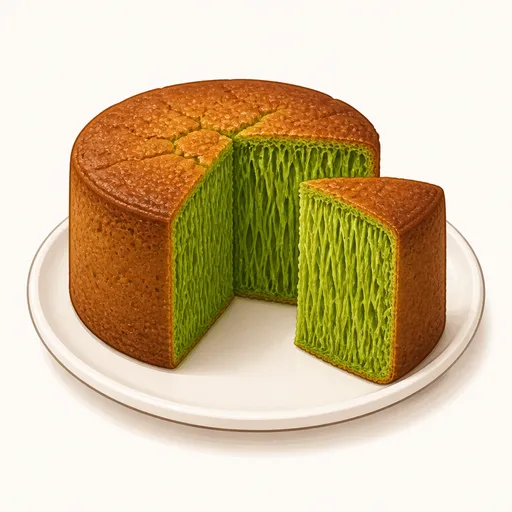
Baked pandan honeycomb cake has a lightly crisp golden crust on the outside and a jade green crumb inside, with long strands running through it like a honeycomb. The richness of coconut milk and the gentle fragrance of pandan make this cake a perennial favorite for afternoon tea.
- Difficulty
- Medium
- Prep
- 25 min
- Cook
- 55 min
- Rising or chilling
- 1 hr 30 min
- Total time
- 2 hr 50 min
- Method
- Oven-baked
Ingredients
Batter
Preparing the pan
Instructions
Step 1
Put 400 g coconut milk, 220 g granulated sugar and a pinch salt in a saucepan, heat over low heat and stir constantly until the sugar has fully dissolved, then let it cool for about 20 minutes. Coconut milk that is still hot will cook the eggs and stop the honeycomb strands from forming. The mixture is ready when the side of the pot feels only slightly warm against the back of your hand.
Step 2
Crack 300 g eggs into a bowl and whisk them gently in one direction just to break them up, without whipping. Eggs with too much foam give a crumbly, spongy texture instead of long strands. The eggs are ready when the yolks and whites have blended, with only a few small bubbles on top.
Step 3
Pour the cooled coconut milk into the eggs along with 60 g pandan juice and 3 g pandan extract, and stir gently to combine. The pandan gives the cake its fresh green color and signature fragrance. The mixture is ready when it is an even pale green with no yellow streaks of egg.
Step 4
Sift 250 g tapioca starch and 14 g baking powder into the bowl, stir well, then strain the whole mixture through a sieve once more. Straining twice removes every lump of starch and strand of egg, giving a smooth crumb. The batter is ready when it is thin and silky and pours from the whisk in an unbroken stream.
Step 5
Cover the bowl with a clean towel and let the batter rest for about 30 minutes at room temperature. This rest lets the tapioca starch hydrate evenly and large air bubbles pop on their own. The batter is ready when the surface is still and almost free of bubbles.
Step 6
Preheat the oven to 180°C, brush to taste vegetable oil all over a 22 cm Bundt pan and put the pan in the oven to heat for about 10 minutes. A very hot pan is the secret: the batter bubbles up the moment it touches the metal, forming the honeycomb strands. The pan is ready when the oil is just starting to smoke and smells toasty.
Step 7
Stir the batter again, take out the pan and pour the batter in right away; a gentle sizzle means it is just right. Then lower the oven to 170°C and bake for about 45 to 55 minutes. Do not open the oven door during the first half hour, or the cake may sink. It is done when the top is cracked and golden brown and a skewer inserted in the thickest part comes out dry.
Step 8
Take out the cake, leave it in the pan for about ten minutes, then turn it out onto a rack and let it cool completely for about an hour and a half. The crumb is very soft while hot, and cutting it too soon will flatten the honeycomb strands. The cake is ready when it feels light and the bottom is no longer warm.
Step 9
Use a serrated knife to cut the cake vertically into serving pieces. Cutting vertically shows off the strands running from the bottom to the top of the cake. The pieces are right when the cut side shows lots of long green strands and the crust is deep golden and slightly chewy.
Equipment
- Oven
- Bundt pan
- Whisk
- Sieve
- Small saucepan
- Mixing bowl
- Kitchen scale
- Wire cooling rack
- Pastry brush
Tips
- A heavy aluminum or cast-iron pan holds heat better than a thin nonstick pan, so the honeycomb strands form beautifully and evenly.
- Use double-acting baking powder, because the cake needs a second rise when it meets the heat of the oven.
- If your cake only has strands in the lower part, put the pan one rack lower so the bottom gets more heat.
Storage
Covered well, the cake stays pleasantly chewy at room temperature for one day. You can refrigerate it for up to three days; before eating, warm it in the oven at 160°C for about five minutes to crisp the crust again.
Common problems and how to fix them
- The cake has no honeycomb strands and is dense like sponge cake.
- The pan was not hot enough or the eggs were whipped too much. Next time, heat the pan more thoroughly and only beat the eggs gently to break them up.
- The cake rises high in the oven and then sinks.
- The oven door was opened too early or the cake was not fully baked. Wait at least 30 minutes before checking, and bake five minutes more if the skewer is still wet.
This recipe is based on the common ratios for this bake and is written entirely in our own words.