Vietnamese buttercream cake
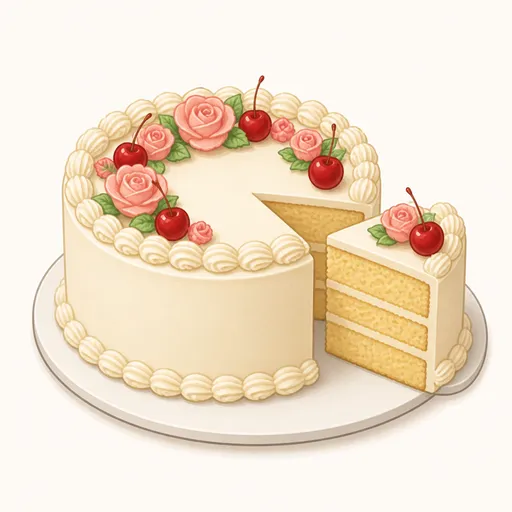
This is the birthday cake so many Vietnamese families remember: a soft golden sponge covered in rich, fragrant condensed milk buttercream, piped with colorful flowers and dotted with a few red cherries. This style of buttercream holds its shape well in hot weather, has that familiar condensed milk sweetness and is easier to make than meringue buttercream.
- Difficulty
- Medium
- Prep
- 1 hr
- Cook
- 35 min
- Rising or chilling
- 2 hr 30 min
- Total time
- 4 hr 5 min
- Method
- Oven-baked
Ingredients
Sponge cake
Soaking syrup
Condensed milk buttercream
Instructions
Step 1
Heat the oven to 160°C, line the bottom of a 20 cm round pan with parchment paper and leave the sides ungreased. Dry sides give the batter something to cling to as it climbs while rising. The oven is ready once it has been fully heated for at least fifteen minutes.
Step 2
Crack 300 g eggs into the bowl of a stand mixer, add 150 g superfine sugar, then set the bowl over a pot of very hot water and stir constantly until the mixture warms to about 40°C. Warm eggs have lower surface tension, so they whip up faster and hold their foam well. The mixture is ready when the sugar has fully dissolved and it feels as warm as bathwater when you dip in a finger.
Step 3
Take the bowl off the pot and whip on high speed for about eight minutes, then turn down to low speed for two more minutes. The low speed at the end breaks up large air bubbles for a fine crumb. The eggs are ready when they are ivory white, have tripled in volume and the ribbon falling from the lifted whisk can draw a figure eight that stays on the surface for a few seconds.
Step 4
Sift 150 g cake flour over the eggs in three additions, each time using a flat spatula to scoop from the bottom of the bowl and gently fold it over. Sifting in stages and folding gently keeps the egg foam from collapsing. The batter is ready when no spots of dry flour remain and it is still airy and smooth.
Step 5
Melt 30 g unsalted butter with 30 g whole milk and 4 g vanilla extract, stir about two tablespoons of the batter into it first, then pour this mixture back into the main bowl and fold gently. Doing it this way lets the fat blend in instead of sinking to the bottom and deflating the foam. The batter is ready when it is glossy and smooth with no streaks of butter and falls in a thick ribbon from the lifted spatula.
Step 6
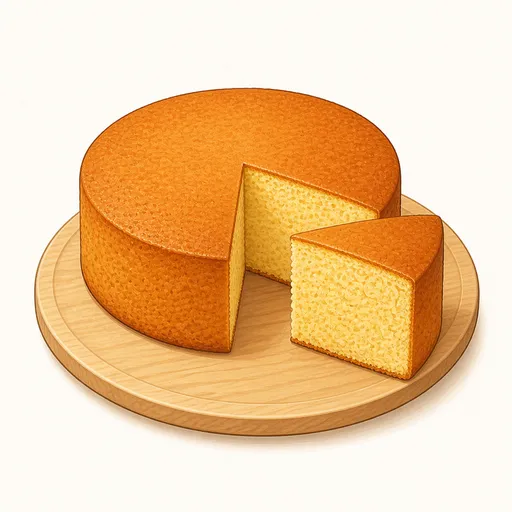
Pour the batter into the pan, tap the pan gently on the counter twice and bake at 160°C for about 32 to 38 minutes. A moderate heat lets the cake rise evenly with a flat, uncracked top. It is done when the top is deep golden, springs back when pressed lightly and the edges pull slightly away from the pan.
Step 7
Drop the pan onto the counter from about a hand's width high, turn the cake out onto a rack and let it cool completely, about an hour, then slice it horizontally into three equal layers. Only a fully cooled cake can be cut into flat layers without crumbling. It is ready when it feels completely cool and the cut surfaces are smooth.
Step 8
Heat 60 g water with 30 g granulated sugar over medium heat until the sugar dissolves completely, then let it cool. Brushing on the syrup keeps the sponge moist and soft once the cake is chilled. The syrup is ready when it is perfectly clear with no sugar crystals left at the bottom of the pan.
Step 9
Beat 250 g unsalted butter, softened at room temperature, with a pinch salt for about five minutes, then gradually add 130 g sweetened condensed milk and 3 g vanilla extract and beat for about three minutes more. Beating the butter for a long time before adding the condensed milk makes the buttercream lighter and whiter. It is ready when it is a pale ivory, silky smooth and forms peaks when you lift the beaters.
Step 10
Set the first cake layer on a board, brush it with syrup and spread on a thick, even layer of buttercream, repeat with the other two layers, then cover the top and sides with a thin coat of buttercream. This first thin coat traps the crumbs so the outer layer stays clean and neat. The cake is ready when the layers are lined up straight and the outside is fully covered.
Step 11
Spread on a thicker coat of buttercream and smooth it out, then divide the remaining buttercream and tint it with to taste food coloring if you like, spoon it into piping bags and pipe borders and flowers on top of the cake. Condensed milk buttercream holds the shape of piped flowers crisply for much longer than whipped cream. The cake is finished when the borders are even, the flowers have sharp edges and there are no cracks in the buttercream.
Step 12
Chill the cake in the fridge for about an hour so the buttercream firms up before slicing. Lightly set buttercream gives clean slices and keeps the layers from sliding. The cake is ready when the piped flowers feel firm and do not stick to your finger when touched lightly.
Equipment
- Oven
- Round cake pan
- Stand mixer
- Spatula
- Sieve
- Piping bag
- Parchment paper
- Kitchen scale
- Small saucepan
- Wire cooling rack
Tips
- The butter must be soft at room temperature but not melting; it is just right for buttercream when your finger sinks into it easily.
- If the buttercream turns lumpy and curdled, warm the sides of the bowl gently with a warm towel and keep beating, and it will turn smooth again.
- You can add a layer of strawberry jam or diced fruit between the layers to make the cake less rich.
Storage
The cake keeps for three days in the fridge if stored in an airtight container so the buttercream does not pick up other smells. Before serving, let it sit at room temperature for about twenty minutes so the buttercream softens and its aroma comes through.
Common problems and how to fix them
- The sponge collapses and has a dense layer at the bottom.
- The eggs were not whipped enough or the butter and milk were poured straight in and burst the foam. Whip until you can draw a figure eight and mix the butter with some of the batter before combining everything.
- The buttercream runs and weeps.
- The butter is too soft or the kitchen is too hot. Chill the bowl of buttercream for about fifteen minutes, then beat it again on medium speed.
This recipe is based on the common ratios for this bake and is written entirely in our own words.